
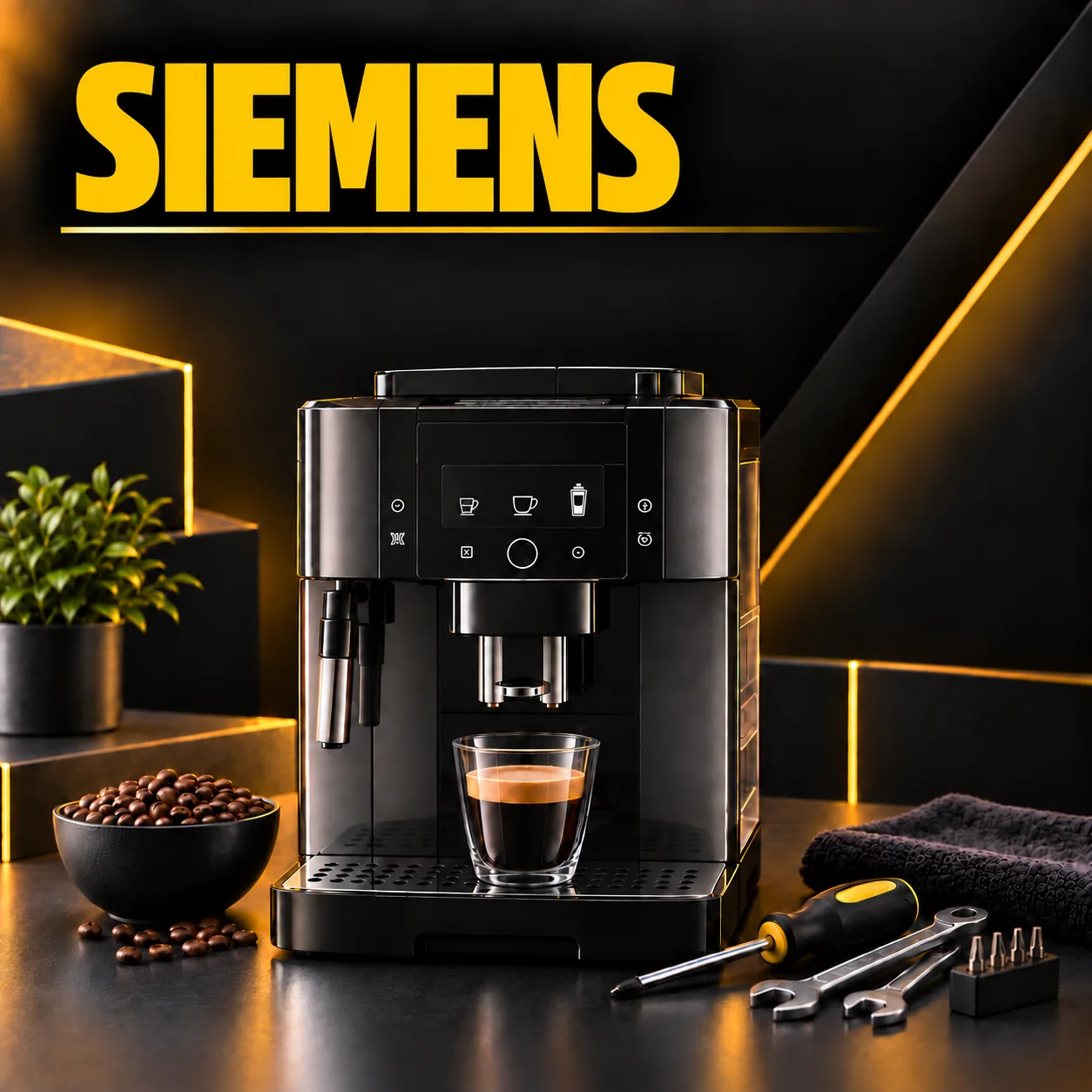
Siemens fully automatic coffee machines have been developed over many years in numerous technical generations. From older surpresso machines and EQ.3, EQ.5, EQ.7, EQ.8 and EQ.9 plus through the widely used EQ.6 plus to current EQ300, EQ500, EQ600, EQ700 and EQ900 fully automatic coffee machines, the brewing unit, grinder, fluid system, operation and electronics sometimes differ considerably.
In addition, Siemens offers high-quality built-in fully automatic coffee machines from the iQ700 family. A technical defect therefore does not automatically mean that the complete fully automatic coffee machine has to be replaced. Depending on the model and fault pattern, individual components can be specifically checked and replaced.
At NEW-Kaffeevollautomaten you will find selected Siemens fully automatic coffee machine spare parts for different machine generations and repair areas.
Depending on the machine, components from areas such as brewing unit, grinder, pump and fluid system, valves, seals, hoses and connectors as well as further repair and wear parts may be relevant.
Siemens E-number – most important basis for spare-part searches
Siemens uses the so-called E-number or E-Nr. for unambiguous machine identification.
It is located on the rating plate of the fully automatic coffee machine and should be copied as completely as possible when searching for spare parts.
Typical complete machine designations include TQ905D03/01, TQ907FZ3/08, CT718L1B0/04 or CT918L1B0/07.
The index after the slash in particular should not be ignored. During a longer production period, components can be revised or replaced by successor versions.
Before ordering a Siemens spare part, the complete E-Nr. is therefore one of the most important pieces of information.
Why the EQ designation alone is not sufficient
The Siemens EQ family includes very different technical generations.
An EQ.3, EQ.6 plus and EQ900 all carry the Siemens EQ name, but differ significantly in terms of brewing unit, electronics, grinder, milk system, valve technology and operation.
Different machine versions also exist within an individual series.
A spare part should therefore not be selected solely on the basis of a designation such as “Siemens EQ6” or “Siemens EQ500”.
Current Siemens fully automatic coffee machines 2026
The current Siemens range includes, among others, EQ300, EQ500 iAroma, EQ600 iAroma, EQ6 plus, EQ700 iAroma and EQ900 or EQ900 plus iAroma.
The models differ in terms of operation, beverage functions, milk system, connectivity and convenience.
On corresponding machines, the current iAroma concept combines grinder, heating system, water pump and brewing unit with electronic control.
For repairs, however, the decisive factor remains which specific assembly is installed in the respective E-Nr.
Siemens EQ300 – compact entry-level model
The EQ300 is one of the more compact current Siemens fully automatic coffee machines.
Typical model designations include TF301E09, TF301E19, TF303E07 or TF305E07.
The machines have a removable brewing unit, integrated grinder and, depending on the version, a system for milk beverages.
The service flap provides access to the brewing unit, drip tray and coffee-grounds container.
When searching for spare parts, the complete TF model number should be taken into account.
Siemens EQ500 – numerous variants
The EQ500 is available in different generations and versions.
Newer machines carry model numbers from the TP and TQ ranges, for example, while earlier EQ500 machines were also listed within other technical platforms.
The machines have a removable brewing unit and different milk systems.
For repairs, the brewing group, pump, valves, grinder, hoses and seals may be particularly relevant.
Siemens EQ600 iAroma – new machine generation
With the EQ600 iAroma, Siemens has introduced another current machine family.
Examples include TP601E09, TP605EM3 and further TP6 versions.
The machines offer extensive beverage programmes, touch operation and, depending on the model, Home Connect functions.
Because this generation is technically newer, spare parts from older EQ500 or EQ6 machines should not automatically be transferred.
The same applies here: the complete E-Nr. determines the specific machine version.
Siemens EQ6 plus – widely used TE6 generation
The EQ6 or EQ6 plus is one of the particularly widespread Siemens fully automatic coffee machines.
Many machines carry model designations from the TE6 range, for example TE657M03DE or comparable TE65 and TE65x versions.
The machines have automatic coffee and milk beverages, a removable brewing unit and different maintenance programmes.
Because of its wide distribution, the EQ6 series also plays an important role in the spare-parts and repair sector.
Siemens EQ700 iAroma
The EQ700 iAroma is one of Siemens' modern connected fully automatic coffee machines.
Current models include TQ727D03, TP725ET7, TP715E17 or TQ717D03.
Depending on the version, classic and integral variants are available.
The EQ700 has a removable brewing unit and extensive service programmes for cleaning, descaling, the milk system and further maintenance functions.
Siemens EQ900 and EQ900 plus
The EQ900 family is one of the highly equipped current Siemens fully automatic coffee machine ranges.
Examples include TQ905D03, TQ927E03 or machines from the TQ907 and TQ927 families.
EQ900 and EQ900 plus have extensive electronic settings, modern beverage control and a removable brewing unit.
On the EQ900 plus, additional automated maintenance functions such as AutoCalc and AutoClean are used.
An older EQ.9 plus should not be confused with the current EQ900. These are different machine generations.
EQ900 is not the same as EQ.9 plus
The similar designation occasionally causes confusion.
The older EQ.9 plus, for example, uses model numbers from the TI9 range, while current EQ900 machines generally have TQ9 model numbers.
An older EQ.9 plus connect such as TI9573X9RW therefore belongs to a different technical generation from a current TQ927E03.
When selecting spare parts, both series should be considered strictly separately.
Older Siemens EQ.3, EQ.5, EQ.7 and EQ.8
In addition to current machines, numerous older EQ models remain in use.
These include EQ.3, EQ.5, EQ.7 and EQ.8.
Siemens itself assigns these generations to different model prefixes. For example, TI3 can be found for EQ.3, TE5 for EQ.5 or certain EQ500 platforms, TE8 for EQ.8 and further corresponding model families.
Repairs can also remain worthwhile for older machines if individual Siemens wear or fluid components are affected.
Siemens surpresso – older TK generation
Before today's EQ fully automatic coffee machines, there were the Siemens surpresso ranges.
Well-known machines include surpresso S20, S40, S60 or S70 as well as different TK5, TK6 and TK7 versions.
One example is the surpresso S70 TK69001.
These machines use a considerably older technical platform than current EQ700 or EQ900 fully automatic machines.
During repairs, particular attention should therefore be paid to the model number, assembly and specific spare-part compatibility.
Siemens iQ700 built-in fully automatic coffee machines
In addition to freestanding EQ machines, Siemens also offers high-quality iQ700 built-in fully automatic coffee machines.
Current or more recent examples include CT718L1B0 and CT918L1B0.
These machines are permanently integrated into the kitchen and combine fully automatic coffee machine technology with a high-quality built-in appliance front.
In the event of a defect, a targeted repair can be particularly worthwhile because complete replacement of the machine must additionally take installation dimensions and kitchen design into account.
The version index is also important for built-in machines
A model such as CT718L1B0 exists in several production versions, for example CT718L1B0/04 or CT718L1B0/06.
Different indices such as /02, /05 or /07 can also be found for the CT918L1B0.
This demonstrates why the complete E-Nr. is so important for Siemens.
A component should not be ordered solely on the basis of the basic designation CT718 or CT918.
Siemens, Bosch, NEFF and Gaggenau – shared BSH technology
Siemens Home Appliances belongs to the BSH appliance family together with Bosch, NEFF and Gaggenau.
For this reason, identical or technically related components are sometimes used in different fully automatic coffee machines.
Depending on the machine platform and production version, this may include pumps, valves, hoses, connectors and further fluid components.
A spare part may therefore be suitable for Siemens, Bosch, NEFF or Gaggenau.
BSH relationship does not mean universal compatibility
The technical similarity between the brands should not be confused with complete structural identity.
Even machines that look similar externally may differ in terms of connections, pump type, electronics, sensors, valves or software version.
A Bosch or NEFF spare part should therefore only be used in a Siemens machine if the specific product description confirms this compatibility.
ULKA EP4 GW water pump for suitable Siemens machines
A good example of a spare part used across several brands is our ULKA EP4 GW water pump with 230 V, 48 W and 50 Hz.
This pump version is used in suitable fully automatic coffee machines from various BSH brands.
It transports the water within the fluid system through the downstream assemblies.
Before installation, the specific E-Nr. or machine allocation should nevertheless be checked.
Not every similar vibration pump is compatible
Vibration pumps can look almost identical externally and still have different technical characteristics.
For the ULKA EP4 GW, for example, voltage, power, frequency, connections and installation environment are relevant.
A pump should therefore not be selected solely by housing shape or a product photograph.
Siemens brewing unit – removable and cleanable
On many Siemens fully automatic coffee machines, the brewing unit or brewing group is removable.
This applies, for example, to EQ300, EQ500, EQ700 and EQ900 as well as numerous other machine generations.
The brewing unit receives the ground coffee, compresses it and performs the actual brewing process.
After preparation, the used coffee grounds are ejected.
Different mechanical components move during every individual coffee preparation.
Clean the Siemens brewing unit regularly
For its corresponding machines, Siemens recommends regular manual cleaning of the removable brewing unit in addition to automatic cleaning.
On the EQ500, for example, it is cleaned under warm running water.
On the EQ700 and EQ900, the brewing group is also removed, rinsed with water and accessible coffee residues are removed from the interior of the machine.
The exact procedure depends on the respective machine generation.
No soap, vinegar or acid on the brewing unit
There are clear maintenance instructions for modern Siemens brewing units.
The brewing unit should be cleaned without cleaning agents.
For EQ700 and EQ900, Siemens explicitly advises against using soap, vinegar or acid to clean the brewing group.
The brewing unit is also not intended for cleaning in the dishwasher.
Important difference: do not grease EQ700 and EQ900
With Siemens, maintenance of the brewing unit should not simply be copied from other manufacturers.
For modern machines such as EQ700 as well as EQ900 and EQ900 plus, Siemens explicitly states that the brewing unit does not need to be greased.
This means that silicone grease should not routinely be applied to guide rails or other areas of the brewing group on these machine generations.
The respective manufacturer's specifications take priority.
When silicone grease can nevertheless be useful on Siemens machines
The fact that modern Siemens brewing units should not be routinely greased does not mean that silicone grease is fundamentally excluded from every Siemens repair.
On designated O-rings, seals or other suitable repair points, a thin lubricating film can be useful as an assembly aid.
For this purpose, we offer our food-grade NEW-009 silicone grease in the 6 g aluminium tube.
The specific installation point is decisive. The silicone grease should not generally be used as brewing-unit grease for all Siemens models.
Silicone grease cannot repair a damaged seal
An O-ring must be mechanically intact in order to seal reliably.
If a seal is torn, severely deformed or hardened, silicone grease cannot restore its function.
At suitable points, the grease serves only as an assembly or sliding lubricant.
For repair businesses with higher consumption, our 100 g tube of food-grade silicone grease is additionally available.
Siemens grinder – current iAroma machines with ceramic grinder
Current Siemens iAroma fully automatic coffee machines use a durable ceramic grinder.
The grinder produces ground coffee as evenly as possible from the coffee beans and works together with the brewing group, heating system and water pump.
Older Siemens machine generations may use different grinder designs or technical versions.
A Siemens grinder spare part should therefore always be selected according to the specific machine generation.
Weak coffee does not automatically mean grinder wear
The intensity of the coffee is influenced by several factors.
These include bean variety, grind setting, selected strength, actual coffee quantity, brewing temperature, brewing group and water flow.
Modern Siemens machines additionally use electronic brewing parameters and iAroma functions.
Thin coffee alone is therefore not proof of a worn grinder.
Grind setting influences water flow
Finer ground coffee creates greater resistance in the coffee puck.
Very coarse ground coffee, on the other hand, allows water to pass through more easily.
A very slow coffee flow can therefore be related, among other things, to a grind setting that is too fine.
Before replacing parts, the setting, beans and brewing group should be taken into account.
Foreign objects in the grinder
Not every unusual grinding noise is caused by normal wear.
Small stones or other hard foreign objects can occasionally enter the bean container together with the coffee beans.
If a hard blocking noise occurs, the grinder should not repeatedly continue to be operated.
Otherwise, the motor, gearbox and grinding components could be additionally damaged.
Siemens pump and fluid system
The water pump is a central component of the fully automatic coffee machine, but only one part of the complete water path.
Depending on the model, the fluid system includes the water tank, water filter, flow meter, pump, hoses, heating system, valves, brewing unit and beverage outlet.
A fault in one of these components can influence the water flow of the complete machine.
Siemens pump loud – do not replace immediately
A vibration pump sounds significantly different when it is not supplied with sufficient water.
Possible causes of a loud pump noise include air in the system, a problem with the water tank or water filter, a restricted water path, limescale or a valve fault.
The water pump should therefore only be replaced after a comprehensible diagnosis.
Pump runs, but no water comes out
This fault pattern also does not prove that the pump is defective.
If the pump is audibly operating, the water path can still be blocked elsewhere.
Possible causes include filter, flow meter, hoses, heater, valves or limescale deposits.
A meaningful diagnosis follows the complete water path from the tank to the outlet.
Water filter can influence the flow
Many Siemens fully automatic coffee machines use a water filter in the tank.
Depending on its design, such a filter reduces certain water constituents and can influence the limescale load.
At the same time, it forms part of the water path.
In the event of water-delivery problems, it should therefore also be checked whether the filter is correctly installed, prepared and still functional.
Hoses and connectors under temperature and pressure
Different lines run between the assemblies of the fluid system.
Depending on their installation position, they transport cold water, hot water or steam.
Many connections are sealed by small O-rings.
In the event of a leak, it should therefore be checked whether the complete hose is actually defective or whether only the seal of the connection needs to be replaced.
Valves determine the water path
A Siemens fully automatic coffee machine must distribute water for different functions.
Depending on the beverage, it reaches the brewing unit, hot-water outlet or the milk or steam path.
Different valves are used for this purpose.
A blocked or leaking valve can therefore cause the pump to operate while water does not appear at the intended outlet.
4-bar outlet valve 66289 for suitable Siemens machines
A specific example of a valve used across different brands is the 4-bar outlet valve 66289.
This valve is used in suitable machines from different manufacturers, including Siemens.
For professional repair businesses, we offer the article as a workshop pack of 25.
The specific machine compatibility must be checked before installation.
Milk system on Siemens EQ fully automatic coffee machines
Depending on the machine generation and equipment, Siemens uses different milk systems.
An EQ300, for example, operates differently from an EQ6 plus, EQ700 or EQ900.
Modern machines combine milk hoses, milk containers, outlet components and internal valves.
Milk contains protein and fat and can therefore leave residues, particularly in narrow lines and air paths.
Poor milk foam – clean first
Suddenly poor milk foam does not necessarily have to be caused by a technical defect.
Possible causes include milk residues, a contaminated milk hose, blocked air paths or incorrectly assembled components.
Thorough cleaning should therefore be one of the first checks.
For suitable milk-carrying components, we offer our Clean o Coffee milk-system cleaner 250 ml.
Additionally clean the milk hose mechanically
Residues can become deposited in narrow milk lines.
In addition to a suitable milk-system cleaner, mechanical cleaning can therefore be useful.
For this purpose, we offer our cleaning brush for milk suction hoses on fully automatic coffee machines.
The milk system should be dismantled in accordance with the instructions for the respective Siemens model.
Calc’nClean – combine Siemens cleaning and descaling
A term typical of Siemens is Calc’nClean.
On corresponding EQ fully automatic coffee machines, this service programme combines cleaning and descaling within a guided maintenance procedure.
Depending on the model and machine generation, separate programmes for cleaning and descaling may also be available.
The display guides the user through the required steps.
EQ900 plus with AutoCalc and AutoClean
On modern EQ900 plus models, the maintenance concept has been further automated.
Siemens uses functions including AutoCalc and AutoClean here.
In terms of maintenance and the products used, these machines should therefore not simply be treated in the same way as older EQ6, EQ7 or EQ9 machines.
The maintenance concept of the specific E-Nr. is always decisive.
Cleaning and descaling are different chemical tasks
Cleaning the coffee circuit primarily treats coffee oils and coffee fats.
Descaling dissolves mineral limescale deposits in the water-carrying system.
Cleaning tablets and descaling agents therefore perform different tasks.
You can find suitable products in our care products category for fully automatic coffee machines.
No household remedies for Siemens descaling
Siemens explicitly warns against unsuitable household remedies for its modern fully automatic coffee machines.
Vinegar and citric acid in particular, or corresponding household solutions, should not be used independently for descaling.
Depending on the machine and material, such agents can affect seals or other components.
The intended descaling programme should be carried out with a suitable descaling product.
Descaling tablets for suitable Siemens fully automatic coffee machines
For corresponding applications, we offer 30 descaling tablets of 18 g each in flowpacks for suitable Siemens fully automatic coffee machines.
The tablets are dissolved in water before use in accordance with the product information.
The actual descaling programme depends on the respective machine.
On an EQ500, for example, the procedure may differ from that on an EQ900 or older surpresso model.
Siemens itself also uses 18 g descaling tablets
Of interest for the technical classification is the fact that Siemens itself has offered descaling tablets with 18 g per tablet for older or certain maintenance products.
Current Siemens products may use different tablet sizes depending on the version.
However, this does not automatically mean that arbitrary descaling tablets are interchangeable.
Product information, required concentration and machine programme must correspond to each other.
Remove the water filter before certain descaling programmes
On various Siemens EQ models, the descaling programme requires an installed water filter to be removed before starting.
On the EQ500, for example, this is part of the official programme.
This may also be required on other series.
The procedure should therefore always be carried out according to the specific operating instructions.
Water hardness influences maintenance intervals
Depending on the machine generation, Siemens calculates requests for service programmes based, among other things, on water hardness and usage.
A correct water-hardness setting is therefore important.
With harder water, mineral deposits can form more quickly.
A water filter can reduce the limescale load but does not replace cleaning of either the coffee circuit or the milk system.
Typical fault: Siemens does not deliver water
If no water appears at the outlet, various causes are possible.
Possible areas include the water tank, water filter, pump, flow meter, hoses, valves, heater or limescale deposits.
On suitable machines, for example, the ULKA EP4 GW water pump may be a relevant component.
However, it should not be replaced on suspicion without further diagnosis.
Typical fault: pump very loud
A pump that suddenly becomes significantly louder can indicate that it is not receiving sufficient water.
The water tank, filter and water supply should be checked first.
Air in the system or a blockage in the downstream water path can also change the operating noise.
Only once these causes have been ruled out should the pump itself be examined more closely.
Typical fault: Siemens is losing water
A leak can occur at many points.
Possible causes include the water-tank connection, hoses, O-rings, pump, valves, heater or brewing unit.
For diagnosis, it is particularly important to observe when the water loss occurs.
Permanent water loss may indicate a different area from a leak that occurs only during brewing under pump pressure.
Typical fault: a lot of water in the drip tray
Water in the drip tray is fundamentally normal on Siemens fully automatic coffee machines.
Automatic rinsing and internal pressure-relief processes deliberately direct water there.
The behaviour becomes particularly noticeable if the amount suddenly increases significantly or less coffee simultaneously reaches the cup.
In this case, valves, seals, brewing unit or other fluid components may be relevant.
Typical fault: coffee flows very slowly
A slow coffee flow does not have to be caused by a weak pump.
A very fine grind setting, contaminated brewing unit, restricted water paths or limescale can also reduce the flow.
Grinder, brewing unit and fluid system should therefore be considered together.
A Siemens spare part should only be ordered after the fault has been meaningfully narrowed down.
Typical fault: coffee too weak
Weak coffee can be caused by different factors.
These include beans, grind setting, selected strength, coffee quantity, brewing unit, temperature and water flow.
Modern iAroma machines additionally use different electronic brewing parameters.
A grinder defect is therefore only one of several possible causes.
Typical fault: brewing unit cannot be inserted
After cleaning, the brewing unit must be reinserted in the intended position.
If it cannot be inserted or locked, force should not be used.
The brewing unit and internal drive must be in the correct position.
The exact procedure depends on the respective EQ or machine generation.
Typical fault: brewing unit difficult to move
A stiff brewing unit can be caused by coffee residues, contamination or mechanical wear.
The assembly should first be thoroughly cleaned with water in accordance with the Siemens instructions.
On modern EQ700 and EQ900 machines, it should then not be routinely greased, as Siemens explicitly does not provide for this on these brewing units.
At other repair points, the respective manufacturer and component specifications are decisive.
Typical fault: no milk foam
If coffee preparation works normally but the milk system has problems, the milk path should be checked first.
Depending on the model, the milk hose, air supply, outlet, milk container and cleaning condition should be checked.
Thorough cleaning can resolve many typical milk problems.
If the fault persists, valves and other fluid components can then be examined.
Typical fault: unusual grinding noises
A suddenly occurring hard noise can indicate a foreign object in the grinder.
In this case, the grinder should not repeatedly continue to be operated.
With normal wear, grinding performance usually changes more gradually.
A technical inspection of the grinder helps to distinguish between the two cases.
Typical fault: coffee remains too cold
A beverage temperature that is too low does not automatically mean that the heater is defective.
Temperature sensors, water flow, limescale deposits and machine settings can also influence the result.
On modern machines, the heating system works closely together with sensors and electronic control.
A diagnosis should therefore be carried out before replacing a larger assembly.
Typical fault: individual beverages do not work
If, for example, coffee works but hot water or milk beverages do not, this provides an important indication.
In this case, the pump may fundamentally still be operating.
Possible faults are then more likely to be found in valves, individual fluid paths, the milk system or corresponding control.
During troubleshooting, it should therefore be noted precisely which functions continue to operate normally.
Do not automatically equate an error code with one component
Modern Siemens fully automatic coffee machines can display different messages or error codes.
Such a message often initially indicates a functional area and does not necessarily prove that an individual component is defective.
For example, a water fault may be caused by the pump, filter, flow meter, valve or a blockage.
The message should therefore always be evaluated together with the complete E-Nr. and the actual machine behaviour.
Maintenance problem or actual defect?
Not every problem immediately requires a spare part.
A contaminated brewing unit, blocked milk path, old water filter or scaled water path can cause symptoms that initially appear to be a technical defect.
Conversely, cleaning cannot repair a damaged seal, mechanically worn pump or defective valve.
Good troubleshooting therefore distinguishes between maintenance condition, settings and an actual component defect.
Repair specifically instead of replacing large assemblies on suspicion
A small seal can be responsible for a visible water leak.
In such a case, neither the pump nor the complete valve may need to be replaced.
At the same time, a functioning brewing unit should not be replaced if only cleaning is required.
The aim should always be to determine the actually affected Siemens spare part as precisely as possible.
Continue repairing older Siemens fully automatic coffee machines
surpresso, EQ.3, EQ.5, EQ.7, EQ.8 and EQ.9 machines also remain in use.
Age alone does not determine whether a repair is worthwhile.
For individual defects involving the pump, seal, valve, grinder or other fluid components, targeted repair may still be worthwhile.
The decisive factors are the overall condition, spare-part availability and specific repair effort.
Consider current EQ600, EQ700 and EQ900 separately from older series
Siemens continuously develops the technical platform of the EQ range.
A new EQ600 or EQ900 does not simply use the same assemblies as an older EQ6 or EQ9.
The maintenance concepts have also changed – for example through new automatic cleaning functions.
The specific E-Nr. is therefore more important than a merely similar series designation.
Siemens spare parts for repair businesses
Due to the large number of installed Siemens, Bosch, NEFF and Gaggenau fully automatic coffee machines, certain BSH components are also of interest to professional workshops.
These include, for example, pumps, valves, seals and maintenance products.
For various products, NEW-Kaffeevollautomaten offers larger workshop and stock quantities.
You can find these in our bulk discount category.
4-bar outlet valves for workshop requirements
One example is our set of 25 4-bar outlet valves 66289.
The cross-brand machine allocation makes such components particularly interesting for workshops that repair different fully automatic coffee machines.
Nevertheless, the specific compatibility must be checked before every installation.
Descaling tablets for regular requirements
Maintenance products are also regularly required by workshops and operators of several machines.
For suitable Siemens fully automatic coffee machines, for example, we offer 30 descaling tablets of 18 g each in flowpacks.
The specific use depends on the product information and the maintenance programme of the respective Siemens machine.
Safety when repairing a Siemens fully automatic coffee machine
A fully automatic coffee machine operates with mains voltage, hot water, heating systems, moving mechanical parts and in some cases pressurised lines.
Before opening, the machine must be completely disconnected from the mains supply.
Hot components should be allowed to cool completely.
For built-in machines, safe removal or access must additionally be taken into account.
Work on electronics, mains voltage and safety-relevant components should only be carried out by persons with appropriate specialist knowledge.
How to find the correct Siemens spare part
1. Read the complete E-Nr.
Determine the complete Siemens machine designation including the index after the slash.
2. Determine the machine generation
Distinguish, for example, between surpresso, EQ.3, EQ.5, EQ.6, EQ.7, EQ.8, EQ.9, EQ300, EQ500, EQ600, EQ700, EQ900 or a CT built-in machine.
3. Narrow down the fault area
Check whether the cause is more likely to be in the brewing unit, grinder, pump, fluid system, valves, heating system, milk system, sensors or electronics.
4. Check the maintenance condition
Clean the brewing unit according to the Siemens specifications and check the milk system, water filter and pending service programmes.
5. Observe the manufacturer's specifications for the brewing unit
Do not generally transfer maintenance methods from other manufacturers to Siemens. On modern EQ700 and EQ900 brewing units, for example, regular greasing is not specified.
6. Compare the existing component
For an already removed spare part, existing numbers, electrical data, connections and design can assist with identification.
7. Check specific machine compatibility
A Bosch, NEFF or Siemens component may be technically identical – but does not have to be. The specific product allocation is decisive.
Frequently asked questions about Siemens fully automatic coffee machine spare parts
Which Siemens spare parts are available from NEW-Kaffeevollautomaten?
You can find all currently available products in our Siemens fully automatic coffee machine spare-parts category. Depending on the machine, components from the areas of brewing unit, grinder, pump, fluid system, seals and valves may be relevant.
What is the E-number of a Siemens fully automatic coffee machine?
The E-Nr. is the precise machine identifier. It is located on the rating plate and should wherever possible be used including the version index after the slash.
Why is the index after the E-Nr. important?
Different production versions may exist within the same basic model range. Individual components may have been changed during the production period.
Which Siemens EQ series are currently available?
The current German range includes, among others, EQ300, EQ500 iAroma, EQ600 iAroma, EQ6 plus, EQ700 iAroma as well as EQ900 and EQ900 plus iAroma.
What is the difference between EQ9 plus and EQ900?
The EQ.9 plus is an older machine generation and uses TI9 model numbers, for example. Current EQ900 machines belong to a new platform and have TQ9 model numbers. Spare parts must not generally be transferred between the two series.
Can the Siemens brewing unit be removed?
On numerous Siemens EQ fully automatic coffee machines, the brewing unit is removable for manual cleaning. These include, for example, EQ500, EQ700 and EQ900.
How do you clean the Siemens brewing unit?
The brewing unit is removed according to the machine instructions and cleaned under running water. Siemens does not provide for cleaning with soap, vinegar or acid on modern machines.
Can the Siemens brewing unit be put in the dishwasher?
No. For EQ500, EQ700 and EQ900, for example, Siemens states that the brewing unit should not be cleaned in the dishwasher.
Does the Siemens EQ700 brewing unit need to be greased?
No. Siemens explicitly states that modern brewing units such as the one in the EQ700 do not need to be greased.
Does the Siemens EQ900 brewing unit need to be greased?
No. For the EQ900 and EQ900 plus as well, Siemens explicitly states that the modern brewing unit does not need to be greased.
Can silicone grease nevertheless be used on Siemens machines?
On designated O-rings and sealing points, suitable food-grade silicone grease can be used as an assembly aid during corresponding repairs. However, it should not generally be applied to modern Siemens brewing units.
Which grinder does Siemens use?
On current iAroma fully automatic coffee machines, Siemens uses a durable ceramic grinder. Older machine generations may use different technical grinder versions.
Why is my Siemens pump suddenly loud?
Possible causes include air in the system, the water filter, insufficient water supply, limescale or a blockage in the water path. The pump should therefore not be replaced solely because of its noise.
Why does my Siemens fully automatic coffee machine pump but no water comes out?
In addition to a pump defect, filters, flow meter, valves, hoses, heater or limescale deposits may be the cause.
Which water pump is available for suitable Siemens machines?
For designated models, we offer, for example, the ULKA EP4 GW water pump with 230 V, 48 W and 50 Hz. The specific E-Nr. must be checked before ordering.
Are Bosch and Siemens fully automatic coffee machines technically related?
Yes. Bosch and Siemens Home Appliances belong to BSH, and different fully automatic coffee machines use technically related or partly identical components. However, not all spare parts are universally interchangeable.
Can a NEFF or Gaggenau spare part fit Siemens?
On certain BSH platforms, individual components can be used across different brands. The specific product and machine allocation is always decisive.
What is Siemens Calc’nClean?
Calc’nClean is a combined service programme for cleaning and descaling on Siemens fully automatic coffee machines equipped accordingly.
What is AutoCalc on the EQ900 plus?
On the EQ900 plus, Siemens automates certain descaling processes via AutoCalc. AutoClean is additionally part of the modern maintenance concept.
Can a Siemens fully automatic coffee machine be descaled with vinegar?
This is not recommended. On modern machines, Siemens explicitly warns against unsuitable household remedies such as vinegar and citric acid. Descaling products suitable for the respective programme should be used.
Which descaling tablets are available from NEW-Kaffeevollautomaten?
For suitable Siemens fully automatic coffee machines, we offer, for example, 30 descaling tablets of 18 g each in flowpacks. The specific programme procedure depends on the respective machine generation.
Why is my Siemens fully automatic coffee machine losing water?
Possible causes include the water-tank connection, hoses, seals, pump, valves, heater or brewing unit. The actual leakage point should be located as precisely as possible.
Is water in the drip tray normal?
Yes. Automatic rinsing and internal pressure relief direct water into the drip tray. A significant change in the amount of water compared with previous behaviour is particularly noticeable.
Why does my Siemens coffee flow very slowly?
Possible causes include a very fine grind setting, a contaminated brewing unit, restricted water paths, limescale or changed pump performance.
Why has my Siemens coffee suddenly become too weak?
In addition to a possible grinder problem, beans, grind setting, coffee strength, brewing unit, temperature and water flow can influence the result.
Why is the milk system no longer working properly?
The milk hose, air paths, outlet and other accessible milk components should first be thoroughly cleaned. For suitable applications, we offer our Clean o Coffee milk-system cleaner.
Are Siemens built-in fully automatic coffee machines available?
Yes. Siemens offers iQ700 built-in fully automatic coffee machines including CT718L1B0 and CT918L1B0. The complete E-Nr. including the version index should also be used for these machines.
Is it worthwhile repairing an old Siemens surpresso?
This depends on the overall condition, fault and spare-part availability. In the case of individual defects involving the pump, valves, seals or other fluid components, repair can still be worthwhile even on older machines.
Are Siemens spare parts available for professional repair businesses?
Yes. For higher requirements, we offer, for example, 25 outlet valves 66289, larger silicone-grease containers and further products in our bulk discount category.
Where can I find spare parts for my Siemens fully automatic coffee machine?
You can find all currently available products directly in our Siemens fully automatic coffee machine spare-parts category at NEW-Kaffeevollautomaten.
Siemens fully automatic coffee machine spare parts at NEW-Kaffeevollautomaten
Siemens fully automatic coffee machines include a particularly large number of different technical generations – from older surpresso machines through EQ.3, EQ.5, EQ.6, EQ.7, EQ.8 and EQ.9 to the current EQ300, EQ500, EQ600, EQ700 and EQ900 series as well as iQ700 built-in fully automatic coffee machines.
At NEW-Kaffeevollautomaten you will find selected Siemens fully automatic coffee machine spare parts for different repair areas and machine generations.
Depending on the machine, components for the brewing unit, grinder, pump and fluid system, valves, seals, hoses and connectors may be relevant.
For suitable BSH machines, for example, we offer the ULKA EP4 GW water pump and, for corresponding valve applications, the 4-bar outlet valve 66289.
For suitable O-rings and sealing points, our food-grade NEW-009 silicone grease is available. However, with modern Siemens brewing units such as EQ700 and EQ900, it must expressly be noted that Siemens does not specify regular lubrication of the brewing unit.
For suitable maintenance programmes, you will also find descaling tablets as well as milk-system cleaner.
For Siemens spare-part identification, the following is particularly important: determine the complete E-Nr. including version index, identify the EQ or machine generation, check the fault and maintenance condition, compare the existing assembly and then take the specific product compatibility into account.
You can find all currently available products directly in our Siemens fully automatic coffee machine spare-parts category.