
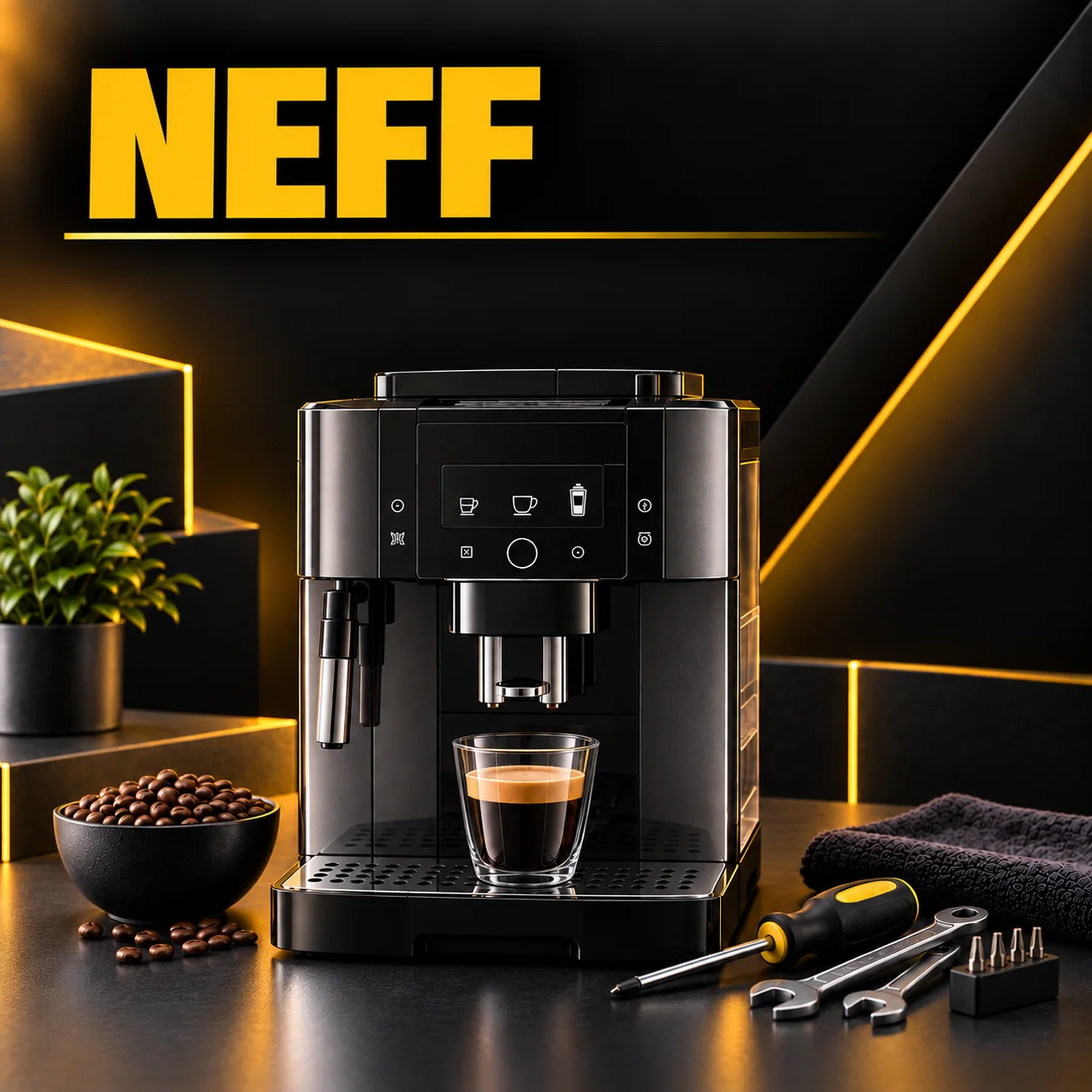
NEFF fully automatic coffee machines are primarily known as high-quality built-in appliances for the kitchen. Behind the appliance panel integrated into the kitchen front, however, operates a technically complex fully automatic coffee machine with grinder, brewing unit, water pump, heating system, valves, sensors, milk system and various water-carrying components.
Even in a high-quality built-in fully automatic coffee machine, individual components can wear over time. A technical fault therefore does not automatically mean that the complete machine has to be replaced.
At NEW-Kaffeevollautomaten you will find selected NEFF fully automatic coffee machine spare parts for different machine generations and repair areas.
Depending on the machine version, components from areas such as brewing unit, grinder, pump and fluid system, valves, hoses, connectors and seals as well as maintenance and care products may be relevant.
NEFF built-in fully automatic coffee machines – several technical generations
When searching for a NEFF spare part, the machine generation should first be determined.
Older built-in fully automatic coffee machines, for example, have model designations such as C77V60N01 or C77V60N2. Later machine generations were offered under designations including C17KS61.
Current N90 fully automatic coffee machines, on the other hand, use model designations such as CL4TT11N0, CL9TX11X0 or CL9TX11Y0.
Many years of technical development lie between these generations. Accordingly, the brewing unit, grinder, pump, valve system, heater, milk system, sensors and electronics can differ significantly.
A spare part should therefore never be selected solely on the basis of the NEFF brand or visual similarity.
The E-number is decisive with NEFF
NEFF uses the so-called E-number or E-Nr. to uniquely identify its machines.
It consists of a combination of letters and numbers and is often supplemented by an index after a slash.
A complete machine designation can, for example, be CL4TT11N0/08, C17KS61H0/07 or C77V60N2/09.
The index after the slash in particular can be relevant for a repair because individual components may change during a longer production period.
Before ordering a NEFF fully automatic coffee machine spare part, the complete E-Nr. should therefore always be checked wherever possible.
Why even the same NEFF model number can have different versions
A model designation does not necessarily represent only one unchanged technical production version.
For the NEFF CL4TT11N0, for example, there are different machine variants with different indices after the slash.
During the production period, components may be revised, suppliers changed or parts replaced by successor versions.
The combination of basic model and version index is therefore considerably more reliable than simply the designation “N90 fully automatic coffee machine”.
Where is the E-Nr. located on the NEFF fully automatic coffee machine?
The E-number is located on the machine's rating plate.
On a built-in fully automatic coffee machine, the rating plate is usually located within an accessible area of the machine and may therefore only become visible after opening or pulling out the corresponding section of the appliance.
In addition to the E-Nr., further information such as the FD number and serial number may be present.
For the most unambiguous spare-part identification possible, the complete E-number should be copied.
Older NEFF C77V60 fully automatic coffee machines
Older NEFF built-in fully automatic coffee machines include, for example, machines from the C77V60 family.
Well-known versions include C77V60N01 and C77V60N2 with different production versions.
These machines originate from an earlier technical generation than current N90 fully automatic machines.
Despite their age, many of these built-in appliances are still in use and are therefore still repaired.
On older machines, classic wear areas such as the pump, grinder, seals, valves, hoses and brewing unit may become particularly relevant.
NEFF C17KS61 – widespread built-in generation
Another important machine family includes models such as C17KS61N0, C17KS61H0 and C17KS61G0.
Depending on the version, these built-in fully automatic coffee machines feature a removable water tank, integrated grinder, milk system and electronic beverage control, among other things.
Different production versions also exist for these machines, for example C17KS61H0/07 or C17KS61G0/09.
When searching for a NEFF spare part, the complete machine version should therefore be taken into account.
Current NEFF N90 fully automatic coffee machines
The current machine generation is offered by NEFF within the N90 series, among others.
These include, for example, the CL4TT11N0 with removable water tank as well as models from the CL9TX11 family.
Modern versions have extensive beverage functions, electronic operation, automatic maintenance programmes, a milk system and Home Connect functions.
At the same time, the fundamental technical components of a fully automatic coffee machine remain: grinder, brewing unit, water supply, pump system, heating and valve technology.
CL4TT11N0 – NEFF N90 with water tank
The NEFF CL4TT11N0 operates with a removable water tank.
The water therefore first enters the internal fluid system through the tank connection and is then routed through the pump, heating system, valves and brewing unit.
In the event of water-flow problems, a defective pump should therefore not automatically be assumed.
The water-tank connection, filter, air in the system, valves or limescale deposits can also influence the water flow.
CL9TX11X0 – NEFF N90 with fixed water connection
A special version is the NEFF CL9TX11X0 with a direct water connection.
This eliminates the need to regularly fill a conventional water tank.
For technical diagnosis, however, this creates an additional area: in addition to the internal components, the supply via the fixed water connection must also be taken into account.
If there is no water flow, it should therefore be checked whether sufficient water is reaching the machine at all before internal pump or fluid components are replaced.
NEFF, Bosch, Siemens and Gaggenau – shared BSH technology
NEFF belongs to the BSH appliance world together with Bosch, Siemens and Gaggenau.
As a result, identical or technically related components are sometimes used in various fully automatic coffee machines from these brands.
Depending on the machine platform and production version, this applies, for example, to pumps, valves, hoses, brewing units and other fluid components.
A spare part can therefore be suitable at the same time for Bosch, Siemens, NEFF and in some cases Gaggenau.
A shared platform does not automatically mean identical spare parts
However, the technical relationship within the BSH Group must not be confused with complete structural identity.
Even if two machines have a similar design, individual components may differ in terms of connections, electrical data, software version, mounting or sensors.
A Siemens or Bosch spare part should therefore only be used in a NEFF machine if the specific machine compatibility can be clearly established.
The E-Nr. therefore remains decisive even for components used across several brands.
ULKA EP4 GW water pump for suitable NEFF fully automatic coffee machines
A very good example of a component used across several brands is the ULKA EP4 GW water pump with 230 V and 48 W.
This pump version is used in suitable fully automatic coffee machines within the BSH appliance world and is intended for corresponding Bosch, Siemens and NEFF machines, among others.
The pump transports the water through the internal fluid system.
Before installation, it must nevertheless be checked whether the specific E-Nr. or machine version is compatible with the pump type offered.
Why the ULKA EP4 GW should not simply be replaced by any vibration pump
Vibration pumps can look very similar externally while still having different technical characteristics.
With our ULKA EP4 GW, relevant technical features include 230 V, 48 W and 50 Hz.
The connections and installation environment must also match the existing machine.
A pump should therefore not be selected solely by housing shape or colour.
Water pump operates loudly – is it really defective?
A noticeably changed pump noise can indicate a problem, but does not yet prove that the pump is defective.
A vibration pump sounds considerably louder, for example, when it draws in air or is not supplied with sufficient water.
Possible causes can include the water tank, fixed water supply, water filter, air in the system, a blocked water path, limescale or a valve fault.
The water pump should therefore not be replaced solely on the basis of its noise level.
Pump runs, but no water comes out
Even if the pump can be heard operating, the water flow may be interrupted elsewhere.
The water path of a fully automatic coffee machine consists of several consecutive components.
Possible sources of faults include the water supply, flow meter, hoses, heater, valves or limescale deposits inside narrow water paths.
Systematic troubleshooting therefore follows the water path from its entry into the machine to the beverage outlet.
NEFF fluid system – considerably more than the water pump
The fluid system refers to all water-carrying components within the fully automatic coffee machine.
Depending on the machine version, this includes the water tank or fixed water supply, filter, pump, flow meter, hoses, connectors, heater, valves, brewing unit and beverage outlet.
A fault in just one of these components can influence the entire water flow.
In the event of water problems, the pump or fluid system should therefore not be reduced to one individual component.
Hoses, plug-in connectors and small seals
Different hoses and pressure lines are used between the various assemblies.
They transport cold water, heated water and, depending on the function, steam as well.
Small O-rings provide the actual seal at many plug-in connections.
If water escapes from a connection, it should therefore be checked whether the hose itself is actually damaged or whether only a seal needs to be replaced.
4-bar outlet valve for suitable NEFF fully automatic coffee machines
Another example of a spare part used across several brands is the 4-bar outlet valve 66289.
The valve is used in suitable fully automatic coffee machines from different manufacturers or technical platforms.
Within the fluid system, it influences a defined pressure or water path.
For professional repair businesses, we also offer the 4-bar outlet valve as a workshop quantity of 25.
Brewing unit in the NEFF fully automatic coffee machine
The brewing unit or brewing group is the central mechanical area of coffee preparation.
After grinding, the ground coffee enters the brewing chamber. There it is compressed and then hot water flows through it.
After the brewing process, the used coffee grounds are ejected.
This process is repeated with every beverage and places mechanical stress on the components and seals of the brewing unit.
NEFF brewing unit can be removed on suitable machines
On corresponding NEFF built-in fully automatic coffee machines, the brewing unit can be removed for cleaning.
This allows the accessible interior of the machine to be cleared of coffee residues and the brewing unit to be cleaned separately.
Removal should be carried out in accordance with the operating instructions for the respective model.
The brewing group should not be pulled out of or inserted into the machine by force.
Keep the brewing unit clean regularly
Moist ground coffee and coffee residues can collect around the brewing group and inside the machine.
Regular mechanical cleaning therefore supports hygiene and can prevent larger quantities of residues from accumulating.
The procedure specified by the respective machine manufacturer should be followed.
Automatic cleaning programmes and manual cleaning of the removable brewing unit perform different tasks and can complement one another.
Brewing unit stiff – do not replace it immediately
A stiff brewing group can have different causes.
Possible reasons include contamination, coffee residues, dry suitable sealing and sliding points or mechanical wear.
The brewing unit should first be cleaned and inspected in accordance with the machine instructions.
A thin film of food-grade silicone grease can then be applied to designated O-rings or sealing points.
Silicone grease for suitable seals and O-rings
During repairs and maintenance work, suitable silicone grease can be used as an assembly and sliding lubricant.
Our 6 g tube of food-grade silicone grease is intended for corresponding seal and O-ring applications.
A very thin film of grease is normally sufficient.
A damaged, torn or hardened seal cannot be repaired with silicone grease and should be replaced.
100 g silicone grease for workshops and regular repairs
Anyone who regularly repairs fully automatic coffee machines requires correspondingly larger quantities.
For this purpose, we additionally offer our 100 g tube of food-grade silicone grease.
It is particularly suitable for repair businesses and other users with regular sealing and assembly requirements.
You can find further packaging sizes in our silicone grease category.
NEFF grinder – current machines with ceramic grinder
The grinder grinds the coffee beans immediately before preparation.
In current N90 built-in fully automatic coffee machines, NEFF uses a ceramic grinder.
Ceramic is wear-resistant and enables precise grinding. Nevertheless, even a high-quality grinder can be affected by foreign objects, unsuitable beans or other mechanical problems.
Depending on the older machine generation, however, other grinder versions may be installed.
A NEFF grinder or grinder spare part should therefore always be selected on the basis of the specific machine version.
Poor coffee does not automatically mean a defective grinder
Taste and extraction are not determined by the grinder alone.
The coffee beans, grind setting, selected coffee strength, brewing unit, water flow and brewing temperature also influence the result.
Coffee that suddenly tastes weaker therefore does not prove grinder wear.
Before replacement, the settings and other components involved in the brewing process should be checked.
Unusual noises during grinding
A suddenly occurring hard or blocking noise can indicate a foreign object in the grinder.
Occasionally, small stones or other hard particles can enter the bean container together with the coffee beans.
A blocked grinder should not be started repeatedly, as this can place additional stress on the motor and mechanism.
A professional inspection is advisable in this case.
Grind setting influences the water flow through the coffee
The grinder not only determines the size of the coffee particles but also indirectly the resistance during the brewing process.
Very finely ground coffee can significantly slow down the water flow. Very coarse ground coffee, on the other hand, provides less resistance.
A slow coffee flow can therefore be caused, among other things, by an unsuitable grind setting.
The setting should be made in accordance with the instructions for the respective NEFF machine.
Heating and temperature – the heater is not always defective
A fully automatic coffee machine must bring the water to the intended brewing temperature within a short period of time.
The heating system, temperature sensors and electronic control work together for this purpose.
If a beverage is suddenly too cold, several causes are therefore possible.
In addition to an actual heating fault, the temperature sensors, water flow, limescale deposits or machine settings can play a role.
A larger assembly should therefore not be replaced without prior diagnosis.
Valves distribute water, hot water and steam
A modern NEFF fully automatic coffee machine has several different water paths.
Depending on the selected beverage, water must be routed, for example, to the brewing unit, hot-water outlet or milk or steam system.
Different valves are used for this purpose.
A blocked or incorrectly switching valve can therefore result in the pump being audibly active while water does not appear at the expected outlet.
NEFF milk system with flexible cappuccinatore
Many NEFF built-in fully automatic coffee machines have a milk system for cappuccino, latte macchiato and other coffee-and-milk specialities.
Current machines use, among other things, a flexible cappuccinatore.
The system feeds milk through a hose or corresponding suction connection to the beverage outlet.
Because milk contains protein and fat, regular cleaning of the milk-carrying components is particularly important.
Automatic rinsing of the milk system
Current NEFF fully automatic coffee machines have automatic maintenance functions for the milk system.
Despite automatic rinsing, accessible milk-carrying parts should be regularly checked and cleaned in accordance with the operating instructions.
For more thorough cleaning of suitable components, we offer the Clean o Coffee milk-system cleaner 250 ml.
Additionally clean milk hoses mechanically
Deposits can form inside thin milk hoses.
In addition to a suitable milk-system cleaner, mechanical cleaning can therefore be helpful.
For this purpose, for example, we offer our cleaning brush for milk suction hoses of fully automatic coffee machines.
Disassembly and cleaning should always be carried out in accordance with the respective machine instructions.
Poor milk foam – clean first
If a NEFF fully automatic coffee machine suddenly produces poor or no milk foam, a valve does not automatically have to be defective.
Possible causes are milk residues, blocked air paths, a contaminated milk hose or incorrectly assembled milk-system components.
Thorough cleaning is therefore a sensible first inspection step.
If the problem persists afterwards, a technical inspection of valves and fluid components may become necessary.
Cleaning the NEFF fully automatic coffee machine
NEFF fully automatic coffee machines have automatic cleaning programmes for the internal coffee system.
Depending on the machine generation and programme, cleaning and descaling can be carried out separately or within a combined maintenance programme.
For corresponding machines, NEFF uses the designation Calc&Clean, among others.
The specific procedure should always be carried out in accordance with the operating instructions for the respective machine.
Cleaning and descaling are different tasks
When cleaning a fully automatic coffee machine, coffee-related deposits such as coffee oils and coffee fats are treated, among other things.
Descaling, on the other hand, deals with mineral deposits from the water.
A cleaning tablet is therefore not automatically a descaler.
You can find suitable cleaning, descaling and milk-system products in our care products category for fully automatic coffee machines.
Descaling a NEFF fully automatic coffee machine
How quickly a fully automatic coffee machine develops limescale depends particularly on water hardness and water consumption.
Current NEFF machines have automatic descaling programmes or corresponding maintenance indicators.
The programme should be carried out when the machine requests it.
Only suitable descaling products and the dosage specified in the operating instructions should be used.
Water filter can influence the limescale load
NEFF also provides for the use of corresponding water filters in its fully automatic coffee machines.
A filter treats the water before it is used in the machine and can reduce the limescale load.
However, it has a limited capacity and must be replaced in accordance with the manufacturer's instructions.
A filter also does not replace cleaning of the coffee or milk system.
Typical fault: NEFF does not deliver water
If no water appears at the coffee or hot-water outlet, various causes are possible.
Possible fault areas include the water tank or fixed water supply, water filter, pump, flow meter, valves, heater or water paths affected by limescale.
On compatible machine generations, for example, the ULKA EP4 GW water pump may be relevant.
However, it should only be replaced after appropriate diagnosis.
Typical fault: NEFF fully automatic coffee machine loses water
Water inside or underneath the machine can originate from different areas.
Possible causes include the water-tank connection, hoses, O-rings, pump, heater, valves or brewing unit.
For diagnosis, it is particularly important to determine when the water loss occurs.
If water escapes only during brewing, for example, the affected water path can often be narrowed down more precisely than in the case of continuous water loss.
Typical fault: unusually large amount of water in the drip tray
A certain amount of water in the drip tray is normal for a fully automatic coffee machine.
Rinsing and pressure-release processes deliberately direct water there.
A significant change compared with previous behaviour is particularly noticeable.
In this case, the valves, brewing unit or other fluid-system components may be relevant, among other things.
Typical fault: coffee flows very slowly
A very slow coffee flow can have different causes.
Possible reasons include ground coffee that is too fine, contamination on the brewing unit, restricted water paths or limescale.
The delivery performance of the pump can also play a role.
The grinder, brewing unit and fluid system should therefore be considered together.
Typical fault: coffee becomes too weak
Weak coffee can be influenced by the grind setting, bean variety or selected coffee strength.
The actual grinding quantity and brewing unit also play a role.
The grinder should therefore not be replaced solely on the basis of taste.
Only once settings and other causes have been ruled out should possible mechanical grinder wear be investigated.
Typical fault: brewing unit cannot be inserted
If the brewing unit was removed for cleaning, it must subsequently be reinserted in the intended position.
If it cannot be inserted or locked, force should not be applied.
The position of the brewing unit and possible coffee residues in the mounting area should first be checked.
The exact procedure depends on the respective model.
Typical fault: grinder unusually loud
Sudden unusual noises can indicate a foreign object or mechanical fault.
The grinder should not be started repeatedly if a hard blocking noise occurs.
This could place additional stress on the motor or other mechanical components.
A technical inspection of the NEFF grinder is advisable in this case.
Typical fault: no more milk foam
If coffee preparation works normally but the milk system no longer does, troubleshooting can already be narrowed down to a smaller area.
The milk hose, air supply, outlet and cleaning condition should first be checked.
For thorough maintenance, for example, our Clean o Coffee milk-system cleaner is suitable.
If the problem persists despite a clean milk system, further technical components can be checked.
Typical fault: coffee remains cold
If the beverage temperature is too low, the complete heater should not immediately be replaced.
Possible causes can include the heating element, temperature sensors, limescale, water flow or electronic control.
Precise diagnosis prevents a large and possibly functional assembly from being replaced unnecessarily.
Do not select a spare part solely on the basis of the photo
Many pumps, valves, hoses and other components within the BSH appliance world look very similar.
Nevertheless, different technical versions may exist.
Particular attention should be paid to connections, electrical data, dimensions, mountings and production version.
A spare part should therefore be selected on the basis of the E-Nr., existing part number and specific product compatibility.
Why a Bosch or Siemens article can still fit NEFF
Especially within the BSH appliance world, the same technical component is sometimes used across several brands.
A good example is our ULKA EP4 GW water pump.
The component can be used in specifically compatible Bosch, Siemens and NEFF machines.
The brand name in the article title is therefore less important than the actual technical machine allocation.
Original numbers and comparison numbers make searching easier
Technical numbers or manufacturer markings can be found on many components.
On the ULKA EP4 GW, for example, designations such as EP4GW can be found as well as comparison numbers from the 120086xx family within corresponding BSH applications.
Such information can help with identification.
As spare-part numbers can be replaced or consolidated over time, the machine's E-Nr. should nevertheless also be checked.
Repair the built-in appliance instead of replacing the complete machine
A repair can be particularly worthwhile for a built-in fully automatic coffee machine.
The machine is visually and structurally integrated into the kitchen. Complete replacement therefore affects not only the coffee machine itself but potentially also the design, installation dimensions and kitchen planning.
If only an individual pump, seal, valve or fluid component is defective, targeted repair can therefore be considerably more sensible.
The overall condition, availability of spare parts and repair effort are always decisive.
Older NEFF C77 machines can also remain repairable
An older built-in fully automatic coffee machine does not automatically have to be replaced simply because it is no longer included in the current product range.
Repair may still be possible for classic wear parts.
Pumps, seals, valves and water-path components in particular are typical areas that are subject to mechanical or thermal stress regardless of the age of the machine.
Before a repair, it should be checked which components are still available or compatible for the complete E-Nr.
New N90 generation – modern, but still with repairable assemblies
Modern machines also do not consist of a single inseparable unit.
NEFF itself lists brewing units, hoses, containers and other components, among others, as spare-part areas for built-in fully automatic coffee machines.
This shows that even current technically complex machines consist of separately replaceable assemblies.
Which repair is appropriate for the respective fault depends on the diagnosis and machine version.
Maintenance can reduce wear, but cannot repair a defect
Regular cleaning and descaling support the intended operation of the fully automatic coffee machine.
A contaminated water path or an uncleaned brewing unit can cause symptoms that initially appear to be a technical defect.
However, an actually torn seal, worn pump or mechanically damaged component cannot be repaired through cleaning.
Maintenance and spare-part repair should therefore be sensibly distinguished from one another.
NEFF spare parts for repair businesses
NEFF built-in fully automatic coffee machines are also repaired by specialised repair businesses and service technicians.
Individual components can be used jointly with corresponding Bosch and Siemens machine platforms.
For a repair business, it can therefore make sense to keep certain wear parts that can be used across several brands in larger quantities.
You can find further corresponding offers in our bulk discount category for workshops and high-volume users.
Outlet valves as a workshop quantity
One example of such a workshop article is the set of 25 4-bar outlet valves 66289.
A component that can be used across several brands can simplify inventory management for a repair business, provided it is approved or compatible with the respective machine version.
The specific model allocation should therefore also be checked before every installation when purchasing workshop quantities.
Safety when working on a NEFF built-in fully automatic coffee machine
A fully automatic coffee machine combines mains voltage, water, high temperatures, pressure and moving mechanical assemblies.
Before opening the machine, it must be completely disconnected from the mains supply.
On machines with a fixed water connection, the water supply should additionally be shut off or professionally disconnected.
Hot components must be allowed to cool sufficiently before work is carried out.
Work on mains voltage, electronics and safety-relevant components should exclusively be carried out by qualified persons.
How to find the correct NEFF spare part
1. Read the complete E-Nr.
Determine the complete machine designation including the index after the slash.
2. Determine the machine generation
Check whether the machine is, for example, an older C77 machine, a C17KS61 version or a modern N90 machine from the CL4 or CL9 generation.
3. Take the water supply into account
Particularly on newer machines, distinguish between a version with a removable water tank and a fully automatic coffee machine with a fixed water connection.
4. Narrow down the fault area
Check whether the cause is more likely to be in the brewing unit, grinder, pump, fluid system, valve, heating system, milk system, sensors or electronics.
5. Compare the existing component
For removed parts, check existing numbers, connections, electrical data and design.
6. Check article compatibility
A BSH component that looks similar is not automatically suitable for every NEFF model. The specific machine allocation remains decisive.
Frequently asked questions about NEFF fully automatic coffee machine spare parts
Which NEFF spare parts are available from NEW-Kaffeevollautomaten?
You can find our currently available components directly in the NEFF spare-parts section. Depending on the machine version, pump, fluid, grinder, valve and maintenance components may be relevant, among others.
What is the E-Nr. on a NEFF fully automatic coffee machine?
The E-number is the exact model identifier of the machine. It consists of letters and numbers and is often supplemented by a version index after the slash.
Why do I have to pay attention to the index after the slash?
Different production versions can exist within the same basic model range. As a result, individual components may have been changed. The complete E-Nr. therefore enables more precise spare-part allocation.
Are NEFF fully automatic coffee machines technically related to Bosch and Siemens?
Yes. NEFF, Bosch, Siemens and Gaggenau belong to the BSH appliance world. As a result, identical or related components may be used on certain machine platforms. However, there is no general compatibility of all spare parts.
Can a Bosch or Siemens pump be used in a NEFF machine?
Yes, on specifically compatible machine versions. One example is our ULKA EP4 GW water pump with 230 V and 48 W. However, the exact machine allocation must be checked before installation.
Can the NEFF brewing unit be removed?
On corresponding NEFF built-in fully automatic coffee machines, the brewing unit is removable and can be taken out for cleaning. The exact procedure depends on the respective model and operating instructions.
How is the NEFF brewing unit cleaned?
After removal, the brewing unit can be cleaned in accordance with the manufacturer's instructions and accessible areas inside the machine can be cleared of coffee residues. In addition, the fully automatic coffee machine has automatic maintenance programmes for the internal coffee system.
Which silicone grease is suitable for appropriate NEFF O-rings?
For designated sealing and sliding points, we offer our food-grade silicone grease in the 6 g tube. It should be used sparingly and only in suitable areas.
Why is my NEFF water pump very loud?
Possible causes are air in the water path, lack of water supply, filter, limescale, a blocked valve or the pump itself. A loud pump should therefore not automatically be replaced.
Why does the NEFF pump run but no water comes out?
In addition to the pump, the water tank or fixed water connection, filter, flow meter, valves, limescale or other blockages in the fluid system may be the cause.
Which ULKA pump is used in suitable NEFF machines?
One version used in various suitable BSH fully automatic coffee machines is the ULKA EP4 GW with 230 V, 48 W and 50 Hz. Compatibility with the specific E-Nr. must be checked before ordering.
Why is my NEFF fully automatic coffee machine losing water?
Possible causes include hoses, seals, plug-in connections, pump, valves, heater or brewing unit. The most precise possible localisation of the leakage point is decisive.
Why does the coffee flow only slowly?
Possible causes include a very fine grind setting, a contaminated brewing unit, a restricted water path, limescale or changed pump performance.
Why is my NEFF coffee suddenly too weak?
In addition to a possible grinder problem, beans, grind setting, selected coffee strength, actual grinding quantity and the brewing unit can influence the result.
Do current NEFF fully automatic coffee machines have a ceramic grinder?
In current N90 built-in fully automatic coffee machines, NEFF uses a precise ceramic grinder. Older machine generations may use different grinder designs.
Are NEFF fully automatic coffee machines available with a fixed water connection?
Yes. Current N90 versions such as the CL9TX11X0 are offered with a direct water connection. Other models such as the CL4TT11N0 use a removable water tank.
What does Calc&Clean mean?
On corresponding machines, Calc&Clean refers to a maintenance programme for cleaning and descaling. The specific programme sequence and required products depend on the respective machine version.
How is the milk system cleaned?
Current machines have automatic rinsing functions. Accessible milk components should additionally be maintained in accordance with the machine instructions. For thorough cleaning of suitable parts, we offer our Clean o Coffee milk-system cleaner.
Is it worthwhile repairing an older NEFF C77 fully automatic coffee machine?
This depends on the overall condition and defect. If individual replaceable components are affected, repairing a high-quality built-in appliance can still make sense.
Are spare parts available for professional repair businesses?
Yes. In addition to individual articles, we also offer workshop and bulk quantities for suitable components. One example is the set of 25 4-bar outlet valves 66289. You can find further offers under bulk discounts.
Where can I find spare parts for my NEFF fully automatic coffee machine?
You can find our currently available products directly in the NEFF fully automatic coffee machine spare-parts category at NEW-Kaffeevollautomaten.
NEFF fully automatic coffee machine spare parts at NEW-Kaffeevollautomaten
NEFF built-in fully automatic coffee machines range from older C77 machines and the C17KS61 generation to modern N90 fully automatic machines such as CL4TT11N0 and CL9TX11X0.
At NEW-Kaffeevollautomaten you will find selected NEFF fully automatic coffee machine spare parts for different repair areas.
The technical proximity to other BSH brands is particularly interesting. As a result, certain components can be used across several brands on suitable machines with Bosch, Siemens or Gaggenau.
One specific example from our range is the ULKA EP4 GW water pump with 230 V and 48 W for suitable Bosch, Siemens and NEFF fully automatic coffee machines.
For maintenance work on suitable O-rings and sealing points, you can also obtain our food-grade silicone grease in the 6 g tube as well as the 100 g version for workshops.
For cleaning, descaling and milk-system maintenance, you will also find suitable products in our care products category for fully automatic coffee machines.
For successful spare-part identification with NEFF, the following is particularly important: determine the complete E-Nr. including version index, identify the machine generation and water supply, narrow down the fault area, compare the existing component and then check the specific article compatibility.
All products currently available can be found in our NEFF fully automatic coffee machine spare-parts category.