
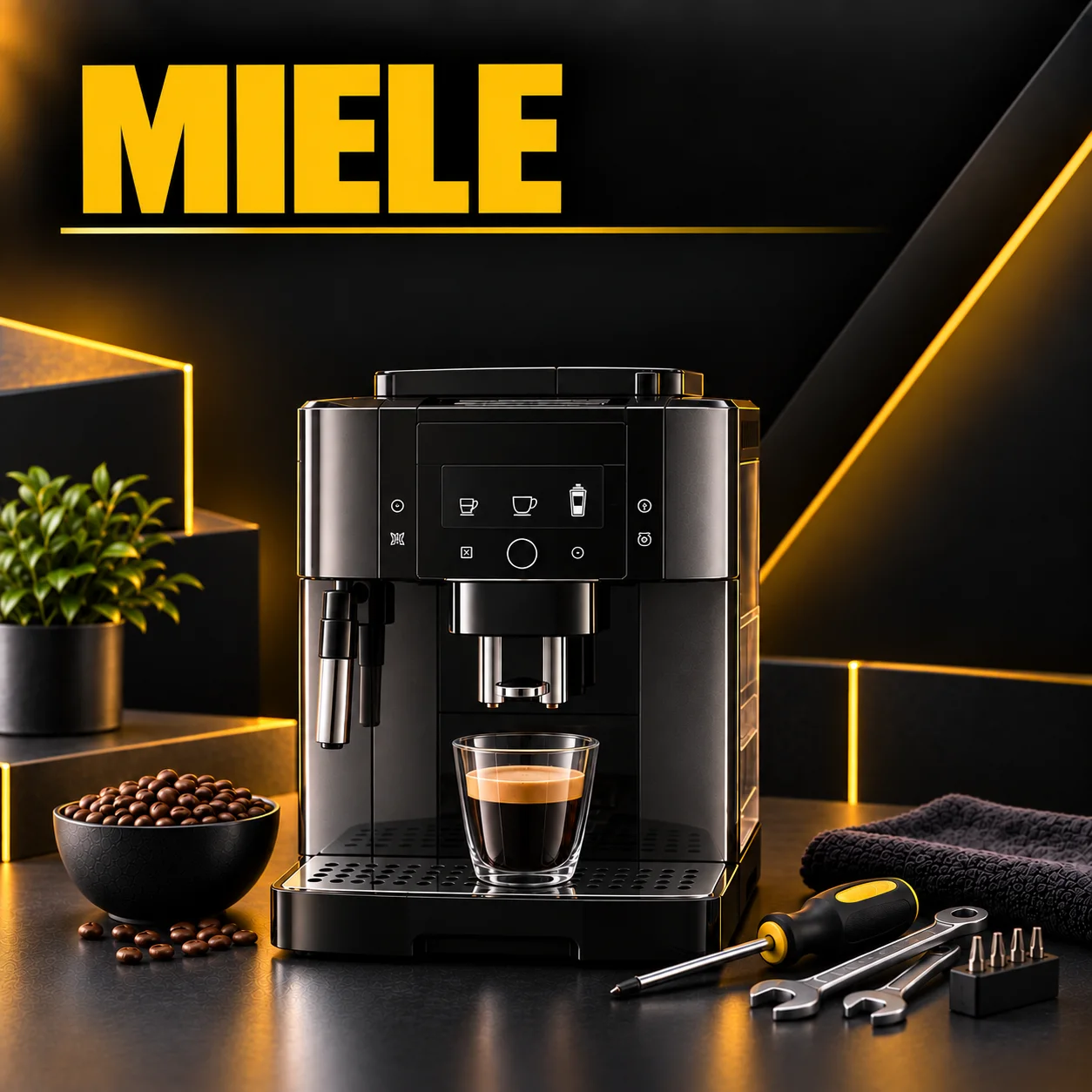
Miele fully automatic coffee machines have been offered for many years both as freestanding machines and as high-quality built-in fully automatic coffee machines. From older CVA generations through CM5, CM6 and CM7 freestanding machines to modern CVA 7000 built-in appliances, the design, equipment and individual technical components can differ considerably.
However, a technical fault or normal wear does not automatically mean that the complete fully automatic coffee machine has to be replaced. Numerous mechanical and water-carrying components can, depending on the machine generation, be replaced individually or professionally repaired.
At NEW-Kaffeevollautomaten you will find selected Miele fully automatic coffee machine spare parts for different repair areas and machine generations.
Depending on the model, components from areas such as brewing unit, grinder, pump and fluid system, seals and O-rings, ceramic and outlet valves, hoses and connectors as well as further wear and repair parts may be relevant.
Miele CM and CVA – two different machine concepts
When searching for spare parts, it is first important to distinguish between the two main Miele machine categories.
At Miele, the designation CM stands for freestanding fully automatic coffee machines. The CVA series, on the other hand, comprises built-in fully automatic coffee machines that are permanently integrated into a kitchen unit or tall-unit combination.
Both types of machine fundamentally operate with similar functional groups such as grinder, brewing unit, water pump, heating system and valve system.
However, the specific design and the components used can differ significantly.
A spare part should therefore never be selected solely on the basis of the Miele brand.
Miele CM5 – compact freestanding fully automatic coffee machines
The CM5 generation includes or has included different machines such as CM5300, CM5310, CM5500, CM5510 or CM5710.
The machines have an integrated grinder, removable brewing unit, water pump, heating system and various internal water paths.
Depending on the version, they additionally feature different functions for milk beverages.
Even within the CM5 family, the complete machine designation or specific machine version should therefore be taken into account.
Miele CM6 – additional milk and convenience functions
The CM6 series comprises various more extensively equipped freestanding fully automatic coffee machines.
Well-known model ranges include CM6100, CM6150, CM6160, CM6300, CM6350 and CM6360.
In addition to espresso and coffee, corresponding machines have more extensive milk functions and, depending on the generation, additional connectivity and convenience features.
This means that additional milk and steam-circuit components are added to the grinder, brewing unit and pump system.
Miele CM7 – high-quality freestanding machines
With the CM7 family, Miele has offered particularly extensively equipped freestanding fully automatic coffee machines.
These include models such as CM7300, CM7350, CM7500, CM7550 or CM7750.
Depending on the version, these machines have additional functions for bean selection, beverage programming, milk preparation and automatic maintenance.
Technically, this also means a more complex combination of grinder, sensors, valves, pumps, brewing unit and electronic control.
Miele CVA – built-in fully automatic coffee machines
The CVA series comprises Miele built-in fully automatic coffee machines.
These machines are permanently integrated into the kitchen environment and combine high-quality appliance fronts with the complete technology of a fully automatic coffee machine.
Several generations have been developed over the years, including CVA4xxx, CVA5xxx, CVA6xxx and CVA7xxx.
Among other things, brewing units, grinder designs, milk systems, operation and various fluid-system components differ between these generations.
Miele CVA 4xxx and CVA 5xxx
Older built-in machines from the CVA4xxx and CVA5xxx generations have in some cases already been in use for many years.
Despite their age, they may still be repairable.
Typical wear areas on older fully automatic coffee machines include seals, brewing unit, valves, pumps, hoses or grinder components.
The age of the machine alone is therefore not a sufficient reason to completely replace a built-in fully automatic coffee machine.
Miele CVA 6xxx – extensively equipped built-in machines
The next generation includes machines from the CVA6xxx series.
Well-known models include CVA6401, CVA6405, CVA6800 and CVA6805.
These machines feature, among other things, a removable brewing unit and extensive maintenance programmes.
Especially with a high-quality built-in appliance, targeted repair of individual components can be particularly attractive from an economic point of view.
Miele CVA 7xxx – modern built-in fully automatic coffee machines
The CVA7xxx generation includes modern Miele built-in fully automatic coffee machines such as CVA7440, CVA7445, CVA7840 and CVA7845 or corresponding current model variants.
These machines combine a conical grinder with extensive beverage programming, a milk system, electronic control and automated maintenance functions.
Certain versions additionally use functions such as multiple bean containers, automatic descaling or DirectWater.
The technical complexity makes the most precise possible spare-part identification particularly important.
Pay attention to the model number and material number with Miele
When searching for a spare part, the complete machine designation of the Miele fully automatic coffee machine should be determined wherever possible.
In addition, material number, rating-plate information and existing spare-part numbers can be helpful when identifying an assembly.
This is particularly important when a machine was produced over many years and individual components changed during the production period.
A spare part should therefore always be compared with the specific machine and article allocation in our Miele spare-parts section.
Miele brewing unit – central assembly for the brewing process
The brewing unit or brewing group is one of the most important mechanical components of a Miele fully automatic coffee machine.
After grinding, the ground coffee enters the brewing chamber. There it is compressed and then hot water flows through it.
After extraction, the used coffee grounds are ejected into the grounds container.
With every coffee, several mechanical components therefore move inside the brewing unit.
Miele brewing unit can be removed
On numerous Miele CM and CVA fully automatic coffee machines, the brewing unit can be removed from the machine for manual cleaning.
This is a significant difference from manufacturers where the brewing group remains permanently inside the machine.
The removable design allows coffee residues to be removed directly from the brewing unit and accessible areas inside the machine.
The exact procedure depends on the respective model and should be carried out in accordance with the Miele operating instructions.
Clean the brewing unit with water only
One technical detail is particularly important when manually cleaning the Miele brewing unit.
The moving components of the brewing unit are lubricated. Miele therefore states that the brewing unit should be cleaned by hand with warm water and without cleaning agents.
Unsuitable cleaning agents can affect the existing lubricating film.
For this reason, manual cleaning of the brewing unit should also not be confused with the automatic degreasing programme for the coffee system.
Keep the screens of the Miele brewing unit clean
Inside the brewing unit are screens through which the brewing water or finished coffee is routed.
Fine coffee particles and coffee oils can increasingly contaminate these areas with use.
If the screens become heavily clogged, the water flow can be affected.
Miele explicitly mentions a contaminated brewing unit or contaminated screens as a possible cause when no beverage or too little beverage is dispensed despite the beans having been ground.
Degreasing the brewing unit and rinsing the brewing unit are two different things
Manual cleaning under water removes loose coffee residues and contamination.
In addition, Miele fully automatic coffee machines have a maintenance programme for degreasing or cleaning the coffee-carrying areas.
Suitable cleaning tablets are used to dissolve coffee oils and coffee fats.
The two measures complement each other, but perform different tasks.
Clean o Coffee cleaning tablets for suitable Miele fully automatic coffee machines
For suitable maintenance programmes, we offer different quantities of our Clean o Coffee 2-phase cleaning tablets.
For professional repair businesses and larger requirements, for example, 480 Clean o Coffee 2-phase cleaning tablets for suitable Miele fully automatic coffee machines, 672 cleaning tablets and 960 cleaning tablets are available.
Use should be in accordance with the requirements of the respective machine and the product information.
Water in the grounds container – not automatically a defective seal
If there is an unusually large amount of water in the grounds container or the coffee grounds are noticeably wetter than usual, there can be various causes.
One possible cause may be a heavily contaminated or blocked brewing unit.
Clogged screens in particular can alter the intended water flow.
The brewing unit should therefore first be cleaned and checked before larger assemblies are replaced on suspicion.
Error F73 – check the brewing unit
On various Miele fully automatic coffee machines, F73 or error 73 may occur.
This error is related to the brewing unit or its position and mobility.
Possible causes include a contaminated brewing unit or an assembly that cannot move correctly into its home position.
Before replacing parts, it should therefore be checked whether the brewing unit can be removed, cleaned and correctly reinserted in accordance with the machine instructions.
Do not insert the brewing unit by force
A Miele brewing unit must be in the intended position so that it can be inserted correctly.
If the position of certain operating or locking elements is changed after removal, the assembly may subsequently no longer be readily insertable.
A stiff brewing group should therefore never be forced into the machine.
The correct home position should first be established in accordance with the machine instructions.
Moving parts of the brewing unit are lubricated
Miele explicitly points out that the moving parts of the brewing unit are lubricated.
This is precisely why household cleaner or washing-up liquid should not be used during normal manual cleaning.
During a professional repair, suitable lubricants may be required at designated sealing and sliding points.
However, the specific lubrication point depends on the model and assembly. A fully automatic coffee machine should not be lubricated indiscriminately in arbitrary areas.
Food-grade silicone grease for suitable repairs
For designated O-rings and sealing points, we offer our food-grade NEW-009 silicone grease in the 6 g aluminium tube.
It can be used as a sliding or assembly aid during suitable repair and installation work.
A very thin film of grease is normally sufficient.
A damaged, torn or hardened seal cannot be repaired with silicone grease and should be replaced.
100 g silicone grease for workshops and regular maintenance
For repair businesses with regular requirements, we additionally offer our 100 g tube of food-grade silicone grease.
The transparent silicone grease is intended for the installation and maintenance of suitable O-rings, seals and plastic parts.
You can find further container sizes and quantity offers in our silicone grease category.
Seals and O-rings in the Miele fully automatic coffee machine
There are numerous seals and O-rings inside a Miele fully automatic coffee machine.
Depending on the machine generation, they are used, for example, on the brewing unit, pump, hoses, valves, heater and various plug-in connections.
Seals are subjected to temperature, water, pressure, mechanical movement and ageing.
With increasing operating time, they can lose their elasticity or become mechanically damaged.
Small seal instead of complete assembly
In the event of a leak, the complete adjacent component does not automatically have to be replaced.
A small O-ring often provides the actual seal for a hose or valve connection.
If only this seal is worn, targeted replacement of the O-ring can be a considerably more sensible repair.
In the event of water loss, it should therefore always be determined as precisely as possible where the leak is actually occurring.
Ceramic valve in Miele fully automatic coffee machines
Complex ceramic valves are used in various Miele fully automatic coffee machines.
These valves distribute water or steam between different functional paths of the machine.
The precise valve surfaces work together with seals and other small components.
A leak or incorrect valve position can therefore affect coffee, hot-water or milk functions.
Seals for suitable Miele ceramic valves
For professional repair businesses, we offer seals for suitable ceramic valves from Miele, Jura, Nivona and Melitta in bulk quantities.
At the same time, the article shows that certain small spare parts can be used across different brands in technically compatible assemblies.
However, no general structural identity of the respective fully automatic coffee machines can be inferred from this.
The specific article and machine compatibility must be checked before installation.
Why ceramic valves from different brands can use similar seals
Individual supplier or standard components are sometimes used by several manufacturers or machine platforms within fully automatic coffee-machine technology.
As a result, a certain seal geometry can, for example, occur in suitable ceramic valves from Miele, Jura, Nivona or Melitta.
However, this means only that the individual component concerned may be compatible.
Valve housing, connections, drive or electronic control can nevertheless have completely different designs.
4-bar outlet valve for suitable Miele machines
Another example of a component used across several brands is the 4-bar outlet valve 66289.
The valve is used in suitable fully automatic coffee machines from different manufacturers, including Miele.
Within the fluid system, it performs a defined function relating to the water path or pressure conditions.
For professional workshops, we offer this spare part as a workshop pack of 25.
Miele pump and fluid system
The water pump transports water from the tank or, on built-in machines designed for this purpose, from the water supply through the fully automatic coffee machine.
It is only one part of the complete fluid system.
Depending on the model, the water path includes the water-tank connection, pump, flow meter, hoses, heater, valves, brewing unit and beverage outlet, among other things.
A fault in water delivery therefore does not automatically mean that the pump is defective.
Pump audible, but no water at the outlet
If the water pump can be heard operating, this only proves that the pump drive is operating.
A blockage may also be located elsewhere.
Possible causes include air in the system, a problem with the water supply, blocked water paths, limescale deposits or a valve that is not switching correctly.
If there is no water flow, the entire pump and fluid area should therefore be checked systematically.
A loud pump is not automatically worn
Vibration pumps can change their operating noise considerably when they draw in air or are not supplied with sufficient water.
A suddenly loud pump can therefore be caused, for example, by an empty water tank, air in the system or restricted water supply.
A blocked valve or heavy limescale can also influence the water flow.
The pump should therefore not be assessed solely on the basis of its noise.
Hoses and connectors in the Miele fluid system
Various hoses, lines and connectors are located between the individual assemblies.
Depending on their installation location, they transport cold water, hot water or steam.
Many plug-in connections are sealed by small O-rings.
In the event of a leak, it should therefore be checked whether the hose itself is damaged or whether only the corresponding connection seal needs to be replaced.
Miele grinder – differences between generations
The grinder grinds the coffee beans immediately before preparation.
Miele has used different grinder versions across the various CM and CVA generations.
Modern machines use conical grinders whose grind setting can be adjusted to the desired extraction.
A grinder spare part should therefore always be selected on the basis of the specific machine and grinder version.
Weak coffee does not automatically mean a worn grinder
The intensity of the coffee does not depend solely on the condition of the grinder.
The bean variety, grind setting, selected grinding quantity, brewing unit, water flow and brewing temperature also influence the result.
Before a Miele grinder is replaced, the settings and other possible causes should therefore first be checked.
Pay attention to the grinding channel and ground-coffee residues
On certain Miele machine generations, ground-coffee residues can collect around the grinding channel or powder chute.
Heavy deposits can affect the actual transport of the ground coffee.
For the fault symptom “grinder runs, but no beverage is prepared”, the grinder motor should therefore not be considered in isolation.
The brewing unit and transport of the ground coffee may also be relevant.
Foreign objects in the grinder
In addition to normal wear, foreign objects can be a cause of grinder problems.
Occasionally, small stones or other hard particles can get among the coffee beans.
A suddenly hard or blocking noise should therefore be taken seriously.
In this case, the grinder should not repeatedly continue to be operated before the cause has been checked.
Miele heater and temperature control
To provide coffee, hot water and steam at the intended temperature, the fully automatic coffee machine operates with an appropriate heating system.
The heater works together with temperature sensors and the electronic control.
A beverage that is too cold therefore does not automatically mean that the heater is defective.
Sensors, water flow, limescale deposits or settings can also influence the temperature.
Milk system in Miele fully automatic coffee machines
Many Miele CM and CVA machines enable the automatic preparation of cappuccino, latte macchiato and other milk beverages.
For this purpose, milk lines, connections and other components are connected to the central beverage outlet.
Milk contains fat and protein and can therefore leave residues particularly inside thin lines.
The milk system should be cleaned regularly in accordance with the Miele maintenance instructions.
Poor milk foam – often a cleaning issue first
If a Miele fully automatic coffee machine no longer produces good milk foam, a technical component does not automatically have to be defective.
Possible causes are milk residues, contaminated lines, blocked air paths or incorrectly assembled milk components.
Thorough cleaning is therefore a sensible first step.
For suitable milk-carrying components, we offer our Clean o Coffee milk-system cleaner 250 ml.
Additionally clean milk hoses mechanically
Residues can become lodged particularly in narrow milk lines.
In addition to a suitable milk-system cleaner, mechanical cleaning can be useful.
For this purpose, for example, we offer our cleaning brush for milk suction hoses.
Disassembly or dismantling of the respective milk system should always be carried out in accordance with the requirements of the specific machine.
Descaling a Miele fully automatic coffee machine
When drinking water is heated, mineral limescale deposits can form inside the fluid system.
How quickly this happens depends particularly on the hardness of the water used and water consumption.
Miele fully automatic coffee machines therefore have corresponding descaling programmes and guide the user through the procedure via the display.
The programme should be completed fully in accordance with the operating instructions.
CM and CVA can have different descaling procedures
The exact descaling procedure is model-dependent with Miele.
Between freestanding machines from the CM family and built-in appliances from the CVA series, the required amount of water, quantity of descaling agent and programme steps can differ, for example.
A general procedure should therefore not be applied to all Miele models.
The instructions for the specific machine generation are always decisive.
Descaling tablets for suitable Miele machines
For corresponding applications, we offer 30 descaling tablets of 18 g each in flowpacks for suitable Miele fully automatic coffee machines.
The tablets are dissolved in water before use in accordance with the product information.
The actual descaling programme then depends on the respective operating instructions.
Cleaning tablets and descaling tablets should not be confused, as they treat chemically different types of deposits.
AutoDescale on certain Miele built-in machines
Certain high-specification Miele CVA machines have an automated descaling system.
A special descaling cartridge is used here and part of the descaling process is carried out automatically by the machine.
This concept differs from classic manual descaling via the water tank.
Especially with modern CVA machines, it should therefore always be checked which maintenance concept is used by the specific version.
AutoCleaner and automatic cleaning on certain machines
Different cleaning systems also exist depending on the machine equipment.
Certain models use automated cleaning solutions, while other machines use classic cleaning tablets and a guided maintenance programme.
The maintenance products used should therefore not be interchanged between different machine generations without checking them first.
The respective operating instructions and the requirements of the specific machine are decisive.
Coffee oils, limescale and milk residues are three different problems
For technically appropriate maintenance, different types of deposits should be distinguished.
Coffee oils and coffee fats occur in the coffee-carrying system and are treated with suitable cleaning tablets.
Limescale originates from minerals in the water used and is removed with a suitable descaling agent.
Milk residues occur in the milk system and require cleaning specifically designed for them.
You can find further suitable products in our care products category for fully automatic coffee machines.
Typical fault: Miele grinds, but no coffee comes out
If the grinder operates but no beverage is dispensed, the grinder itself does not necessarily have to be defective.
One possible cause may be a contaminated or blocked brewing unit.
Heavily clogged screens can also obstruct the water flow through the ground coffee.
The brewing unit should therefore first be checked and cleaned in accordance with the machine instructions.
Typical fault: water in the grounds container
Very wet coffee grounds or visible water in the grounds container can have various causes.
One possible cause is a contaminated brewing unit or a clogged screen.
Depending on the fault symptom, seals or other components of the brewing-water path can also be involved.
The cause should therefore be narrowed down as precisely as possible before larger assemblies are replaced.
Typical fault: brewing unit cannot be removed
If the brewing unit cannot be removed, it may be outside the intended home position.
In this case, the handle should not be pulled by force.
Depending on the machine generation, it may be necessary to switch the machine on or off correctly so that the internal drive moves the brewing group back into its starting position.
The specific procedure depends on the respective Miele instructions.
Typical fault: error F73
On corresponding machines, Miele error F73 or error 73 is related to the position or mobility of the brewing unit.
Possible causes can include contamination or an incorrect home position.
The brewing unit should therefore be checked and cleaned in accordance with the manufacturer's instructions.
If the error persists, more in-depth technical diagnosis of the brewing unit, drive or sensors may be necessary.
Typical fault: Miele loses water
Water underneath or inside the fully automatic coffee machine can originate from very different areas.
Possible causes include hoses, plug-in connectors, seals, pump, valves, heater or brewing unit.
For diagnosis, particular attention should be paid to when the water loss occurs.
If water escapes only during brewing, different components may be affected than in the case of permanent water loss immediately after filling the water tank.
Typical fault: a lot of water in the drip tray
A certain amount of water in the drip tray is normal for a fully automatic coffee machine.
Rinsing, pressure-relief and cleaning processes deliberately direct water into the tray.
The behaviour becomes particularly noticeable if the amount of water suddenly increases significantly while less beverage reaches the cup at the same time.
In this case, the valves, brewing unit, seals or other fluid-system components may be relevant, among other things.
Typical fault: pump loud, but hardly any water
A loud water pump can indicate air in the system or restricted water supply.
Limescale deposits, valve problems or other blockages in the water path can also play a role.
The Miele pump should therefore not be replaced on suspicion without further diagnosis.
Typical fault: coffee only comes out drop by drop
A very slow coffee flow can have various causes.
Possible factors include coffee ground too finely, contaminated brewing-unit screens, restricted water paths or limescale.
Weaker water delivery can also influence the flow rate.
The grinder, brewing unit and fluid system should therefore be assessed together.
Typical fault: coffee suddenly tastes weaker
A changed coffee result is not automatically a grinder fault.
In addition to grind setting and bean variety, the selected coffee quantity, brewing unit, water flow and brewing temperature can also influence the result.
The grinder should therefore only be replaced after a technically understandable diagnosis.
Typical fault: no milk foam
If coffee preparation continues to work normally while the milk function fails, troubleshooting can already be narrowed down to a smaller technical area.
The milk line, connection, air supply and beverage outlet should first be cleaned and checked thoroughly.
For suitable applications, milk-system cleaner and a brush for milk hoses can be helpful.
Typical fault: coffee remains too cold
A beverage temperature that is too low can have different causes.
In addition to the heating system itself, temperature sensors, water flow, limescale or machine settings can be responsible.
A heater should therefore not be replaced solely because of a subjectively lower temperature.
The cause should be narrowed down technically wherever possible.
Descaling a Miele fully automatic coffee machine correctly
On corresponding models, the machine guides the user through the required descaling procedure via messages on the display.
The procedure differs depending on the CM or CVA machine generation.
It is important to complete the started maintenance programme fully and to observe the specified concentration of the descaling agent.
Self-mixed household remedies should be avoided because material compatibility and the required concentration depend on the specific machine.
Why water hardness is important for Miele fully automatic coffee machines
The rate of limescale formation depends largely on the mineral content or hardness of the water used.
With harder water, more limescale-forming minerals pass through the fully automatic coffee machine.
Deposits can therefore form more quickly, particularly in heated and narrow water-carrying areas.
The water-hardness setting or the respective maintenance concept of the machine should therefore be configured correctly.
Repair the Miele built-in appliance instead of adapting the complete kitchen
With a built-in fully automatic coffee machine, repairing an individual component is often particularly attractive.
A CVA machine is visually and structurally integrated into the kitchen.
Complete replacement may therefore affect not only the fully automatic coffee machine itself, but also installation dimensions, appliance front and design combination.
If only a replaceable valve, seal, pump or other individual component is defective, targeted repair can therefore be considerably more sensible.
Older Miele CVA machines can also remain repairable
High-quality built-in appliances in particular are often used for many years.
An older CVA4xxx, CVA5xxx or CVA6xxx machine therefore does not automatically have to be replaced when an individual technical fault occurs.
Typical wear parts from the areas of seals, valves, fluid system or brewing unit can still make repair possible.
The overall condition, spare-part availability and specific repair effort are decisive.
Miele original part or compatible spare part
Depending on the component, original spare parts or suitable compatible repair components may be available for repairs.
At NEW-Kaffeevollautomaten, we offer, among other things, compatible wear and maintenance components for designated Miele applications.
One example is our seals for suitable Miele ceramic valves.
The specific technical compatibility is always decisive, not merely the brand designation.
Do not select spare parts solely on the basis of the product photo
Many valves, seals and other components look very similar externally.
Technically, however, the dimensions, material, connections, electrical design or internal function can differ.
A spare part should therefore be selected on the basis of the machine designation, existing part number and specific product description.
A visual comparison can be helpful, but does not replace a compatibility check.
Repair instead of unnecessarily replacing large assemblies
Precise fault diagnosis can prevent technically fault-free components from being replaced unnecessarily.
If, for example, only a small seal on a valve is damaged, the complete valve may not have to be replaced.
For precisely such professional repairs, we offer, for example, ceramic-valve seals in corresponding workshop quantities.
This type of targeted repair is an important part of our spare-parts range.
Miele spare parts for repair businesses
Miele fully automatic coffee machines are repaired both by private users and by specialised service and repair businesses.
For workshops, regularly required seals, valve components and care products are particularly relevant.
For various articles, NEW-Kaffeevollautomaten therefore offers larger packaging units for professional requirements.
You can find further offers in our bulk discount category.
Ceramic-valve seals in professional quantities
A typical workshop article is small seals that are regularly required during repairs.
For high requirements, we offer, for example, 1,000 seals for suitable ceramic valves from Miele, Jura, Nivona and Melitta.
Such quantities are particularly intended for repair businesses, service centres and resellers.
Outlet valves as workshop quantities
The set of 25 4-bar outlet valves 66289 is also intended for corresponding professional applications.
Especially with a component used across several brands, a larger stock quantity can be useful for workshops.
Before every installation, the specific machine and assembly compatibility must of course be checked.
Care products for professional maintenance
Professional maintenance does not consist solely of replacing technical spare parts.
The brewing unit, coffee path, water paths and milk system must also be maintained accordingly.
For this purpose, we offer, for example, 480 cleaning tablets, 960 cleaning tablets, descaling tablets and various products for milk-system maintenance.
Safety when repairing Miele fully automatic coffee machines
A fully automatic coffee machine combines mains voltage, hot water, heating systems, moving mechanical parts and in some cases pressurised water lines.
Before opening the machine, it must be completely disconnected from the mains supply.
On correspondingly equipped built-in appliances with a direct water supply, the water supply must additionally be taken into account professionally.
Hot components must be allowed to cool sufficiently before work is carried out.
Work on electronics, mains voltage and safety-relevant components should only be carried out by appropriately qualified persons.
How to find the correct Miele spare part
1. Determine CM or CVA
First check whether the machine is a freestanding CM fully automatic coffee machine or a CVA built-in appliance.
2. Determine the complete model designation
Determine the exact machine designation, for example CM5310, CM6160, CM6360, CM7350, CVA6800, CVA7440 or CVA7845.
3. Take the machine generation into account
A CM5 brewing unit is not automatically identical to a brewing unit from CM6, CM7 or CVA7000.
4. Narrow down the fault area as precisely as possible
Distinguish between problems with the brewing unit, grinder, pump, fluid system, valves, heating, milk system or electronics.
5. Check the maintenance condition
Check whether the brewing unit, screens, milk system and water paths have been cleaned or descaled in accordance with the manufacturer's specifications.
6. Compare the existing part number
If the defective component has already been removed, manufacturer markings and material numbers can help with identification.
7. Check product compatibility
The allocation for the respective article is decisive. A spare part that looks similar should not be used without clear technical allocation.
Frequently asked questions about Miele fully automatic coffee machine spare parts
Which Miele spare parts are available from NEW-Kaffeevollautomaten?
Our currently available Miele fully automatic coffee machine spare parts include, depending on the model, repair and wear parts from different technical areas.
What is the difference between Miele CM and CVA?
CM refers to freestanding Miele fully automatic coffee machines. CVA refers to built-in fully automatic coffee machines that are integrated into a kitchen unit or tall cabinet.
Can the Miele brewing unit be removed?
On numerous CM and CVA machines, the brewing unit is removable and can be cleaned by hand. The exact procedure depends on the respective machine generation.
How do you clean a Miele brewing unit?
On corresponding machines, Miele specifies rinsing the brewing unit by hand with warm water without cleaning agents. The moving parts are lubricated and should not be degreased by unsuitable cleaning agents.
Can the Miele brewing unit go in the dishwasher?
The brewing unit should be cleaned by hand in accordance with Miele's maintenance instructions. For other removable components, Miele may provide ComfortClean or dishwasher suitability depending on the model, but this does not automatically apply to the brewing unit.
Why can my Miele brewing unit not be removed?
It may not be in the intended home position. The brewing unit should not be pulled out by force. Depending on the model, the machine may first need to be correctly switched on or off or the procedure described by the manufacturer must be carried out.
What does Miele error F73 mean?
Error F73 or error 73 can indicate a problem with the position, mobility or contamination of the brewing unit. The brewing unit should first be checked and cleaned in accordance with the machine instructions.
Why does my Miele fully automatic coffee machine grind, but no coffee comes out?
One possible cause is a contaminated or blocked brewing unit. Clogged screens can also impair the water flow. The grinder itself therefore does not necessarily have to be defective.
Why is there water in the Miele grounds container?
Heavily contaminated screens or a contaminated brewing unit can contribute to unusually wet coffee grounds. Depending on the fault symptom, additional sealing or fluid problems are also possible.
Which silicone grease is suitable for appropriate Miele seals?
For designated repair and sealing points, we offer our food-grade NEW-009 silicone grease. It should only be used in a thin layer and at suitable points.
Does every Miele brewing unit have to be lubricated regularly?
No. This should not be assumed generally for every model. Normal maintenance and cleaning depend on the information in the respective Miele operating instructions. Silicone grease is only used at designated sealing and sliding points or during corresponding repair work.
Why is my Miele fully automatic coffee machine losing water?
Possible causes include seals, hoses, pump, valves, heater, brewing unit or other fluid-system components. The actual leakage point should be located as precisely as possible.
Can a small ceramic-valve seal be the cause?
On suitable valve versions, small seals can be decisive for sealing. For professional repairs, we offer, for example, seals for suitable Miele ceramic valves.
Why does my Miele machine pump, but no water comes out?
In addition to a worn pump, air in the system, blocked water paths, limescale, valves or other fluid components may be the cause. The entire water path should therefore be checked.
Why has my Miele water pump suddenly become very loud?
A pump can operate considerably more loudly when it draws in air or is not supplied with sufficient water. Blockages in the subsequent water path can also influence the operating noise.
When does a Miele fully automatic coffee machine need to be descaled?
This depends on the machine generation, water hardness, consumption and, where applicable, automatic descaling. On corresponding models, the machine guides the user through the required maintenance procedure via the display.
Are cleaning tablets and descaling tablets the same?
No. Cleaning tablets are used particularly for coffee oils and coffee fats. Descaling tablets are intended for mineral limescale deposits in the water system.
Which descaling tablets are available from NEW-Kaffeevollautomaten?
For suitable machines, for example, we offer 30 descaling tablets of 18 g each in flowpacks. The specific descaling programme depends on the respective Miele model.
Which cleaning tablets are available for larger requirements?
For professional users, we offer, for example, 480, 672 or 960 Clean o Coffee 2-phase cleaning tablets for corresponding compatible applications.
How do you clean the Miele milk system?
The exact maintenance procedure depends on the model. For thorough cleaning of suitable milk-carrying components, we offer our Clean o Coffee milk-system cleaner and a brush for milk hoses.
Can an outlet valve be used across several brands?
Yes. Certain standard or supplier components can be used across several brands. One example is the 4-bar outlet valve 66289. However, the actual machine compatibility must always be checked.
Is it worthwhile repairing an older Miele CVA fully automatic coffee machine?
This depends on the overall condition and specific defect. Especially with a high-quality built-in appliance, replacing individual wear or fluid-system components can still make economic sense.
Are Miele spare parts and care products available for workshops?
Yes. In addition to individual articles, we offer various bulk quantities, for example 1,000 ceramic-valve seals, 25 outlet valves and larger quantities of cleaning and descaling products.
Where can I find spare parts for my Miele fully automatic coffee machine?
You can find all currently available products in our Miele fully automatic coffee machine spare-parts category at NEW-Kaffeevollautomaten.
Miele fully automatic coffee machine spare parts at NEW-Kaffeevollautomaten
For many years, Miele has offered both freestanding CM fully automatic coffee machines and high-quality CVA built-in appliances. From CM5 through CM6 and CM7 to the different CVA generations, different technical assemblies and development stages are used.
At NEW-Kaffeevollautomaten you will find selected Miele fully automatic coffee machine spare parts for different repair areas.
Depending on the machine version, these include components from areas such as brewing unit, grinder, pump and fluid system, seals and valves as well as further repair and maintenance components.
For suitable valve repairs, for example, we offer seals for Miele ceramic valves as well as the 4-bar outlet valve 66289 for suitable machines.
For maintenance and assembly work on designated sealing points, you can also obtain our food-grade NEW-009 silicone grease.
You will also find care products for cleaning coffee-carrying areas, descaling and milk-system maintenance in our range.
For spare-part identification with Miele, the following is particularly important: determine the CM or CVA machine family, identify the complete model, take the machine generation into account, check the fault area and maintenance condition and then compare the specific article compatibility.
You can find all currently available products directly in our Miele fully automatic coffee machine spare-parts category.