
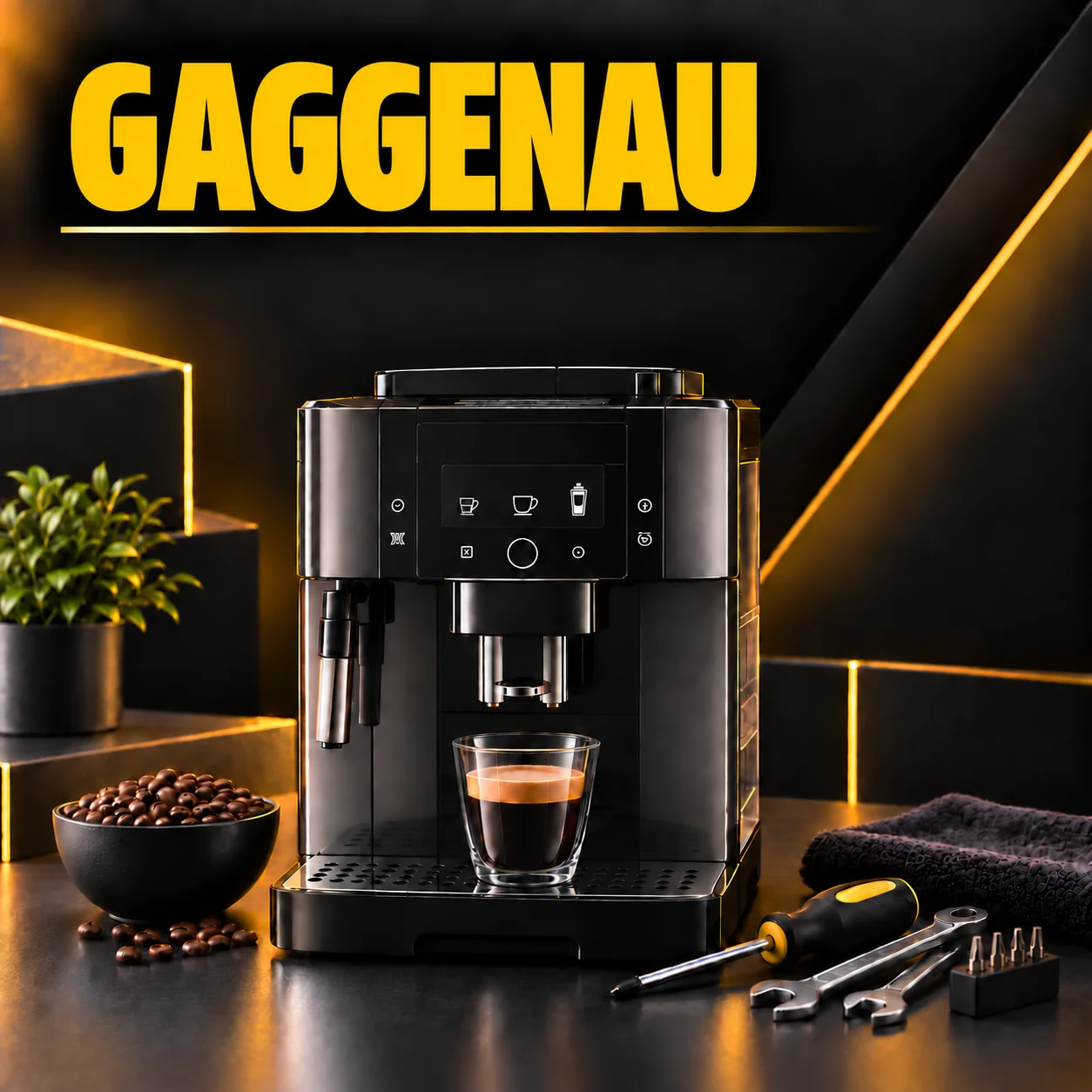
Gaggenau fully automatic coffee machines differ from many conventional freestanding machines in one important respect: a large proportion of the models are designed as high-quality built-in fully automatic coffee machines and are permanently integrated into the kitchen units. Behind the appliance front, however, the typical assemblies of a fully automatic machine are at work – grinder, brewing system, water pump, heater, valves, sensors and a complex fluid system.
Even in a high-quality built-in appliance, individual components can wear over the course of their service life. A fault therefore does not automatically mean that the complete fully automatic coffee machine has to be replaced. At NEW-Kaffeevollautomaten you will find selected Gaggenau fully automatic coffee machine spare parts for various machine generations.
Our current Gaggenau range focuses particularly on areas such as pump and fluid system, grinder as well as food-grade silicone grease for suitable sealing and maintenance work.
One specific example is our ULKA EP4 GW water pump with 230 V and 48 W, which according to our machine allocation can be used in various Gaggenau CM450 and CMP250 built-in fully automatic coffee machines, among others.
Gaggenau fully automatic coffee machines – built-in appliances with complex technology
Gaggenau is particularly well known for high-quality built-in appliances. This concept is also consistently applied to its fully automatic coffee machines.
The appliance largely disappears into the kitchen front, while the actual coffee-machine technology operates inside the built-in housing.
A Gaggenau fully automatic coffee machine combines, among other things, grinder, brewing unit, water pump, flow-through heater, valve system, coffee outlet, milk system, sensors and electronics.
This combination can result in very different possible fault patterns. A problem with coffee dispensing, for example, does not necessarily have to be caused by the grinder. Likewise, poor water flow does not automatically mean that the pump is defective.
The most precise possible diagnosis is therefore the basis for selecting the correct Gaggenau spare part.
Series 200 and Series 400 from Gaggenau
With newer Gaggenau built-in fully automatic coffee machines, the designations Series 200 and Series 400 are particularly common.
Well-known models include machines from the CMP250, CM450 and CM470 series, for example.
The exact version is supplemented by further digits and a version index. This results in complete machine designations such as CM450110/09 or CMP250110/09.
This complete designation in particular is significantly more informative when searching for spare parts than simply “Gaggenau Series 400”.
Gaggenau Series 200 fully automatic coffee machines
The Series 200 includes various built-in fully automatic coffee machines, including machines from the CMP250 family.
Despite the compact built-in concept, all essential functional groups of a modern fully automatic machine are located inside.
Coffee beans are ground in the integrated grinder, the ground coffee is processed within the brewing system and the water is routed through the heater, valves and other components with the aid of a pump.
Depending on the selected beverage, hot-water and milk functions are also used.
Gaggenau Series 400 CM450
The Gaggenau CM450 is one of the Series 400 built-in fully automatic coffee machines.
Different versions and production stages exist within this model family. Examples include CM450100, CM450102, CM450110, CM450112 and further variants.
The version or production index is additionally located after the slash.
When searching for spare parts, you should therefore not search only for “CM450”, for example, but for the complete designation such as CM450110/09.
Gaggenau CM470 – Series 400 with mains water connection
Another version of the Series 400 is the Gaggenau CM470.
This machine generation differs from the CM450, among other things, in its water connection. Corresponding CM470 versions are designed for a permanent water supply or mains water connection.
This also changes the technical environment of the water system.
For spare parts relating to water supply, pumps, valves and fluid system, particular care must therefore be taken to determine which machine version the component is intended for.
Older Gaggenau CM200 and CM210 fully automatic coffee machines
In addition to newer series, numerous older Gaggenau fully automatic coffee machines are still in use.
These include models such as CM200110, CM200130, CM200610, CM200630, CM210110, CM210130 and CM210710.
These machines are based on older technical platforms and differ significantly from current CM450, CM470 or CMP250 machines.
Despite their age, repair options are still available for various components.
One specific example from our range is the 115 °C / 10 A 1NT01L thermostat for the water pump, which according to our machine allocation is used in various older Gaggenau CM200 and CM210 models, among others.
The complete E-number is crucial for Gaggenau
Gaggenau – like other brands within the BSH appliance world – uses a so-called E-number or E-No. for unique machine identification.
It consists of the model designation and often an additional version index after the slash.
Examples are CM450110/09, CM470101/04 or CMP250102/05.
This index should not be ignored. During a longer production period, components can be changed or replaced by newer versions.
The complete E-number is therefore one of the most important pieces of information when searching for Gaggenau fully automatic coffee machine spare parts.
Where can the Gaggenau E-number be found?
The E-number can be found on the appliance's rating plate.
On a built-in fully automatic coffee machine, its position may differ from that on a freestanding appliance. Depending on the model and design, the rating plate is located within an accessible area of the appliance.
In addition to the E-number, further information such as the FD number and serial number may be present.
For spare-part identification, the complete E-No. should be copied as accurately as possible.
Gaggenau, Bosch, Siemens and Neff – understanding technical overlaps
Gaggenau, together with Bosch and Siemens home appliances, belongs to the BSH appliance world. Various fully automatic coffee machines therefore use technical platforms and components across several brands.
A spare part may therefore, for example, be offered under a Bosch or Siemens designation and still be suitable for certain Gaggenau machines.
However, this does not mean that every Bosch or Siemens spare part automatically fits a Gaggenau fully automatic coffee machine.
The specific E-number and product allocation are always decisive.
A good example: ULKA EP4 GW water pump
A particularly clear example of this technical overlap is our ULKA EP4 GW water pump with 230 V, 48 W and 50 Hz.
The product is listed in our shop for various Bosch, Siemens and Neff machines, among others.
At the same time, according to our compatibility list, the pump is also intended for various Gaggenau machines, including:
CM450110/09, CM450130/09, CM450100/09, CMP250100/09, CMP250110/09 and CMP250130/09.
This is precisely why a spare part should not be assessed solely by which brand name appears prominently in the product title.
The actual technical compatibility is decisive.
Water pump – central component of the Gaggenau fluid system
The water pump has the task of transporting water through the fully automatic coffee machine at the required delivery pressure.
However, it is only one part of the complete fluid system.
Depending on the machine model, the water path includes, among other things, water tank or mains water supply, pump, pressure hoses, flow-through heater, valves, brewing system and beverage outlet.
A fault in one of these components can therefore cause symptoms similar to those of a weak or defective pump.
ULKA EP4 GW – do not simply install any pump
Even if vibration pumps look similar externally, they differ in their technical characteristics and connections.
Our ULKA EP4 GW water pump operates at 230 volts and 48 watts at 50 Hz.
When replacing it, not only the electrical version but also the connections, installation position and specific machine compatibility should be taken into account.
A visually similar pump is not automatically a suitable replacement.
When the Gaggenau water pump becomes loud
A noticeably louder pump does not necessarily have to be defective.
A vibration pump changes its operating noise, for example, when it draws in air instead of water or operates against a severely restricted water path.
Possible causes include air in the fluid system, no water supply, a blocked water path, limescale deposits or a valve that is not switching correctly.
The water pump should therefore not be replaced solely because of its noise.
Pump runs, but no water comes through
This fault pattern can also have several causes.
If the pump can be heard operating, this merely means that the pump drive is active. It does not prove that water can flow freely through the entire appliance.
Components to check include water supply, hoses, flow-through heater, valves and possible blockages.
Severe limescale can additionally restrict water-carrying cross-sections.
Only after these possible causes have been checked can it be assessed whether a new ULKA EP4 GW pump is actually necessary.
Thermostat on the pump – small safety component
On various older fully automatic coffee machines, a thermostat is fitted on or in the immediate vicinity of the pump.
This component provides thermal protection and can interrupt the electrical circuit in the event of overload or excessive temperature.
A corresponding product from our range is the 115 °C / 10 A 1NT01L thermostat.
It is used in suitable older Gaggenau fully automatic coffee machines such as CM200110, CM200130, CM200610, CM200630, CM210110, CM210130 and CM210710.
Defective pump thermostat or defective water pump?
If the water pump does not function, the complete pump should not automatically be replaced.
Depending on the machine, the thermostat, electrical supply line, control system or other safety components can also influence the power supply.
On older compatible machines, the 1NT01L pump thermostat may therefore also form part of the troubleshooting process.
Work on the electrical system of a fully automatic coffee machine should only be carried out by appropriately qualified persons.
Gaggenau fluid system – the complete path of the water
The term fluid system describes much more than just the water pump.
It includes all water-carrying components of the fully automatic coffee machine.
Depending on the machine, these may include water supply, flow meter, pump, pressure hoses, flow-through heater, valves, brewing unit, hot-water outlet and milk system.
In the event of a water problem, it therefore makes sense to examine the complete path from the water inlet to the beverage outlet.
CM470 with mains water – special diagnostic requirements
Corresponding CM470 models additionally have a permanent water connection.
This means the water supply differs from that of a fully automatic coffee machine supplied exclusively via a removable water tank.
In the event of a fault, it must therefore also be checked, for example, whether the required water supply is present and whether upstream components are functioning correctly.
A lack of water flow does not automatically indicate a defect in the internal pump or a valve here either.
Hoses and connections under pressure
Inside a built-in fully automatic coffee machine, water is transported between the assemblies through various lines.
Some of these connections are under pressure during operation and must at the same time withstand elevated temperatures.
Leaks can therefore be caused by hoses, plug-in connectors or their seals.
If water leaks inside the machine, the exact point should be located before the pump, valve or other larger components are replaced on suspicion.
Gaggenau grinder – freshly ground coffee for every beverage
The grinder of the Gaggenau fully automatic coffee machine grinds the coffee beans immediately before preparation.
For every beverage, it must produce a grinding quantity and particle size that are as reproducible as possible.
Grinders are therefore among the mechanically heavily stressed assemblies.
As operating time increases, the grinding surfaces can change. However, a change in the coffee result does not automatically mean that the grinder is worn.
Poor coffee does not automatically mean a grinder defect
Flavour and extraction are influenced by several factors.
These include coffee beans, grind setting, selected coffee strength, actual grinding quantity, brewing system, brewing temperature and water flow.
Before the Gaggenau grinder is replaced, it should therefore be checked whether mechanical wear is actually present.
Systematic diagnosis reduces unnecessary replacement of expensive assemblies.
Grinder makes unusual noises
Unusual grinding noises can be caused by normal wear, but may also have another cause.
Occasionally, foreign objects can be present among the coffee beans and block the grinder.
Hardened deposits or mechanical damage can also cause noises.
If a clearly blocking noise occurs, the machine should not repeatedly be restarted because this can place additional stress on other components.
Assess grind setting and grinding quantity together
The grind setting influences the resistance of the coffee puck during extraction.
Very coarse ground coffee allows water to pass through more quickly, while very fine ground coffee can restrict the water flow more strongly.
The actual grinding quantity also has a considerable influence on the result.
A repair to the grinder therefore only makes sense once the setting, beans and other causes have been taken into account.
Brewing unit – ground coffee becomes coffee
After grinding, the coffee powder enters the brewing unit.
There it is compressed into a coffee puck and hot water flows through it.
The brewing unit contains moving components and sealing points that are subjected to stress with every coffee.
The specific design differs depending on the respective Gaggenau machine generation.
As our current Gaggenau section is specifically focused on the spare parts currently available for these machines, the specific E-number and availability should always be checked for assemblies that are not listed.
Gaggenau, Bosch and Siemens – same technical basis does not mean the same machine
Some Gaggenau built-in fully automatic coffee machines are technically closely related to certain Bosch and Siemens machine platforms.
Individual components can therefore be used across several brands.
Our ULKA EP4 GW water pump is a very good example of this.
It is listed in the product title for Bosch, Siemens and Neff, but according to the compatibility list is also suitable for various Gaggenau CM450 and CMP250 machines.
The decisive factor is therefore not the brand name in the title, but the actually verified machine allocation.
Why the same pump can occur in several brands
Manufacturer platforms are not necessarily developed completely from scratch for every brand.
Certain technical components can be identical across different machine and brand variants.
From a spare-parts perspective, this is an advantage: proven pumps, valves or other components can remain available across several machine families.
For the buyer, however, this means that a spare part should not be selected solely on the basis of the brand logo.
The E-No. and the specific compatibility list are considerably more reliable.
Gaggenau flow-through heater and water temperature
For coffee preparation, water must be brought to a defined temperature.
Newer Gaggenau built-in fully automatic coffee machines use powerful flow-through heaters or heating systems for this purpose.
However, a problem with beverage temperature does not automatically mean that the heater is defective.
Temperature sensors, water flow, limescale or electronic control can also influence the result.
A technical diagnosis should therefore be carried out before larger assemblies are replaced.
Valves distribute water, steam and hot water
A modern built-in fully automatic coffee machine must distribute water between several functions.
In addition to the normal brewing process, hot water and, on machines with a milk function, steam or hot steam are available, for example.
Different valves are used for this purpose.
A blocked or incorrectly switching valve can therefore result in water not reaching the intended outlet even though the pump is technically functioning.
Ceramic valves on related BSH machine platforms
Ceramic valves or complex distribution valves are used on various modern BSH coffee-machine platforms.
They distribute water and steam precisely between different functional paths.
The specific machine generation must be taken into account when selecting spare parts.
A valve assembly that looks similar externally can differ internally or at the connections.
Milk system on Gaggenau built-in fully automatic coffee machines
Many Gaggenau fully automatic machines can automatically prepare cappuccino, latte macchiato and other milk beverages.
Depending on the model, milk container, milk hose, air supply and further components are connected to one another for this purpose.
Milk contains fat and protein. Residues can therefore remain particularly in narrow lines and nozzles.
The milk system should be cleaned regularly in accordance with the appliance's care instructions.
You can find suitable cleaning products in our care products category for fully automatic coffee machines.
Poor milk foam – do not immediately buy spare parts
If the milk foam suddenly becomes worse, a technical component does not automatically have to be defective.
In many cases, milk residues, blocked air paths, contaminated connections or an incorrectly inserted milk hose can influence the result.
The complete milk system should therefore first be cleaned and checked.
Only if maintenance does not resolve the problem does further technical diagnosis make sense.
Silicone grease when repairing and installing seals
On suitable O-rings and moving sealing points, a thin lubricating film can make installation easier.
For this purpose, we offer our food-grade silicone grease in the 6 g aluminium tube.
The transparent silicone grease is suitable for designated sealing and sliding points on fully automatic coffee machines and is applied only in a thin layer.
A damaged seal cannot be repaired with silicone grease.
If an O-ring is torn, deformed or hardened, the corresponding seal must be replaced.
6 g silicone grease for individual maintenance and repairs
For occasional maintenance work, a small amount of lubricant is often sufficient.
Our 6 g tube of food-grade silicone grease is therefore particularly suitable for individual repairs and private or smaller workshop requirements.
As O-rings are normally only greased very thinly, even a small tube is sufficient for numerous sealing points.
100 g silicone grease for workshops and regular requirements
For repair businesses or users with regularly higher consumption, our 100 g tube of food-grade silicone grease is additionally available.
The silicone grease is transparent, odourless and tasteless and is intended for installing and maintaining suitable seals.
You can find further quantities and packaging units in our silicone grease category.
Why silicone grease is used only very sparingly
When lubricating an O-ring, “more is better” does not apply.
A thin, even film is normally sufficient at suitable sealing points to reduce friction during installation and movement.
Large quantities of grease provide no additional benefit and can spread unnecessarily onto adjacent components.
The food-grade silicone grease should therefore be used sparingly.
Typical fault: Gaggenau fully automatic coffee machine does not deliver water
If no water is delivered, several causes are possible.
Possible causes include water supply, pump, air in the system, valve, limescale or another blockage in the fluid system.
On suitable CM450 and CMP250 models, the ULKA EP4 GW pump may be a relevant component.
Before it is replaced, however, it should be determined wherever possible whether the pump is actually the cause.
Typical fault: pump remains completely silent
If no pump noise can be heard at all, either the pump itself or its electrical supply may be affected.
On older compatible Gaggenau machines, for example, the 115 °C / 10 A 1NT01L thermostat in the pump area may also play a role.
Electronics, wiring or further safety elements may also be involved.
Electrical measurements should only be carried out by appropriately qualified persons.
Typical fault: Gaggenau loses water
Water inside the appliance can originate from different points.
Possible causes include hoses, plug-in connections, O-rings, pump, heater, valves or other parts of the fluid system.
For diagnosis, it is important to observe when the water loss occurs.
If the water escapes exclusively during coffee or hot-water dispensing, for example, the affected water path can often be narrowed down further.
Typical fault: coffee flows only slowly
A slow coffee outlet does not necessarily have to be caused by the water pump.
Very fine ground coffee, deposits in the brewing system, restricted water paths or valve problems can also reduce the flow.
The grinder and pump or fluid system should therefore be considered together.
Typical fault: coffee becomes too weak
If the coffee suddenly becomes significantly weaker, the grinding quantity and grind setting can play a role.
Changes in the beans used can also influence the result.
Only once these factors have been ruled out should possible wear of the Gaggenau grinder be investigated more closely.
Typical fault: unusual noises during grinding
An unusual noise can indicate mechanical wear or a foreign object.
If there is a severe blocking noise, the grinding process should not be repeatedly forced.
This could place additional stress on the motor, gearbox or other grinder components.
A professional inspection of the grinder is advisable in this case.
Typical fault: beverage does not become properly hot
A beverage temperature that is too low can have several causes.
In addition to the heating system, temperature measurement, water flow, limescale or machine settings can play a role.
A flow-through heater should therefore not be replaced on suspicion without diagnosis.
A restricted water path can also influence the temperature behaviour of a fully automatic coffee machine.
Typical fault: no hot water or steam
If coffee continues to work but hot water or steam no longer functions, this is an important indication for diagnosis.
In this case, valves, the heating system or the corresponding water or steam path may be affected, for example.
The fact that the pump generally operates does not rule out a fault within the remaining fluid system.
Limescale in the Gaggenau fully automatic coffee machine
As with any fully automatic coffee machine, mineral deposits from the water used can also form inside a Gaggenau machine.
The rate depends particularly on water hardness and water consumption.
Limescale can accumulate in heated or narrow water-carrying areas.
This can influence water flow and heat transfer.
The descaling and maintenance programmes provided by the machine should therefore be carried out regularly or whenever requested by the machine.
Descaling is not a repair for a defective pump
A restricted water path can be caused by limescale deposits, but not every pump problem can be resolved by descaling.
If the pump is mechanically or electrically worn, the corresponding component must be replaced.
For suitable CM450 and CMP250 versions, for example, we offer the ULKA EP4 GW water pump.
Correct fault diagnosis helps to distinguish a maintenance problem from a technical defect.
Cleaning, descaling and repair are different tasks
Different types of deposits should be distinguished when maintaining the machine.
Coffee fats and coffee residues are treated with the cleaning agents intended for this purpose, while descaler dissolves mineral limescale deposits.
The milk system, in turn, requires cleaning specifically designed for milk residues.
You can find suitable products for these tasks in our care category.
A built-in appliance should not be replaced prematurely
With a built-in fully automatic coffee machine, replacing the complete appliance is generally considerably more involved than with a freestanding fully automatic machine.
The appliance is structurally and visually integrated into the kitchen units.
If only one technical component such as the pump, thermostat or another replaceable assembly is defective, repair can therefore be particularly worthwhile.
The prerequisite is always that the remainder of the machine is technically in an appropriate condition.
Repairing older Gaggenau fully automatic coffee machines
Older CM200 and CM210 machines can also still be repairable.
Particularly with classic wear or functional components, targeted repair can be more economical than replacing the complete built-in appliance.
The 1NT01L pump thermostat demonstrates, for example, that individual repair components may still be available even for significantly older machines.
Repairing newer CM450 and CMP250 machines
Even on newer machines, a defect does not automatically mean that a complete functional assembly must be replaced.
One example is again the ULKA EP4 GW 230 V water pump.
It can be replaced separately on various specific CM450 and CMP250 machine versions.
This allows an otherwise technically functional high-quality built-in appliance to continue to be used.
Why the spare-part number alone is not always sufficient either
An existing part number is very helpful during the search.
However, manufacturers can replace components over time with successor products or change them within a model series.
Therefore, in addition to an existing part number, the complete machine E-number should always be checked.
The safest combination consists of E-No., version index, existing part number and spare-part compatibility information.
Why a Bosch product can still fit Gaggenau
Especially with Gaggenau, spare-part searches can occasionally cause confusion because a different BSH brand appears on a component or in a product listing.
Our ULKA EP4 GW pump demonstrates exactly this situation.
The product title names Bosch, Siemens and Neff, while the detailed machine allocation additionally includes several Gaggenau models.
This is not a contradiction, but a consequence of technical components being shared within related machine platforms.
Not every BSH pump fits every Gaggenau fully automatic coffee machine
However, the technical relationship must not be overinterpreted.
Not every Gaggenau fully automatic machine uses the same pump and not every BSH water pump is automatically compatible.
Older CM200 and CM210 machines also use different technical platforms from newer CM450 or CMP250 machines.
The specific compatibility list for the respective Gaggenau spare part should therefore always be observed.
Gaggenau spare parts for professional repair businesses
Built-in fully automatic coffee machines present special requirements when being repaired. Precise machine identification is therefore particularly important for professional workshops.
At the same time, certain pumps and other components are used across several brands.
A spare-parts inventory for Bosch, Siemens, Neff and Gaggenau can therefore partly contain the same technical components.
For various products, NEW-Kaffeevollautomaten also offers quantity pricing or larger quantities for regular workshop requirements.
You can find further corresponding offers in our bulk discount category.
Safety when working on Gaggenau built-in fully automatic coffee machines
A fully automatic coffee machine contains mains voltage, water, hot components, moving mechanisms and, in some cases, pressurised lines.
Before opening or removing a built-in appliance, it must be completely disconnected from the mains supply.
On machines with a mains water connection, the water supply must additionally be taken into account or shut off.
Electrical tests, work on heating systems and intervention in safety-relevant assemblies should only be carried out by appropriately qualified persons.
How to find the correct Gaggenau spare part
1. Determine the complete E-number
Read the complete machine designation, including the index after the slash, from the rating plate, for example CM450110/09.
2. Determine the machine generation
Check whether it is, for example, an older CM200/CM210 machine, a CMP250 model or a CM450 or CM470.
3. Narrow down the fault area
Wherever possible, distinguish between problems with the pump, fluid system, grinder, heater, valves, milk system, sensors or electronics.
4. Check the existing component
Compare existing part numbers, electrical specifications, connections and design with the offered spare part.
5. Check machine compatibility
The product description is decisive. A component should only be used if the specific machine version or E-number can be assigned accordingly.
Frequently asked questions about Gaggenau fully automatic coffee machine spare parts
Which Gaggenau spare parts are available from NEW-Kaffeevollautomaten?
Our current Gaggenau spare-parts section particularly includes components and products from the areas of pump and fluid system, grinder and silicone grease for suitable maintenance work.
What does the E-number mean for Gaggenau?
The E-number is the complete machine designation and is used for unique identification. The index after the slash is also important, for example in a designation such as CM450110/09.
Why is the index after the model number important?
It can identify different production stages or machine variants. Different components may therefore have been used within the same basic model series.
Are Gaggenau fully automatic coffee machines technically related to Bosch and Siemens?
Gaggenau, Bosch and Siemens belong to the BSH appliance world. There are therefore technical overlaps and shared components among various fully automatic coffee machines. Nevertheless, not every spare part is compatible across brands.
Can a Bosch or Siemens pump fit a Gaggenau fully automatic coffee machine?
Yes, the same component may be used in specific machine versions. One example is our ULKA EP4 GW water pump, which according to the compatibility list is suitable not only for Bosch, Siemens and Neff machines but also for various Gaggenau CM450 and CMP250 models.
Which Gaggenau machines does the ULKA EP4 GW pump fit?
According to the current product allocation, our ULKA EP4 GW 230 V / 48 W water pump is intended for CM450110/09, CM450130/09, CM450100/09, CMP250100/09, CMP250110/09 and CMP250130/09, among others.
Which spare parts are still available for older Gaggenau CM200 and CM210 machines?
For various older machines, for example, we offer the 115 °C / 10 A 1NT01L thermostat for the pump. According to the product allocation, it is suitable for CM200110, CM200130, CM200610, CM200630, CM210110, CM210130 and CM210710, among others.
Why is my Gaggenau water pump very loud?
A loud pump can indicate air in the system or a restricted water supply, among other causes. Limescale, a blocked valve or the pump itself can also be the cause.
Why does the pump run but no water comes out?
In addition to a pump defect, possible causes include blocked water paths, valves, air in the system, limescale or problems with the water supply. The complete fluid system should therefore be checked.
Why does the water pump not start at all?
In addition to the pump itself, the electrical supply, control system and safety elements may be involved. On various older machines, for example, the 1NT01L pump thermostat may also be relevant.
Can a Gaggenau built-in fully automatic coffee machine be repaired?
Yes. Depending on the fault, machine generation and availability, individual components can be replaced separately. Whether a repair makes economic sense depends on the overall condition of the machine.
Is silicone grease suitable for Gaggenau fully automatic coffee machines?
Suitable food-grade silicone grease can be applied in a thin layer to designated O-rings and sealing points. Which points may actually be lubricated depends on the respective assembly and repair.
Can silicone grease repair a leaking seal?
No. At suitable points, silicone grease acts as a sliding and installation aid. A damaged, torn or permanently deformed seal must be replaced.
Which is better – 6 g or 100 g silicone grease?
For occasional maintenance work, our 6 g tube is very economical. For workshops and regular requirements, the 100 g tube of food-grade silicone grease is suitable.
Why does my Gaggenau fully automatic coffee machine grind too little coffee?
Possible causes include the grind setting, beans used, bean feed or grinder wear. Before replacement, it should be checked whether there is actually a mechanical grinder defect.
Why has the coffee suddenly become too weak?
In addition to the grinder, the grind setting, selected coffee strength, beans, brewing system and water flow can influence the result. Precise diagnosis prevents unnecessary grinder replacement.
Why is my Gaggenau fully automatic coffee machine losing water?
Possible causes include the pump, hoses, seals, valves or other water-carrying components. It is particularly important to locate the actual point of leakage.
Does the complete fully automatic coffee machine have to be replaced if the pump is defective?
No. On suitable machines, the water pump can be replaced as an individual spare part. For various CM450 and CMP250 machines, for example, we offer the ULKA EP4 GW water pump.
Where can I find spare parts for my Gaggenau fully automatic coffee machine?
You can find our currently available products directly in the Gaggenau fully automatic coffee machine spare-parts category.
Gaggenau fully automatic coffee machine spare parts at NEW-Kaffeevollautomaten
Gaggenau built-in fully automatic coffee machines combine high-quality built-in concepts with technically complex coffee-machine systems. From older CM200 and CM210 machines through the CMP250 series to the CM450 and CM470, different machine platforms and production stages exist.
At NEW-Kaffeevollautomaten you will find selected Gaggenau fully automatic coffee machine spare parts for repair and maintenance.
A current focus is on pump and fluid-system components as well as products for grinders and maintenance.
For various newer Gaggenau models, for example, we offer the ULKA EP4 GW water pump with 230 V and 48 W.
For suitable older CM200 and CM210 machines, the 115 °C / 10 A 1NT01L thermostat is available, among other products.
When repairing and installing suitable seals, you can additionally use our food-grade silicone grease in the 6 g tube or, for higher consumption, the 100 g tube of silicone grease.
For Gaggenau in particular, the following is decisive when searching for spare parts: read the complete E-number including the index, determine the machine generation, narrow down the fault area as precisely as possible and then check the specific product compatibility.
You can find all currently available components directly in our Gaggenau fully automatic coffee machine spare-parts category.