
Silicone grease is a versatile lubricant, sliding agent and care product for seals, O-rings and suitable moving components. Particularly in fully automatic coffee machines, it is used in areas where seals are regularly moved, inserted or separated from one another and may at the same time come into contact with water or areas where a suitable lubricant is required.
The decisive factor is choosing the right product. For applications on fully automatic coffee machines, coffee machines, drinking water fittings or other food-related areas, not just any technical lubricating grease should be used. For this purpose, at NEW-Kaffeevollautomaten we offer specially selected food-grade silicone grease in different pack sizes.
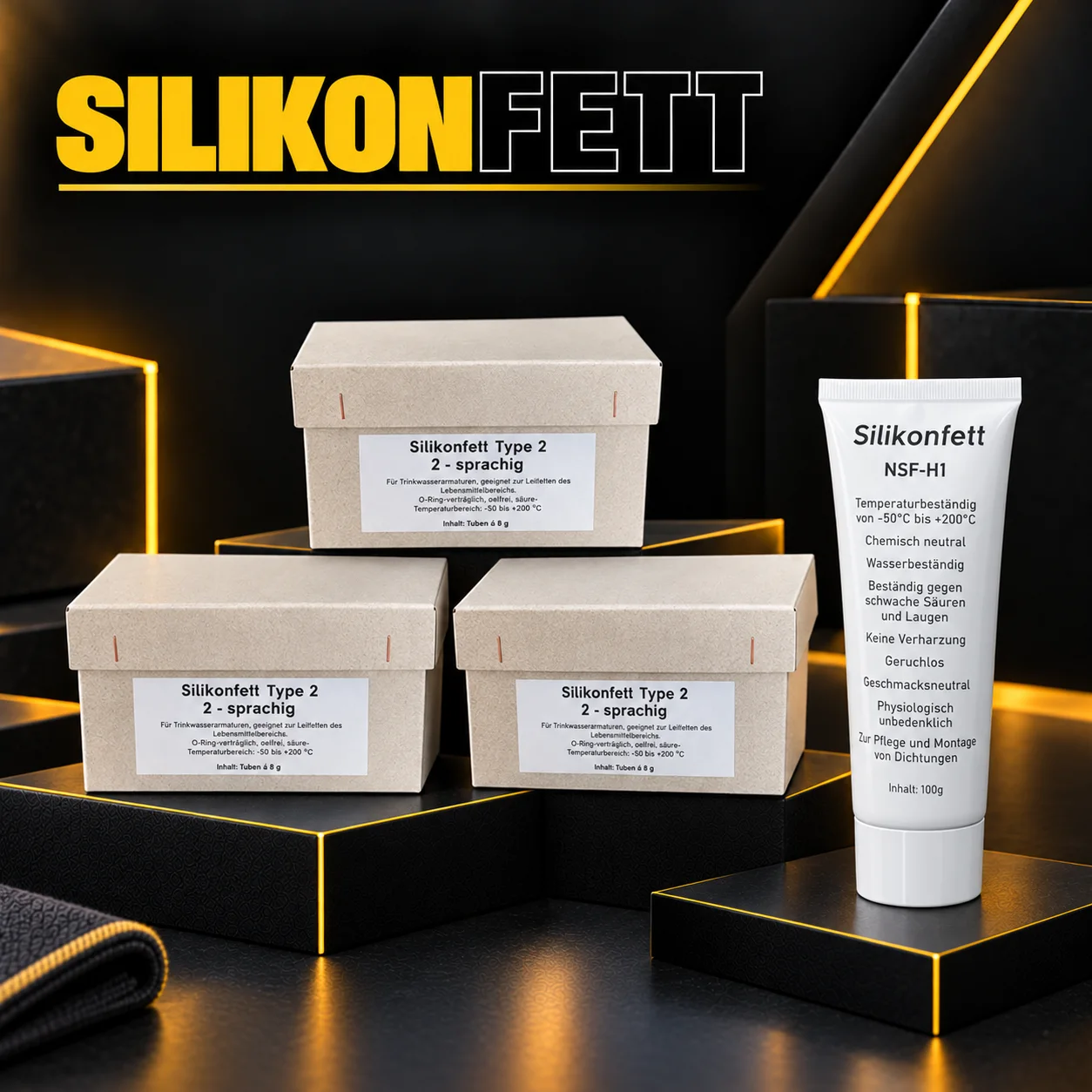
Our range extends from the compact 6 g tube of silicone grease for maintenance and individual repairs to the 100 g tube of silicone grease for regularly higher consumption. Larger quantities are also available for workshops, repair businesses, resellers and other commercial users.
What is silicone grease?
Silicone grease is a silicone-based lubricant. Unlike low-viscosity silicone oil, silicone grease has a paste-like consistency and therefore adheres better to the intended lubrication point.
In suitable applications, it forms a thin lubricating film between two surfaces. This can reduce friction and facilitate the movement of seals, O-rings or plastic components.
Depending on the product and composition, silicone grease is therefore also searched for under terms such as tap grease, O-ring grease, seal grease, fitting grease, silicone lubricating grease, brew group grease or multi-purpose silicone grease.
The different terms sometimes describe similar areas of application. However, the specific product specification is always decisive, not just the product name.
Why is silicone grease used in fully automatic coffee machines?
Numerous sealing points in a fully automatic coffee machine are subjected to mechanical stress during operation. Pistons move within a brewing unit, plug-in connections are pushed together and O-rings must seal while at the same time allowing movement.
A dry seal creates more friction. Depending on the design, this can become noticeable, for example, through stiff movement, difficulty inserting a brewing unit or increased mechanical stress on an O-ring.
At the points intended for this purpose, silicone grease for fully automatic coffee machines can form a thin lubricating film. This facilitates movement and can help reduce mechanical stress on suitable seals during insertion or movement.
Silicone grease is therefore not a conventional cleaning product, but a component of the mechanical maintenance of certain parts.
Lubricating O-rings and seals correctly
O-rings are used at numerous points in fully automatic coffee machines. They seal, for example, plug-in connections, pistons, valves, brewing units, pressure lines and other areas of the fluid system against one another.
At sealing points intended for this purpose, a thin film of O-ring grease can facilitate installation. Particularly when inserting an O-ring into a bore or fitting a connection, this can reduce friction between the seal and the mating surface.
This is relevant because, depending on the design, O-rings can become tilted, twisted or mechanically stressed by sharp edges when assembled dry.
However, the following applies: Silicone grease does not repair a damaged seal. If an O-ring is torn, severely deformed, hardened or otherwise damaged, the corresponding seal or suitable spare part should be replaced.
Silicone grease for the brewing unit and brew group
The brewing unit or brew group is one of the typical areas of application for silicone grease. Depending on the manufacturer, pistons and other mechanical components move within the unit during a brewing process.
At suitable sliding points and seals, brew group grease can support smooth movement. Particularly with removable brewing units, checking the intended sealing and sliding points is often part of maintenance.
However, which points may or should actually be lubricated depends on the manufacturer and the machine design. The respective maintenance and operating instructions for the fully automatic coffee machine should therefore always be observed.
Not every brew group is maintained by the user in the same way. Some machines explicitly provide for certain maintenance tasks, while other manufacturers use completely different maintenance concepts.
Less friction does not mean: use as much silicone grease as possible
When lubricating O-rings and seals, more is not automatically better. In many applications, a very thin, evenly distributed film on the intended surface is sufficient.
The silicone grease should lightly coat the surface and should not remain on the seal in large quantities. Excess grease can spread to adjacent components and provides no additional benefit at the actual lubrication point.
For typical maintenance work on a single fully automatic coffee machine, even a small 6 g tube of food-grade silicone grease is therefore very economical.
Silicone grease is not a sealant for damaged components
The term seal grease can occasionally be misunderstood. Silicone grease supports suitable seals in their function, but does not replace the seal itself.
A damaged seal cannot be permanently sealed by using a larger quantity of grease. Likewise, cracks in hoses, damaged plug-in connections or worn mechanical components cannot be repaired with silicone grease.
In the event of a leak, the cause should therefore first be identified. If, for example, an O-ring is damaged, you will find suitable spare parts in our fully automatic coffee machine spare parts category.
Why food-grade silicone grease?
A fully automatic coffee machine is not an ordinary mechanical device. Water is pumped through the inside of the machine, heated and then used to prepare a beverage. Depending on the design, lubrication points may therefore be located close to water-carrying or food-related areas.
For such applications, a suitable food-grade silicone grease intended for this purpose should therefore be used.
Our silicone grease is transparent, odourless and tasteless and is suitable for its intended use as a sealing and sliding lubricant. The 6 g version we offer has been tested according to LFGB.
This distinguishes such a product from arbitrary technical lubricants that have been developed exclusively for mechanical engineering, vehicles or other industrial applications, for example.
Silicone grease, tap grease and fitting grease – what is the difference?
Anyone searching online for a suitable lubricant for seals will encounter numerous terms. Silicone grease, tap grease, fitting grease, seal grease and O-ring grease are used particularly frequently.
Tap grease typically refers to a lubricant for seals and moving components in fittings. Since high-quality silicone greases are water-resistant and can be used with many suitable elastomers and plastics, certain products are also offered as tap grease.
However, the decisive factor is not which term is printed particularly prominently on a tube. What matters are the approval or suitability for the intended area, temperature range, material compatibility and product properties.
Our 6 g silicone grease or tap grease is specifically available as a versatile sealing and sliding lubricant for corresponding applications.
Which properties are important for silicone grease?
Several properties are decisive for practical use. A suitable silicone grease should adhere to the lubrication point, be easy to spread thinly and maintain its properties as consistently as possible within its intended operating range.
Our food-grade silicone grease in the 100 g tube is transparent, odourless and tasteless. It is intended for the assembly and maintenance of seals and has a specified temperature range of -50 °C to +200 °C.
The wide temperature range in particular is interesting for many technical applications. Nevertheless, before each application it should be checked whether the silicone grease is suitable for the specific component, material and area of use.
Material compatibility with O-rings and plastics
Fully automatic coffee machines contain a wide variety of plastics and elastomers. Depending on their task, O-rings can be made from different sealing materials.
For this reason, material compatibility should be taken into account with every lubricant. Our silicone grease behaves neutrally towards many commonly used plastics and elastomers and is suitable for numerous sealing applications.
However, a blanket statement that every silicone grease is compatible with every existing plastic or sealing material would not be technically appropriate. For special materials or specific industrial applications, the requirements of the respective component should therefore always be taken into account.
Silicone grease when installing new O-rings
When replacing a seal, the old seal should first be completely removed and the sealing point inspected. Depending on the component, residues and dirt can be removed before the new O-ring is installed.
At a lubrication point intended for this purpose, a small amount of seal grease can then be spread thinly over the O-ring.
The O-ring should then be installed without severe twisting or mechanical damage. Particular care is advisable around sharp edges, threads and tight plug-in connections.
A thin layer of lubrication can not only support subsequent movement but also make the installation of a new O-ring easier.
Where is silicone grease used in a fully automatic coffee machine?
The actual lubrication points depend on the model. Depending on the design, typical areas of application can include brewing units, brewing pistons, O-rings, moving seals, plug-in connections, couplings or certain connection points.
Manufacturer instructions also provide a clear example: for various Miele fully automatic coffee machines, silicone grease is explicitly specified for lubricating certain seals or the coupling of the brewing unit.
Food-grade silicone greases are also offered as maintenance or lubricating agents for various other fully automatic coffee machines. However, the exact position and maintenance method always depend on the respective machine.
Not every component in a fully automatic coffee machine may be greased
Silicone grease should only be used at lubrication points that are suitable or intended for it.
In particular, this means that the grinder, grinding ring, grinding cone, electrical contacts, sensor surfaces or other components not intended for lubrication should not simply be treated with silicone grease.
Grease should also not be applied indiscriminately in coffee-carrying areas. Maintenance should be limited to the sealing and sliding points intended for the respective machine.
Silicone grease is different from silicone oil
Although both product types can be silicone-based, silicone oil and silicone grease differ significantly in consistency and application.
Silicone oil is considerably more fluid and can therefore move away from or spread from a lubrication point more easily. Silicone grease, on the other hand, has a significantly higher consistency and adheres better at many sealing and sliding points.
For the typical manual lubrication of an O-ring or an intended seal on a fully automatic coffee machine, silicone grease is therefore frequently used.
Silicone grease and petroleum jelly are not the same
Silicone grease and petroleum jelly should not simply be regarded as the same product either. They are based on different raw material systems and can differ in terms of material compatibility, temperature behaviour and intended area of application.
If silicone grease is specified for a seal or brewing unit, an arbitrary other grease should therefore not be used as a replacement without checking.
Particularly in the environment of fully automatic coffee machines and water-carrying components, the use of a product expressly suitable for the respective application is recommended.
Our 6 g tube of silicone grease – compact and highly economical
For maintenance and individual repairs, we offer our food-grade silicone grease in the 6 g tube.
The tube is compact and is particularly suitable for private users, repairs to individual machines and storage in a tool or spare-parts inventory.
Since only a very thin film of grease is usually required for O-rings and seals, even small quantities are sufficient for numerous lubrication points.
The 6 g version is supplied in an aluminium tube with a plastic cap. It is labelled bilingually in German and English and is therefore also suitable for commercial users and international use.
100 g tube of silicone grease for regular maintenance requirements
Anyone who regularly maintains fully automatic coffee machines or also requires silicone grease for other suitable applications can use a larger pack.
Our 100 g tube of food-grade silicone grease provides considerably more content and is particularly suitable for workshops, repair businesses, commercial users and regularly higher consumption.
The transparent grease can be used, for example, for assembling and maintaining suitable seals, O-rings and plastic parts. In addition to coffee machines, other technical and food-related applications may also be suitable depending on the respective requirements.
Silicone grease in bulk quantities for workshops and resellers
While a private user can usually use a single tube for a long time, requirements in a repair workshop or for resale are completely different. If fully automatic coffee machines are regularly overhauled or silicone grease is offered together with sealing and maintenance kits, considerably larger quantities may be required.
For this reason, in addition to normal individual quantities, NEW-Kaffeevollautomaten also offers silicone grease in larger quantities and bulk packs.
For higher requirements, for example, our pack of 100 6 g tubes of silicone grease is available.
We offer even larger quantities as 300 tubes of silicone grease at 6 g each, 600 tubes of silicone grease at 6 g each and 1200 tubes of silicone grease at 6 g each.
These bulk quantities are aimed particularly at repair businesses, service technicians, specialist retailers, spare-parts dealers and resellers who require silicone grease permanently or in larger quantities.
Silicone grease not only for fully automatic coffee machines
Food-grade multi-purpose silicone grease offers considerably more applications than just the maintenance of a fully automatic coffee machine.
Depending on the specific application, it can be used, for example, as tap grease for fittings, as a lubricant for suitable seals in drinking-water applications, in kitchen and household appliances and for various O-ring applications.
Silicone grease can also be used in areas such as water sports, diving equipment or watch seals, provided that the respective component and its manufacturer permit the use of a corresponding lubricant.
This means that our silicone grease is suitable not only as fully automatic coffee machine grease, but also as a versatile specialist lubricant for numerous sealing and assembly tasks.
Silicone grease for drinking-water fittings and taps
The term tap grease originates particularly from the area of taps and fittings. O-rings and other sealing elements are also used there and must both seal and remain movable.
For such applications, suitability for food-related or drinking-water areas is particularly important. An arbitrary machine grease should therefore not simply be used on such fittings.
Our food-grade silicone grease / tap grease has been selected for corresponding sealing and sliding applications and can be used in a variety of ways.
Silicone grease for seals in kitchens and households
Outside a fully automatic coffee machine, there are also numerous appliances with seals, plastic parts and moving connections.
For suitable applications, silicone grease can therefore also be used, for example, with kitchen appliances, coffee machines and other appliances where a suitable food-grade lubricant is required.
However, the prerequisite remains the same: the material and intended area of application must be compatible with the lubricant used.
Silicone grease for Jura fully automatic coffee machines
Numerous O-rings and seals are used inside Jura fully automatic coffee machines. When repairing individual components, silicone grease can therefore be relevant for suitable seals and installation work.
It should be taken into account that Jura uses a different maintenance concept for the permanently installed brewing unit in its fully automatic coffee machines than manufacturers with brew groups that can be removed by the user. Silicone grease should therefore not be introduced into the machine without a specific reason.
During a professional repair or when replacing Jura seals and O-rings, however, a suitable lubricant can facilitate the installation of certain sealing points.
Silicone grease for DeLonghi fully automatic coffee machines
Depending on the series, DeLonghi fully automatic coffee machines have numerous seals on the brewing unit, brewing piston, heater, valves and water-carrying plug-in connections.
Particularly during maintenance work on suitable seals, food-grade silicone grease for DeLonghi fully automatic coffee machines can be used as an installation and sliding lubricant.
Which seal is required for the respective machine depends on the series and model. Suitable components can be found in our DeLonghi spare-parts section.
Silicone grease for Siemens, Bosch and other fully automatic coffee machines
O-rings and seals are also used on various mechanical and water-carrying components in fully automatic coffee machines from Siemens and Bosch. Manufacturers and spare-parts programmes also offer food-grade silicone greases for corresponding maintenance work.
Our silicone grease can therefore be used for suitable sealing and lubrication points in various coffee machines, provided that the material, design and manufacturer's specifications permit this.
Suitable spare parts can be found, for example, in the Siemens spare parts and Bosch spare parts sections.
Silicone grease for Miele fully automatic coffee machines
For various Miele fully automatic coffee machines, lubricating certain components is explicitly part of the intended maintenance. Depending on the model, Miele specifies, for example, seals, the connection to the central outlet or the coupling of the brewing unit as lubrication points.
This demonstrates particularly clearly that silicone grease for seals and brewing units can be more than just an aid during a repair and, with certain machine designs, forms part of regular maintenance.
Spare parts for suitable machines can be found in our Miele spare-parts section.
Also for AEG, Krups, Melitta, Nivona, Philips and Saeco
The basic principle of a lubricated sealing point can be found in many technical devices. Depending on the respective design, our silicone grease can therefore also be used with suitable O-rings and sealing points in various fully automatic coffee machines.
Suitable spare parts are available, among others, for AEG, Krups, Melitta, Nivona, Philips and Saeco.
Combining silicone grease with repair and maintenance
Silicone grease is often particularly useful when seals are already being replaced as part of a repair.
After removing an assembly, sealing surfaces can be inspected, defective O-rings replaced and the new seals intended for this purpose lightly lubricated before installation.
For this purpose, NEW-Kaffeevollautomaten offers both fully automatic coffee machine spare parts and seals as well as silicone grease in different pack sizes.
This allows seal replacement, installation and lubrication to be sensibly combined.
When should silicone grease be renewed?
There is no universal lubrication interval for all fully automatic coffee machines. Some manufacturers specify specific maintenance intervals, while with others lubrication is only carried out as part of a repair or maintenance procedure.
The decisive factors are therefore always machine manufacturer, model, assembly, use and condition of the respective seal.
If a sealing point intended for lubrication is visibly dry or a mechanical connection increasingly becomes stiff, an inspection may be advisable. Before applying more grease, however, it should be checked whether a worn or damaged seal is actually the cause.
How is silicone grease applied correctly?
1. Check the sealing point
Before lubrication, it should be checked whether the O-ring and mating surface are undamaged. A worn seal should be replaced rather than simply being greased again.
2. Remove contamination
The intended sealing or sliding surface should be clean in accordance with the maintenance specifications. Old residues, coffee particles or other contamination can impair the function of a seal.
3. Use a very small amount of silicone grease
A small amount of silicone grease is spread thinly and evenly over the intended seal or sliding surface.
4. Install the component carefully
The O-ring should not twist, become pinched or be damaged by a sharp edge during assembly. The thin lubricating film often makes it easier to assemble a suitable plug-in connection.
Typical mistakes when using silicone grease
One of the most common mistakes is using too much grease. A visible lump of grease is normally not required for a seal. A thin film is sufficient for most corresponding maintenance work.
Another mistake is using it in unsuitable places. Just because silicone grease is a versatile lubricant does not mean it belongs on every moving component of a fully automatic coffee machine.
Likewise, the term “food-grade” should not be understood to mean that the product may intentionally be added to beverages or food. It is a lubricant for corresponding technical applications.
Finally, material compatibility should also be taken into account. With unknown or special materials, suitability should be checked before application.
6 g or 100 g – which quantity of silicone grease makes sense?
For occasional maintenance of a private fully automatic coffee machine, the 6 g tube is a practical choice in many cases. Since only small quantities are required, it is economical despite its compact format.
For regular use, several fully automatic coffee machines or professional repair work, the 100 g tube of silicone grease provides greater reserves and reduces the need for frequent reordering.
Workshops and resellers with corresponding requirements can in turn use our bulk quantities of silicone grease.
Silicone grease for professional repair businesses
In a professional repair business, silicone grease is a typical consumable. When brewing units, valves, fluid systems or other assemblies are regularly repaired, O-rings and seals have to be installed repeatedly.
This means that requirements differ significantly from a single repair in a private household. In addition to the product itself, pack size, quantity, stock levels and consistent product properties therefore also play an important role.
With our pack sizes ranging from a single tube to 1200 tubes of silicone grease, both small and very large requirements can be covered.
Silicone grease for resellers and B2B customers
In addition to workshops, food-grade silicone grease is also of interest to spare-parts dealers and resellers. The compact 6 g tube can, for example, be offered as a stand-alone care product or as a supplement to seals and repair components.
For corresponding quantities, NEW-Kaffeevollautomaten offers bulk packs with 100 tubes, 300 tubes, 600 tubes and 1200 tubes.
Commercial customers can register in our shop. After the corresponding customer account has been checked, individual B2B conditions or commercial pricing structures can be stored.
Frequently asked questions about silicone grease
Which grease is used for O-rings in a fully automatic coffee machine?
For sealing points intended for this purpose, a suitable food-grade silicone grease for O-rings should be used. Material compatibility and the instructions of the respective machine manufacturer must be taken into account.
How much silicone grease does an O-ring need?
As a rule, a thin, even film of grease is sufficient. The O-ring does not need to be surrounded by a thick layer of grease.
Can silicone grease repair a leaking seal?
No. If a seal is damaged or heavily worn, it must be replaced. Silicone grease is used to lubricate suitable sealing points and is not a substitute for an intact O-ring.
Is silicone grease for fully automatic coffee machines food-grade?
That depends on the respective product. For fully automatic coffee machines, a product explicitly suitable for the corresponding applications should be selected. Our 6 g silicone grease is food-grade and has been tested according to LFGB.
Is tap grease the same as silicone grease?
Not necessarily. Tap grease primarily describes the intended area of application. However, many suitable products are silicone-based and are therefore offered both as silicone grease and tap grease.
Can silicone grease be used for the brewing unit?
Yes, for many brewing units and sealing points intended for this purpose. However, which points should be lubricated differs depending on the manufacturer and machine. The operating or maintenance instructions should therefore be taken into account.
Can silicone grease be used on grinding burrs?
No. The grinding ring, grinding cone and actual grinding surfaces are not typical lubrication points in a fully automatic coffee machine. Silicone grease should not be applied there.
Can silicone grease be used for taps?
A food-grade silicone grease suitable for corresponding fittings can be used as tap or fitting grease on intended seals and sliding points. The requirements of the specific fitting must be taken into account.
Is silicone grease waterproof?
Silicone greases generally have a high resistance to water and are therefore suitable for numerous corresponding sealing applications. However, the specific specifications of the respective product and the intended area of application remain decisive.
Can silicone grease be used for plastic parts?
Our silicone grease is intended for many suitable plastic and sealing applications. However, since not every plastic has identical properties, compatibility should be checked for special materials.
Which tube is suitable for occasional repairs?
For occasional maintenance of a fully automatic coffee machine, our 6 g tube of food-grade silicone grease is a compact and economical solution.
Is silicone grease also available in larger quantities for workshops?
Yes. In addition to the 100 g tube, NEW-Kaffeevollautomaten also offers larger quantities of the 6 g tube up to 1200 tubes for professional and commercial users.
Food-grade silicone grease at NEW-Kaffeevollautomaten
Silicone grease is a small aid with a wide range of applications. In fully automatic coffee machines, it supports the installation and movement of O-rings and seals at suitable points. In addition, depending on the respective requirements, it can be used as tap grease, fitting grease, seal grease and lubricant for other technical applications.
At NEW-Kaffeevollautomaten you can obtain food-grade silicone grease for fully automatic coffee machines, O-rings, seals and other applications in different pack sizes.
For individual maintenance work and repairs, our 6 g aluminium tube of silicone grease is available. For higher consumption, we offer the 100 g tube of silicone grease as well as bulk quantities for workshops, specialist retailers and resellers.
All versions and currently available quantities can be found directly in our silicone grease category.