
Limescale is one of the most common deposits in household appliances that carry water – and fully automatic coffee machines are particularly affected. With almost every beverage, water is transported through hoses, valves, pumps and heated components. Over time, minerals from the drinking water can accumulate in the fluid system.
For this reason, descaling the fully automatic coffee machine is one of the important regular maintenance measures. Properly performed descaling helps dissolve limescale deposits from water-carrying areas and maintain the function of the appliance as intended by the manufacturer.
However, how often descaling is required, which descaling agent is suitable and how the descaling programme is started depends on water hardness, appliance manufacturer, model, water consumption, filter use and appliance settings.
At NEW-Kaffeevollautomaten, you will find various solutions for this purpose – from the Clean o Coffee professional descaler with colour indicator and Clean o Coffee descaling tablets to the DeLonghi EcoDecalk DLSC500.
Why does a fully automatic coffee machine develop limescale?
Drinking water contains dissolved minerals. These include, in particular, calcium and magnesium compounds, which make up a significant part of what is known as water hardness.
When water is heated inside a fully automatic coffee machine, the chemical equilibria in the water change. As a result, poorly soluble mineral compounds can form and deposit on surfaces.
These deposits are commonly referred to as limescale or scale deposits.
Areas in which water is heated or through which hot water regularly flows are particularly affected. Depending on the design, these can include, for example, the thermoblock, flow heater, boiler, valves, hoses and other parts of the fluid system.
Because these components are concealed inside the appliance, limescale build-up is often not visible from the outside.
Why is descaling important for a fully automatic coffee machine?
Limescale forms an increasingly thick mineral layer on water-carrying surfaces. The heavier these deposits become, the more they can affect the intended water path and heat transfer.
In narrow water channels or valves, deposits can reduce the available cross-section. On heated components, limescale forms an additional layer between the heating surface and the water.
Regular descaling of the fully automatic coffee machine is therefore not solely about visual cleanliness. It is part of the technical maintenance of the water-carrying system.
Modern fully automatic coffee machines therefore often automatically remind the user to run a descaling programme.
Water hardness determines how quickly limescale forms
A decisive factor in limescale formation is water hardness. This is why two identical fully automatic coffee machines can have completely different descaling requirements.
With soft water, comparatively few hardness-forming minerals enter the appliance. With hard water, their concentration is significantly higher. Accordingly, limescale can form more quickly with the same water consumption.
For this reason, many fully automatic coffee machines allow the local water hardness to be entered during initial setup.
This setting should not be skipped or selected arbitrarily. The appliance can use the configured water hardness together with water consumption to determine when the next descaling is required.
Setting the water hardness correctly on a fully automatic coffee machine
Many appliances are supplied with a test strip for determining water hardness. Alternatively, the hardness level can often be obtained from the local water supplier.
The corresponding level is then set in the menu of the fully automatic coffee machine. The exact procedure differs from manufacturer to manufacturer and sometimes even between different appliance series.
Correctly setting the water hardness is particularly important if the appliance relies on this value when calculating descaling intervals.
If, for example, the water hardness is set too low, the machine may possibly prompt for descaling later than would correspond to the actual water quality.
When does a fully automatic coffee machine need to be descaled?
Specifying a fixed interval such as “once a month” or “every three months” for all fully automatic coffee machines would not be technically appropriate.
An appliance that prepares ten beverages a day using hard water will take in considerably more scale-forming minerals than an appliance that produces only a few beverages using soft water.
For this reason, the general rule for modern appliances is: If the fully automatic coffee machine prompts you to descale it, the designated descaling programme should be carried out.
Depending on the appliance, the prompt may appear, for example, as a text message, symbol, indicator light or within a maintenance or service menu.
Typical signs of heavier limescale build-up
Ideally, a fully automatic coffee machine is descaled before heavy deposits lead to functional problems. However, if descaling is not carried out for an extended period, various symptoms may occur.
Depending on the appliance, possible indications may include altered water flow, unusually long heating times, changes when dispensing hot water or problems in individual water paths.
However, such symptoms do not automatically prove that limescale is the cause. Reduced water delivery can also be caused, for example, by the pump, valve, flow meter, hoses or other components.
In the event of a technical fault, it should therefore not automatically be assumed that descaling will solve every problem. For mechanically or electrically damaged components, you will find suitable spare parts for fully automatic coffee machines in our range.
Descaling and cleaning are two different processes
A particularly common misunderstanding is to treat cleaning and descaling as the same thing.
Descaling deals with mineral deposits from the water. Cleaning, on the other hand, removes coffee-related residues such as coffee oils and coffee fats from components that carry coffee.
A cleaning tablet is therefore not automatically a descaler. Conversely, a descaler is not intended for removing coffee fats.
For complete maintenance, both descaler and suitable cleaning products may therefore be necessary.
You will find additional suitable products in our maintenance category for fully automatic coffee machines.
How does a descaler work?
Limescale deposits consist mainly of mineral compounds that can be chemically dissolved with suitable acids.
A coffee machine descaler therefore contains active ingredients that react with the limescale deposits and convert them into soluble components.
The dissolved components are then transported out of the appliance with water during the descaling and rinsing programme.
Concentration, contact time, temperature and material compatibility all play an important role. This is precisely why not just any acid should be put into a fully automatic coffee machine.
Why household remedies can be problematic in fully automatic coffee machines
Vinegar and citric acid are often used in the household to remove visible limescale deposits. However, this does not automatically mean that they are suitable for every fully automatic coffee machine.
A fully automatic coffee machine consists of different metals, plastics, elastomers and sealing materials. At the same time, the descaling solution is pumped through pumps, valves and heated components.
For this reason, some appliance manufacturers explicitly warn against certain household remedies or non-approved descaling agents.
Our recommendation is therefore: Observe the descaling instructions from the appliance manufacturer and the instructions for use of the descaler being used.
This helps prevent an unsuitable product from being used simply because it is generally capable of dissolving limescale in the household.
Liquid descaler or descaling tablets?
Descalers for fully automatic coffee machines are available in various forms. Liquid descalers and descaling tablets are particularly common.
Both variants pursue the same basic objective: to dissolve limescale deposits in the water-carrying system. However, they differ in dosage, handling and preparation.
A liquid descaler can be mixed directly with the specified amount of water.
A descaling tablet, on the other hand, is first dissolved in water in accordance with the product and appliance instructions.
Which version should be used depends in particular on the respective fully automatic coffee machine and the manufacturer's specifications.
Clean o Coffee professional descaler with colour indicator
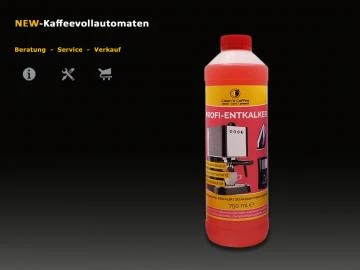
A special descaler in our range is the Clean o Coffee professional descaler with colour indicator in the 750 ml bottle.
The liquid descaler is intended for removing limescale deposits and mineral encrustations from suitable appliances.
A special feature is the integrated colour indicator. In addition to the actual descaling effect, it provides visible information about the condition of the descaling solution being used.
This distinguishes the Clean o Coffee professional descaler from many simple liquid descalers without a visual indicator.
What does a colour indicator do in a descaler?
As a descaler reacts with limescale, the active ingredients it contains are gradually consumed. A colour indicator reacts to the chemical change in the solution and makes its condition visually recognisable.
Our Clean o Coffee professional descaler has exactly this type of colour-indicator function.
This provides the user with additional visual guidance during use. However, the colour indicator does not replace the operating instructions for the fully automatic coffee machine or the specified dosage.
The specifications of both the appliance manufacturer and descaler manufacturer should therefore still be followed for the descaling programme.
Clean o Coffee – our maintenance range
The professional descaler is part of our Clean o Coffee maintenance range. Under this product line, NEW-Kaffeevollautomaten offers various products for different maintenance and care tasks.
For descaling, these include both the liquid Clean o Coffee professional descaler and our Clean o Coffee descaling tablets.
This means that different forms are available depending on the appliance, application and personal preference.
Clean o Coffee descaling tablets, 18 g
Our Clean o Coffee descaling tablets each weigh 18 g and are individually packaged in flowpacks.
Individual packaging is particularly practical for storage, as the required tablet is only removed from its packaging immediately before descaling.
Before use, the descaling tablet is completely dissolved in the specified amount of water in accordance with the product information. The solution can then be used for the descaling programme specified by the appliance manufacturer.
For normal requirements, for example, we offer 6 Clean o Coffee descaling tablets, 18 g each, in flowpacks.
30 descaling tablets for higher requirements
Anyone operating several fully automatic coffee machines or descaling more frequently does not necessarily need a very large commercial pack. For this reason, we also offer a medium-sized pack.
Our 30 descaling tablets, 18 g each, in flowpacks are aimed, for example, at users with regular requirements, several appliances or smaller repair and service businesses.
According to the product assignment, the tablets are intended for corresponding applications in suitable fully automatic coffee machines from manufacturers including Jura, Nivona, Siemens, Melitta and Miele.
Here too, the decisive factor is always that the descaling method used complies with the specifications of the respective appliance.
500 Clean o Coffee descaling tablets for workshops and B2B
Professional repair businesses, dealers or companies with many fully automatic coffee machines can have a significantly higher consumption of descaling agents.
For this requirement, we offer 500 Clean o Coffee descaling tablets, 18 g each, in flowpacks.
The bulk pack is aimed in particular at workshops, service technicians, resellers and other commercial users who regularly require descaling tablets.
Our range of descaling tablets therefore extends from a small pack for a private fully automatic coffee machine to a professional bulk quantity.
DeLonghi EcoDecalk DLSC500
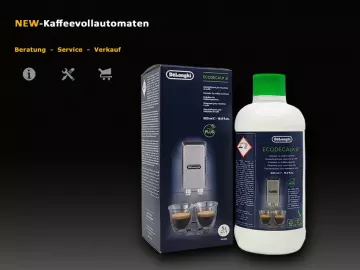
For users of a DeLonghi fully automatic coffee machine, we additionally stock the DeLonghi EcoDecalk DLSC500 descaler 5513296041.
This is the liquid descaler offered by DeLonghi for its coffee machines. The bottle contains 500 ml of descaler and is designed for several descaling cycles.
For its fully automatic coffee machines, DeLonghi advises using the corresponding appliance-specific descaling programme. The descaling frequency for these appliances also depends, among other things, on the configured water hardness.
The EcoDecalk DLSC500 is therefore particularly interesting for users who specifically want to use the corresponding manufacturer's product in their DeLonghi appliance.
How to descale a DeLonghi fully automatic coffee machine correctly
The exact procedure for DeLonghi fully automatic coffee machines differs depending on the series. Appliances from the ECAM, ETAM or ESAM series can have different user interfaces and descaling programmes.
In general, the appliance prompts the user to descale it and then guides the user through the individual steps. These typically include preparing the water tank with descaling solution, placing a sufficiently large collection container underneath and then carrying out a rinsing cycle with fresh water.
Which buttons need to be pressed and whether, for example, a water filter should be removed beforehand depends on the model.
For this reason, the operating instructions for the specific model should always be followed for DeLonghi appliances. As a suitable descaling agent, we stock the DeLonghi EcoDecalk DLSC500.
Descaling a Jura fully automatic coffee machine
Depending on the model and configuration, Jura fully automatic coffee machines also have guided maintenance programmes. If the appliance is operated without an activated filter system or is in descaling mode, it prompts for descaling after a certain amount of water has passed through it.
The exact procedure differs between the individual Jura generations. Accordingly, the operating or quick-start instructions supplied with the appliance should always be used.
For suitable applications, for example, we offer our 18 g descaling tablets for corresponding Jura fully automatic coffee machines.
Anyone using a Jura filter system should additionally observe the maintenance requirements for filter operation and filter replacement that apply to the respective model.
Descaling a Siemens fully automatic coffee machine
Siemens uses its own service programmes for cleaning, descaling and, in some cases, Calc'nClean on many fully automatic coffee machines.
Depending on the series, the machine may offer a dedicated descaling programme or a combined maintenance programme. The display guides the user through the process step by step.
On various Siemens appliances, an installed water filter must be removed before starting the descaling programme.
For corresponding appliances, our descaling tablets for Siemens fully automatic coffee machines can be a suitable alternative for the intended applications.
Descaling Nivona, Melitta and Miele fully automatic coffee machines
Descaling programmes are also part of the regular appliance maintenance for fully automatic coffee machines from Nivona, Melitta and Miele.
However, the machines differ considerably in terms of operation, programme duration, dosage and required work steps.
According to the product assignment, our 18 g descaling tablets in a pack of 30 are intended for corresponding applications in suitable appliances from these manufacturers.
Before use, however, you should always check which descaling agent and dosage are specified for the particular model.
Water filters and descaling – does a filter replace descaling?
Water filters can significantly influence the limescale load in a fully automatic coffee machine. They treat the water before or during use and, depending on the filter system, can reduce certain minerals.
However, this does not automatically mean that every fully automatic coffee machine with a filter installed will never need to be descaled again.
The decisive factors are appliance design, the filter system used, correct programming and timely filter replacement.
With some appliances, a correctly activated filter significantly changes the maintenance intervals. If a filter is not recognised, not programmed or used for too long, the appliance can revert to a normal descaling mode.
The water filter should therefore always be used in accordance with the appliance manufacturer's instructions and replaced in good time.
Can filtered water still contain limescale-forming minerals?
Yes. Water filtration does not necessarily mean that all minerals are completely removed.
The effectiveness of a filter also changes with the amount of water that has passed through it. For this reason, many modern fully automatic coffee machines or filter systems have defined replacement intervals.
If the filter is used for too long, its intended capacity may be exceeded.
Accordingly, both filter replacement and the maintenance programmes displayed by the appliance should be observed.
Bottled water can also cause limescale
A common misunderstanding is to regard still mineral water as fundamentally free from limescale-forming minerals.
Bottled water can also contain significant amounts of calcium and magnesium. The decisive factor is not whether the water comes from the tap or a bottle, but its actual mineral composition and water hardness.
Anyone who permanently uses bottled water in a fully automatic coffee machine should therefore also take the mineral information into account and select the appliance's water hardness setting accordingly.
Limescale can affect the water path
The fluid system of a fully automatic coffee machine has some very small cross-sections. Water is transported by the pump through hoses, heaters, valves and other components.
If mineral layers build up on these surfaces, the free cross-section can become smaller.
This makes it clear why regular descaling is technically relevant: it is not about a visible ring of limescale like the one in a kettle, but often about deposits in areas that the user cannot see at all.
If parts of the fluid system are already mechanically damaged or permanently blocked, a repair may be necessary. You will find corresponding components in our spare parts category for fully automatic coffee machines.
Limescale on the thermoblock, heater or boiler
Heated components are particularly relevant when it comes to limescale. This is where the water is brought to the temperature required for coffee, hot water or steam.
A layer of limescale between the heating surface and the water acts as an additional barrier to heat transfer.
The exact effect depends greatly on the design and degree of limescale build-up. For this reason, an appliance should be descaled as regularly as possible in accordance with its own maintenance indicator, before very heavy deposits form.
Heavy limescale build-up is different from regular maintenance descaling
An important distinction must be made between regularly performed descaling and an appliance that has not been descaled at all for a very long period.
With normal maintenance descaling, developing deposits should be removed regularly before massive layers of limescale form.
In an extremely scaled or already partially blocked appliance, on the other hand, larger quantities of existing deposits may be loosened. In such a case, diagnosis and, if necessary, professional repair may be required.
Descaling should therefore not only be carried out once clear functional problems have already occurred.
Descaling a fully automatic coffee machine – basic procedure
The exact procedure always depends on the model. Nevertheless, many guided descaling programmes are similar in their basic structure.
1. Check the operating instructions
First, check which descaling agent, what quantity and which procedure are specified for the particular fully automatic coffee machine.
2. Prepare the descaling solution
Depending on the product, for example, liquid descaler is diluted with water or a descaling tablet is completely dissolved in water.
3. Remove the water filter if necessary
With many appliances, an installed water filter must be removed before descaling. Whether this is necessary for your own fully automatic coffee machine can be found in the relevant operating instructions.
4. Position a collection container
During the programme, a larger amount of descaling solution and subsequently rinsing water is dispensed. A sufficiently large container should therefore be positioned beneath the outlets specified by the manufacturer.
5. Start the descaling programme
The corresponding service or descaling programme is started using buttons, the menu or the display. The appliance instructions should then be followed.
6. Allow the programme to run completely
During descaling, the appliance often controls various pumping, waiting and contact-time phases. The programme should therefore not be interrupted unnecessarily.
7. Rinse thoroughly with fresh water
After the actual descaling process, the rinsing phase specified by the appliance follows. For this purpose, the water tank is cleaned or filled with fresh water.
The fully automatic coffee machine should only be used normally again once the complete programme has finished.
Why the descaling programme should not be cancelled
A descaling programme usually does not simply consist of a single pass of water. The appliance can deliberately pump the solution through different water paths and allow contact times between individual pumping cycles.
This is followed by one or more rinsing cycles with fresh water.
If the programme is ended prematurely, both the actual descaling process and the subsequent rinsing may remain incomplete.
With some appliances, an interrupted service programme must then be started again.
Dosing descaler correctly
The following also applies to descalers: a larger quantity does not automatically work better.
A descaling agent is designed for a specific application concentration. An unnecessarily high concentration does not automatically provide better descaling and can increase the stress on materials.
Conversely, excessive dilution can result in the amount of active ingredient present being insufficient for the amount of limescale.
For this reason, the dosage instructions for the descaler being used as well as the appliance manufacturer's specifications should be observed.
Dissolve descaling tablets completely
Anyone using descaling tablets should dissolve them completely in water in accordance with the instructions for use before adding the solution to the appliance.
Components that have not completely dissolved should not unnecessarily enter the sensitive fluid system.
Our Clean o Coffee tablets are supplied individually in flowpacks and can therefore be removed as required immediately before the descaling process.
What is important after descaling
After the descaling cycle, the descaling solution must be completely rinsed out of the appliance.
The fully automatic coffee machine therefore normally prompts the user to empty, clean and refill the water tank with fresh drinking water.
At least one rinsing phase then runs through the water paths that were previously descaled.
The appliance should only be used normally again once the intended descaling and rinsing programme has been completed in full.
Descaling indicator does not go out – what should you do?
If the descaling message remains after the supposed descaling process, this does not necessarily mean that there is a fault.
With some fully automatic coffee machines, the electronics only recognise descaling as completed if the designated programme has been carried out in full.
If descaler was merely run through the appliance without starting the actual descaling programme, the message may therefore remain displayed.
A programme that was ended prematurely or a rinsing phase that was not completed can also play a role.
In this case, the operating instructions for the specific appliance should first be checked and the full programme sequence reviewed.
Descaling does not protect against every defect
Regular descaling is important, but it cannot repair mechanically or electrically worn components.
If, for example, a water pump is worn, a valve is damaged or an O-ring is leaking, descaling will not eliminate the actual defect.
At the same time, limescale deposits and technical faults can cause similar symptoms. For this reason, if problems persist, the fault should be diagnosed as precisely as possible.
Suitable spare parts for fully automatic coffee machines are available from NEW-Kaffeevollautomaten, sorted by manufacturer and assembly.
Descaling privately and commercially used fully automatic coffee machines
A fully automatic coffee machine in a private household may have significantly lower water consumption than an appliance in an office, workshop, sales area or catering environment.
As water consumption increases, correspondingly larger quantities of scale-forming minerals pass through the appliance.
For users with several machines or regular requirements, we therefore offer different pack sizes of our descaling products.
From the pack of 6 Clean o Coffee descaling tablets and 30 descaling tablets through to the bulk pack of 500, the required quantity can be selected according to actual consumption.
Descaling agents for workshops and service technicians
For a fully automatic coffee machine workshop, descaling agents are among the typical consumables.
Anyone who regularly services appliances for different customers requires descaler considerably more frequently than a private household.
The 500 Clean o Coffee descaling tablets in flowpacks therefore provide a bulk quantity specifically for corresponding professional requirements.
In addition, the Clean o Coffee professional liquid descaler can be a practical alternative for appliances and applications where a corresponding liquid descaler is specified.
Typical mistakes when descaling a fully automatic coffee machine
Some mistakes repeatedly occur when descaling. These include, for example, ignoring the descaling indicator and only carrying out the procedure once clear functional problems occur.
An incorrect water hardness setting, unsuitable household remedies, incorrect dosage or interrupting the descaling programme while it is running can also be problematic.
For appliances with a water filter, it may additionally be crucial whether the filter has been correctly installed, programmed and replaced in good time.
A combination of correct water hardness setting, suitable descaler, correct descaling programme and complete rinsing process is therefore particularly important.
Frequently asked questions about descaling fully automatic coffee machines
How often do I need to descale my fully automatic coffee machine?
This depends in particular on water hardness, water consumption, filter use and appliance model. With modern fully automatic coffee machines, the appliance's automatic descaling prompt should generally be observed.
Which descaler should I use for my fully automatic coffee machine?
A descaling agent suitable for the respective appliance should be used. For this purpose, NEW-Kaffeevollautomaten offers, among other products, the Clean o Coffee professional descaler with colour indicator, Clean o Coffee descaling tablets and, for DeLonghi, the EcoDecalk DLSC500.
Can I descale my fully automatic coffee machine with vinegar?
This should not be recommended as a general rule. Some manufacturers explicitly exclude vinegar and other household remedies for certain fully automatic coffee machines. You should therefore use a descaling agent suitable for the appliance and follow the operating instructions.
Can I use citric acid for descaling?
The specifications of the respective appliance manufacturer also apply here. Not every product that can remove visible limescale deposits in the household is automatically suitable for the complex fluid system of a fully automatic coffee machine.
Which is better – liquid descaler or descaling tablets?
Both variants can be used for suitable appliances. The decisive factors are the respective formulation, correct dosage and approval or suitability for the specific appliance. Liquid descaler is mixed with water, whereas descaling tablets are first dissolved in accordance with the instructions.
What is the benefit of a colour indicator in a descaler?
A colour indicator makes changes in the descaling solution visually apparent. Our Clean o Coffee professional descaler has such a colour-indicator function.
Does the water filter have to be removed before descaling?
Yes, with many appliances, but not as a general rule for every model. The exact procedure can be found in the operating instructions for the respective fully automatic coffee machine.
Why does my fully automatic coffee machine ask for descaling despite having a water filter?
Possible causes include, for example, a filter that has not been correctly recognised or programmed, exceeded filter capacity or an appliance configuration in which descaling intervals are still provided for. The specific cause depends on the model.
Is cleaning the same as descaling?
No. Descaling removes mineral deposits from the water. Cleaning tablets, on the other hand, are intended, for example, for coffee oils and coffee fats. Both maintenance procedures may therefore be necessary independently of each other.
Can a cleaning tablet remove limescale?
A normal cleaning tablet for removing coffee fat does not automatically have a descaling effect. A descaler intended for this purpose should be used for limescale.
Can descaler remove coffee fat?
Descaler is primarily intended for mineral deposits and does not replace a special cleaning agent for coffee oils and coffee fats.
Why does the descaling indicator not go out after descaling?
With many appliances, the designated descaling programme must be started and completed in full. If descaler is merely pumped manually through the appliance or the programme is interrupted, the electronics may not recognise the process as completed.
Can too much limescale damage a fully automatic coffee machine?
Heavy limescale deposits can impair water-carrying and heated components. The regular descaling specified by the appliance should therefore not be permanently ignored.
Which descaling tablets are suitable for higher consumption?
For regular requirements, we offer 30 descaling tablets, 18 g each. For workshops, resellers and other high-volume users, the Clean o Coffee bulk pack of 500 is also available.
Descaling fully automatic coffee machines correctly with products from NEW-Kaffeevollautomaten
Regular descaling is one of the fundamental maintenance tasks for a fully automatic coffee machine. However, the decisive factor is not a blanket time interval, but the interaction between water hardness, water consumption, filter use and the specifications of the respective appliance.
At NEW-Kaffeevollautomaten, you will find various solutions for different requirements.
Our Clean o Coffee professional descaler in the 750 ml bottle with colour indicator offers a liquid solution with a visual indication of the descaling solution.
Alternatively, Clean o Coffee descaling tablets, 18 g each are available in different pack sizes – from small requirements through to the professional bulk pack of 500.
For owners of a DeLonghi fully automatic coffee machine, we additionally stock the DeLonghi EcoDecalk DLSC500 5513296041.
You will find additional cleaning, descaling and maintenance products in our maintenance products section for fully automatic coffee machines.
Regardless of the product used, the following applies: Select a descaler suitable for the appliance, set the water hardness correctly, use the designated descaling programme and complete the subsequent rinsing process in full.