
DeLonghi is one of the best-known manufacturers of fully automatic coffee machines and has developed numerous machine generations over many years. From older EAM and ESAM models through compact ETAM machines to modern ECAM and EPAM fully automatic coffee machines, the design, equipment and individual components differ considerably in some cases.
However, a defect does not automatically mean that the complete fully automatic coffee machine has to be replaced. Many mechanical, electrical and water-carrying components can be replaced or repaired individually. At NEW-Kaffeevollautomaten you will find an extensive range of DeLonghi fully automatic coffee machine spare parts for this purpose.
Depending on the machine generation, our DeLonghi range includes, among other products, brewing units and brewing pistons, grinders, water pumps and fluid-system parts, seals and O-rings, thermoblocks and heaters, solenoid valves, hoses and connectors, sensors, drive components as well as coffee outlets, maintenance and repair parts.
DeLonghi spare parts – first determine the machine generation
With hardly any other manufacturer is the exact model designation as helpful when searching for spare parts as it is with DeLonghi. The various prefixes before the model number identify different machine families or generations.
The most common designations include EAM, ESAM, ECAM, ETAM and EPAM. There are also other product groups and older machine designations.
These prefixes are important because a spare part for an older ESAM fully automatic coffee machine cannot automatically be used in a modern ECAM machine.
Different versions even exist within the same machine family. Before every order, the complete model designation should therefore be checked and then compared with the compatibility information for the respective product.
EAM and ESAM – classic DeLonghi fully automatic coffee machines
Many older DeLonghi fully automatic machines belong to the EAM and ESAM generations. These include numerous machines from the well-known Magnifica, Perfecta and PrimaDonna families.
Models such as ESAM 3000, ESAM 3200, ESAM 3500, ESAM 4000, ESAM 4200 or ESAM 5500 have been widespread for many years and are therefore frequently repaired.
Typical repair areas in this generation include brewing piston, thermoblock, brewing unit, brew-group drive, water pump, solenoid valves, seals and grinder.
A major advantage of many of these machines is that numerous components are still available individually and can therefore be replaced specifically.
ECAM – one of the largest DeLonghi machine families
With the ECAM series, DeLonghi has developed a particularly large number of different fully automatic coffee machines.
This machine platform includes numerous models from the Magnifica, Magnifica S, Magnifica Start, Magnifica Evo, Dinamica, Dinamica Plus, Eletta, Eletta Explore and various PrimaDonna families.
The range extends from comparatively simple fully automatic coffee machines to machines with automatic milk systems, colour displays, extensive beverage selections and additional electronic functions.
A spare part should therefore never be selected solely on the basis of the description “for ECAM”. An ECAM 22.xxx may be technically very different from an ECAM 350.xx, ECAM 450.xx or ECAM 650.xx.
ETAM – more compact DeLonghi fully automatic machines
The ETAM machines were offered as more compact fully automatic coffee machines and differ from the larger ECAM models in various components.
Nevertheless, depending on the component, there are technical overlaps between ECAM and ETAM. This can be seen, for example, with certain DeLonghi solenoid valves for ECAM and ETAM fully automatic coffee machines or grinder components.
However, the specific product allocation remains decisive. A shared machine family in the product title does not automatically mean that every model within this family is compatible.
EPAM and Maestosa – complex modern technology
Machines such as the Maestosa add further technical platforms. One well-known example is the EPAM 960.75.GLM Maestosa.
Such machines have extensive electronics, multiple functions and a correspondingly complex internal design.
At the same time, classic wear components such as seals, sensors and further water-carrying parts continue to play a role even in modern machines.
Precise spare-part identification is therefore particularly important for high-quality current machines.
Magnifica – one of the best-known DeLonghi series
The Magnifica designation has been used across several machine generations.
Older machines include various EAM and ESAM Magnifica models. These were later followed by Magnifica S, Magnifica Start and Magnifica Evo, among others, within the ECAM family.
This means that two machines bearing the Magnifica name can have completely different pumps, grinders, heaters or drives internally.
When searching for spare parts, the complete model number should therefore always be used – for example ESAM 3000.B, ECAM 22.110.B or ECAM 290.61.B and not simply “Magnifica”.
Perfecta, Dinamica, Eletta and PrimaDonna
Product names such as Perfecta, Dinamica, Eletta and PrimaDonna also cover different model generations.
Older Perfecta machines, for example, include ESAM models, while Dinamica and many Eletta versions belong to the ECAM machine family.
PrimaDonna has been used across a particularly large number of generations – from older EAM and ESAM machines to modern ECAM models such as PrimaDonna Class, Elite or Soul.
The sales designation is therefore useful for orientation, but does not replace the complete model number.
DeLonghi brewing unit – removable and easy to maintain
A special feature of many DeLonghi fully automatic coffee machines is the removable brewing unit.
It receives the ground coffee, compresses it and holds it in the brewing chamber during extraction. After the brewing process, the used coffee grounds are ejected.
The brewing unit moves inside the machine with every beverage preparation. Guides, pistons and seals are therefore mechanically stressed with every coffee.
However, this design also enables comparatively easy inspection and cleaning of the brewing unit.
Clean the DeLonghi brewing unit regularly
The removable brewing unit should be cleaned regularly in accordance with the manufacturer's instructions.
It is important to note that on many DeLonghi fully automatic machines, the brewing unit may only be removed when the machine has been correctly switched off. During the switch-off process, the drive first moves the unit into its intended starting position.
If the brewing unit cannot be removed, it should therefore not be pulled out by force.
For normal cleaning, the brewing unit is rinsed with water. Washing-up liquid or dishwashers are not suitable for DeLonghi brewing units designed for this purpose.
Stiff brewing unit – seals often play a role
As operating time increases, the large piston seals of the brewing unit can wear or become dry.
A typical spare part is, for example, the DeLonghi O-ring piston seal 5313238581.
This sealing ring is used on the brewing unit or upper brewing piston in numerous DeLonghi machines from different generations.
A worn seal can impair movement and at the same time lose its sealing effect.
For this reason, a stiff brewing unit should not automatically result in replacement of the complete brew-group drive. The condition, cleanliness and seals should first be checked.
DeLonghi seal set with silicone grease
For typical maintenance work, we offer, for example, the 4-piece DeLonghi seal set with O-rings and silicone grease.
Such sets are suitable for repairs in which several coordinated sealing components are to be checked or replaced at the same time.
The specific compatibility with the respective DeLonghi model must always be checked using the product description.
Silicone grease for DeLonghi brewing unit and O-rings
For suitable moving O-rings and sealing points, a thin layer of lubrication can be useful.
For this purpose, we offer our food-grade silicone grease in the 6 g aluminium tube.
The silicone grease is applied only in a thin layer to designated O-rings and sliding points. A large amount of grease provides no additional benefit.
It is also important to note that silicone grease can lubricate a dry seal, but cannot repair a torn, deformed or worn seal.
Upper brewing piston – second important area of the brewing circuit
In addition to the removable brewing unit, a DeLonghi fully automatic coffee machine has another central area of the brewing circuit: the upper brewing piston or brewing head.
Depending on the machine design, this is located around the heater or thermoblock and, together with the moving brewing unit, forms the brewing chamber during the brewing process.
Here too, there are seals and water paths that can wear or become contaminated as operating time increases.
For older EAM and ESAM machines, for example, we offer the DeLonghi brewing piston 5513227981 for EAM and ESAM fully automatic coffee machines.
ECAM brewing pistons differ from older ESAM versions
With the ECAM generation, the design of various components was further developed.
One example is the DeLonghi brewing piston or brewing head 5513227961 for various ECAM fully automatic coffee machines.
Other machine generations in turn use further versions, for example the brewing piston 7313243821 for various DeLonghi ECAM 26.xxx models.
These examples show why precise model allocation is so important: “DeLonghi brewing piston” does not describe a universally compatible component.
DeLonghi brew-group drive – movement of the brewing unit
The brewing unit does not move by itself during operation. A brew-group drive positions it for grinding, brewing and ejecting the coffee grounds.
Depending on the machine generation, the drive consists of a motor, gearbox, spindle and further mechanical or electrical components.
For older EAM and ESAM machines, for example, we offer the DeLonghi brew-group drive for EAM and ESAM fully automatic coffee machines.
Before a drive is replaced, however, it should be checked whether the brewing unit itself is stiff. Heavily stressed or dry piston seals can place additional load on the drive.
Typical fault: brewing unit does not move correctly
If the brewing unit stops in the wrong position or can no longer be removed, there are several possible causes.
These include, for example, a stiff brew group, a mechanical drive fault, limit switches or position sensors, or an interrupted switch-off sequence.
The brewing unit should therefore not be forcibly pulled out of the machine.
It should first be checked whether the machine has been fully switched on and then switched off normally using the on/off button.
DeLonghi grinder – several generations and versions
The grinder grinds the coffee beans immediately before each brewing process.
DeLonghi has used different grinder generations over the years. Complete grinders and individual grinder components therefore differ accordingly.
Older EAM and ESAM machines use different versions from many ECAM or ETAM fully automatic coffee machines.
If there is a grinder problem, it should therefore first be checked which version is actually installed.
Replace grinding ring and grinding cone instead of the complete grinder
An important focus at NEW-Kaffeevollautomaten is repair solutions that avoid unnecessarily replacing a complete grinder.
For suitable DeLonghi grinders, for example, we offer the DeLonghi grinder repair kit with grinding ring and grinding cone.
On suitable grinders, this allows the actual wear-prone grinding components to be replaced while technically sound parts of the existing grinder can continue to be used.
This can be an interesting alternative to replacing the complete grinding unit.
Complete DeLonghi grinder as an alternative
Not every grinder problem can be solved by replacing the grinding ring and grinding cone.
If, for example, the motor is damaged, the mechanism is broken or there is another defect that cannot be repaired separately, a complete grinder may be required.
One example is the DeLonghi grinder 7313230951 for various ECAM and ETAM fully automatic coffee machines.
For other ECAM models, we also offer the DeLonghi grinder 7313230501.
Grinders for older EAM and ESAM machines
Complete grinders are also still available for older machine generations.
These include, for example, the DeLonghi grinder 7313230461 for various ESAM fully automatic coffee machines.
Another version is the DeLonghi grinder 5513227971 / 7332203600 for EAM, ECA and ESAM machines.
Here too, selection should be based exclusively on the specific model compatibility.
When are the grinding ring and grinding cone really worn?
A change in the taste of the coffee does not prove that the grinder is worn.
Bean variety, grind setting, coffee quantity, brew group or water flow also influence the result.
An actually worn grinder can, for example, become noticeable through significantly changed grinding performance, longer grinding times or increasingly uneven ground coffee.
Before replacing parts, the interaction between the grinder and brewing system should therefore always be considered as a whole.
DeLonghi water pump – the heart of water delivery
The water pump transports water from the tank through the fully automatic coffee machine.
DeLonghi uses different pump types depending on the machine generation.
A widely used spare part is, for example, the DeLonghi water pump 5113211281 ULKA EP5.
For various ECAM machines, we also offer the DeLonghi ULKA EP5 GW 230 V / 48 W water pump.
When the pump is loud but no water comes out
A loud pump does not automatically mean that the pump itself is defective.
Possible causes include air in the water system, a blocked water-tank connection, a clogged filter, limescale, a blocked solenoid valve or another restriction in the fluid system.
If the pump is running dry or is not receiving water, it can operate significantly louder.
The water path should therefore be checked as systematically as possible before a new pump is installed.
DeLonghi fluid system – from the water tank to the brewing unit
The term fluid system covers the complete water path inside the fully automatic coffee machine.
This includes, among other things, the water-tank connection, filter, pump, hoses, pressure lines, thermoblock, solenoid valves, brewing piston and further plug-in connections.
A fault at a single point can affect the water flow throughout the entire machine.
For this reason, if no coffee is being dispensed, for example, the brewing unit or water pump should not automatically be the only components checked.
Pressure hoses and small O-rings
Many connections in the DeLonghi fluid system are made using pressure hoses and plug-in connections.
The actual sealing function is often performed by a small O-ring.
One example is the DeLonghi O-ring seal 5313217701 in 3.85 × 2 mm for pressure hoses.
Such small seals are typical wear parts. If a connection is leaking, the complete hose or connected valve therefore does not automatically have to be replaced.
Small seal – major effect
Compared with a thermoblock or grinder, O-rings are very small and inexpensive components. Nevertheless, they can have a major effect on the function of the machine.
A damaged pressure-hose seal can lead to water loss. A worn piston seal can make the brewing unit stiff or prevent the brewing chamber from sealing reliably.
For this reason, it is worthwhile checking the condition of surrounding seals during repairs.
On seals intended for this purpose, a thin layer of food-grade silicone grease can subsequently make installation easier.
Solenoid valves control the water paths
Depending on the machine generation, DeLonghi fully automatic coffee machines use various solenoid valves.
They open and close specific water or steam paths inside the machine.
A defective or blocked valve can therefore cause very different symptoms – from a lack of hot water and problems dispensing steam to water escaping at the wrong point.
Here too, the exact machine generation is decisive.
2-way and 3-way solenoid valves on EAM and ESAM
For various older machines, for example, we offer the DeLonghi 2-way solenoid-valve kit 5513225701 for EAM and ESAM fully automatic coffee machines.
There is also, among other products, the DeLonghi 3-way CEME solenoid valve for EAM and ESAM as well as the 3-way solenoid-valve kit 5513225711.
The number of ways and the respective valve design are technically relevant. A 2-way valve cannot simply be replaced with any 3-way valve.
Solenoid valves for ECAM and ETAM
Corresponding valve solutions are also used in newer ECAM and ETAM machines.
One example is the DeLonghi solenoid valve 5213218431 for various ECAM and ETAM fully automatic coffee machines.
Before replacement, not only the appearance of the existing valve should be compared. Electrical data, connections, valve function and model allocation must also match.
Thermoblock and heater – hot water for coffee and steam
The thermoblock or heater heats the water to the temperature required for coffee, hot water or steam.
Depending on the machine generation, different heating systems and, in some cases, additional steam heaters are used.
Particularly in older ESAM machines, there are different thermoblock versions that may differ, for example, in water flow and connections.
Precise product allocation is therefore important here as well.
DeLonghi thermoblock 5513227901
One specific example from our range is the DeLonghi thermoblock 5513227901 in the complete 5 mm version.
This version is supplied complete with thermal sensor, fuses and connection fittings and is intended for numerous suitable ESAM models.
With thermoblocks in particular, the decision should not be based solely on power rating or external shape. Flow cross-section, connections and specific machine compatibility must match.
Temperature sensors monitor the heater
The thermoblock works together with temperature sensors or NTC sensors.
They transmit the current temperature of the heating system to the electronics.
One example is the DeLonghi NTC temperature sensor 180 °C for various Magnifica, PrimaDonna and Lattissima machines.
A temperature problem therefore does not automatically mean that the complete thermoblock is defective. The sensor, thermal fuse, wiring or electronic control may also be involved.
DeLonghi coffee outlet – the final path before the cup
After the brewing process, the coffee is routed through internal lines to the coffee outlet.
Over time, coffee oils and coffee residues can accumulate there. Depending on the design, mechanical parts or connections can also become damaged.
For various ESAM Perfecta machines, for example, we offer the DeLonghi coffee outlet with chrome cover, spring and cap for ESAM Perfecta 5400, 5450, 5500, 5550, 5600 and 5700.
Here too, it becomes clear that even an apparently simple component can have a model-dependent design.
Milk system and frother
Many DeLonghi fully automatic coffee machines have an automatic or manual milk and frothing system.
Depending on the model, conventional steam nozzles, cappuccinatore systems or LatteCrema milk containers are used.
Milk contains protein and fat. Residues can therefore remain in thin lines, nozzles and suction paths.
Problems with milk foam do not therefore automatically mean that a pump or solenoid valve is defective. Cleaning, air supply, milk hose and seals should often be checked first.
Fully automatic coffee machine loses water – troubleshoot systematically
Water underneath or inside a DeLonghi fully automatic coffee machine can originate from very different areas.
Typical possible sources include the water-tank connection, pressure hoses, small O-rings, thermoblock, brewing piston, solenoid valves or brewing unit.
It is particularly helpful to observe when the water loss occurs.
If the machine already loses water while at rest, the cause is often located somewhere different from a leak that occurs exclusively during brewing or steam dispensing.
Water ends up in the grounds container
If there is an unusually large amount of water in the coffee-grounds container or around the brewing unit, the brewing circuit should be checked.
Possible causes include worn piston seals, leaks at the upper brewing piston or faulty sealing inside the brewing unit.
For example, the condition of the DeLonghi piston O-ring 5313238581 may be relevant here.
A precise visual inspection is more useful than prematurely replacing complete assemblies.
Coffee flows too slowly or only drips
This fault can also have different causes.
If the ground coffee is very fine, the coffee puck can create high resistance. A contaminated brewing screen, deposits in the water path, a valve problem or weak water delivery can also play a role.
The grind setting, grinding quantity, brewing unit and fluid system should therefore be considered together.
The grinder should not be replaced solely because the coffee flows more slowly than before.
Coffee suddenly becomes too weak
A weak coffee result can be caused by coffee grounds that are too coarse or by an insufficient amount of ground coffee.
Worn grinder components can also play a role.
Before replacement, it should therefore be checked whether the grinder or grinding ring and grinding cone are actually worn or whether only a setting or another cause is responsible.
DeLonghi does not heat correctly
If coffee or hot water no longer reaches the expected temperature, several components may be involved.
In addition to the thermoblock, the NTC temperature sensor, thermal fuses, wiring and electrical control, for example, should be taken into account.
Heavy limescale can also impair heat transfer and water flow.
A complete DeLonghi thermoblock should therefore not be replaced on suspicion without diagnosis.
Descaling DeLonghi – consider water hardness
Limescale is caused by mineral components in drinking water. The harder the water used and the higher the consumption, the faster corresponding deposits can form.
DeLonghi fully automatic coffee machines therefore have model-dependent descaling programmes and a water-hardness setting.
If the machine requests descaling, the intended programme should be completed in full.
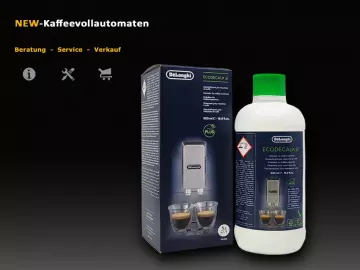
As a suitable manufacturer product, we offer the DeLonghi EcoDecalk DLSC500 descaler 5513296041.
Descaling is not the same as cleaning
Regular machine care consists of different measures.
Descaling deals with mineral deposits originating from the water. Cleaning, on the other hand, deals among other things with coffee residues, coffee oils and contamination.
The milk system in turn has its own cleaning requirements.
A descaler therefore does not replace cleaning of the brewing unit or a milk-system cleaner.
You can find further products in our care products category for fully automatic coffee machines.
Water filter and descaling
Many DeLonghi machines can be operated with a water filter.
Depending on its design, a water filter can reduce certain minerals and thereby influence the limescale load.
However, the filter does not automatically replace all maintenance work. It must be inserted, activated and replaced in good time in accordance with the manufacturer's instructions.
The machine's water-hardness setting should also match actual use.
Do not select a spare part based only on colour and appearance
DeLonghi has numerous components that look very similar externally.
This applies particularly to solenoid valves, thermoblocks, grinders, brewing pistons, hoses and plug-in connections.
Despite an almost identical appearance, there may be differences in connections, diameter, electrical values or design details.
Model number, spare-part number and specific product compatibility are therefore much more informative than a purely visual comparison.
Original spare-part numbers help with the search
Many DeLonghi components carry product or manufacturer numbers.
Examples from our range include 5113211281, 5313238581, 5513225701, 5513227901 or 7313230951.
Such numbers can make spare-part searches considerably easier.
Nevertheless, it should be taken into account that manufacturers may change spare-part numbers over the years or replace them with successor products.
Machine compatibility therefore remains important in addition to any existing number.
Repair instead of unnecessarily replacing complete assemblies
An important approach at NEW-Kaffeevollautomaten is targeted repair of individual components.
One example is grinders: if the motor and mechanics are still functional, our DeLonghi grinder repair kit with grinding ring and grinding cone can, on suitable versions, be an alternative to replacing the complete grinding unit.
The same applies to seals. A leaking pressure-hose connection does not automatically require a completely new water path if only the appropriate O-ring is worn.
Such repair solutions can allow technically intact components to continue to be used.
DeLonghi spare parts for workshops and service technicians
DeLonghi fully automatic coffee machines are among the machines frequently repaired in the professional service sector.
Workshops therefore regularly require typical wear parts such as O-rings, water pumps, valves and grinder components.
For corresponding requirements, we offer numerous products with quantity pricing as well as special bulk quantities.
One example is our set of 10 DeLonghi ULKA EP5 water pumps 5113211281.
You can find further professional packaging units in our bulk discount category.
Seals as workshop supplies
Small O-rings are frequently required for professional repairs and can therefore be sensibly kept in stock.
For DeLonghi pressure hoses, for example, we also offer the pack of 100 red O-ring seals for 4 mm DeLonghi pressure hoses.
Particularly with such inexpensive wear parts, maintaining an appropriate workshop stock can reduce short-term individual orders.
Overview of typical DeLonghi repair areas
On both older and modern fully automatic coffee machines, many faults do not occur randomly but are concentrated on components that are regularly subjected to mechanical, thermal or water-related stress.
These include in particular brewing unit and piston seals, brew-group drive, grinder, water pump, pressure hoses and plug-in connections, solenoid valves, thermoblock, brewing piston, temperature sensors and milk system.
However, the fact that a fault occurs frequently in a certain area does not replace diagnosis. Similar symptoms can be caused by different components.
How to find the correct DeLonghi spare part
1. Determine the complete model number
First check whether it is, for example, an EAM, ESAM, ECAM, ETAM or EPAM model and read the complete machine designation.
2. Do not confuse the machine family with the model number
“Magnifica”, “Dinamica”, “Eletta” or “PrimaDonna” are product families. The specific model number is considerably more precise for spare-part allocation.
3. Locate the fault as precisely as possible
Check whether the problem is more likely to be in the brewing unit, drive, grinder, water delivery, valves, heating, coffee outlet or milk system.
4. Compare the existing spare-part number
If the defective component has already been removed, any manufacturer or product numbers present can provide additional help.
5. Check the product compatibility list
The information for the respective product is decisive. A component that looks suitable may nevertheless be intended for a different machine generation despite a similar design.
Frequently asked questions about DeLonghi fully automatic coffee machine spare parts
Which DeLonghi spare parts are available?
At NEW-Kaffeevollautomaten, depending on the model, you will find brewing units, seals, grinders, pumps, fluid-system parts, solenoid valves, heaters, brewing pistons, drives, hoses, sensors and further DeLonghi spare parts.
What do EAM, ESAM, ECAM and ETAM mean?
These are different DeLonghi machine families or technical generations. Both the prefix and the complete model number that follows are therefore important for identifying spare parts.
Does an ECAM brewing unit also fit ESAM machines?
Not universally. Different machine generations can have different brewing units, brewing pistons and drive designs. Selection should be based exclusively on the specific model compatibility.
Why can't I remove my DeLonghi brewing unit?
The brewing unit must be in the intended rest position. If, for example, the machine was disconnected from the mains during operation, the unit may be in the wrong position. The machine should be switched on normally and then completely switched off using the on/off button. The brewing unit must not be pulled out by force.
How is a DeLonghi brewing unit cleaned?
On machines designed for this purpose, the removable brewing unit is cleaned with water. Washing-up liquid and dishwashers should not be used in accordance with DeLonghi's care instructions.
Which silicone grease is suitable for DeLonghi O-rings?
At designated sealing and sliding points, our food-grade silicone grease in the 6 g tube can be applied in a thin layer.
Can a DeLonghi grinder be repaired?
On suitable grinders, worn grinding components can be replaced separately. For this purpose, we offer, among other products, the DeLonghi grinder repair kit with grinding ring and grinding cone. In the case of a motor fault or another major mechanical defect, however, a complete grinder may be required.
Why has my DeLonghi water pump suddenly become very loud?
A pump can become louder if it draws in air or does not receive sufficient water supply. A blocked water path or worn pump are also possible. A decision should therefore not be based solely on the noise.
Which water pump is used in DeLonghi machines?
This depends on the model. One frequently used type is, for example, the ULKA EP5 water pump 5113211281. Other machines use different pump versions.
Why is my DeLonghi fully automatic coffee machine losing water?
Possible causes range from a small O-ring seal through pressure hoses and solenoid valves to the thermoblock, brewing piston or brewing unit. The decisive factor is to locate the point of leakage as precisely as possible.
Why does water end up in the coffee-grounds container?
Possible causes include leaks within the brewing circuit, for example worn piston seals or problems with the upper brewing piston. A precise inspection of the brewing unit and adjacent sealing points is useful.
Can limescale cause or block a solenoid valve?
Mineral deposits can impair water-carrying components. However, a solenoid valve can also fail mechanically or electrically. A distinction should therefore be made between a blockage of the water path and an actual electrical defect.
Which descaler is suitable for DeLonghi?
We offer the DeLonghi EcoDecalk DLSC500 descaler 5513296041. The specific descaling programme depends on the respective model.
Is it worth repairing an older ESAM fully automatic coffee machine?
This depends on the overall condition and fault. For individual defects involving seals, pump, solenoid valve, grinder or other replaceable components, a repair can still make economic sense.
Are DeLonghi spare parts available in larger quantities?
Yes. For workshops and high-volume users, we offer selected bulk quantities such as 10 DeLonghi ULKA EP5 water pumps or 100 DeLonghi pressure-hose O-rings. Further offers can be found in our bulk discount category.
Where can I find spare parts for my DeLonghi fully automatic coffee machine?
All currently available components can be found in our DeLonghi fully automatic coffee machine spare-parts category.
DeLonghi fully automatic coffee machine spare parts at NEW-Kaffeevollautomaten
Over many years, DeLonghi has developed a large number of different fully automatic coffee machines. The spare-part requirements are correspondingly diverse.
At NEW-Kaffeevollautomaten you will find DeLonghi spare parts for EAM, ESAM, ECAM, ETAM and further machine generations.
Our range extends from small O-rings and pressure-hose seals through water pumps, solenoid valves, brewing pistons and sensors to thermoblocks, brew-group drives and complete grinders.
In addition, we offer targeted repair solutions such as the DeLonghi grinder repair kit with grinding ring and grinding cone, which means that the complete grinding unit does not have to be unnecessarily replaced on suitable grinders.
For maintenance and care, we also offer our food-grade silicone grease, the DeLonghi EcoDecalk DLSC500 descaler as well as further care products for fully automatic coffee machines.
Precise spare-part allocation is particularly important with DeLonghi: determine the machine family and complete model number, narrow down the fault area, check any existing spare-part number and then compare the compatibility information for the respective product.
All currently available products can be found directly in our DeLonghi fully automatic coffee machine spare-parts category.