
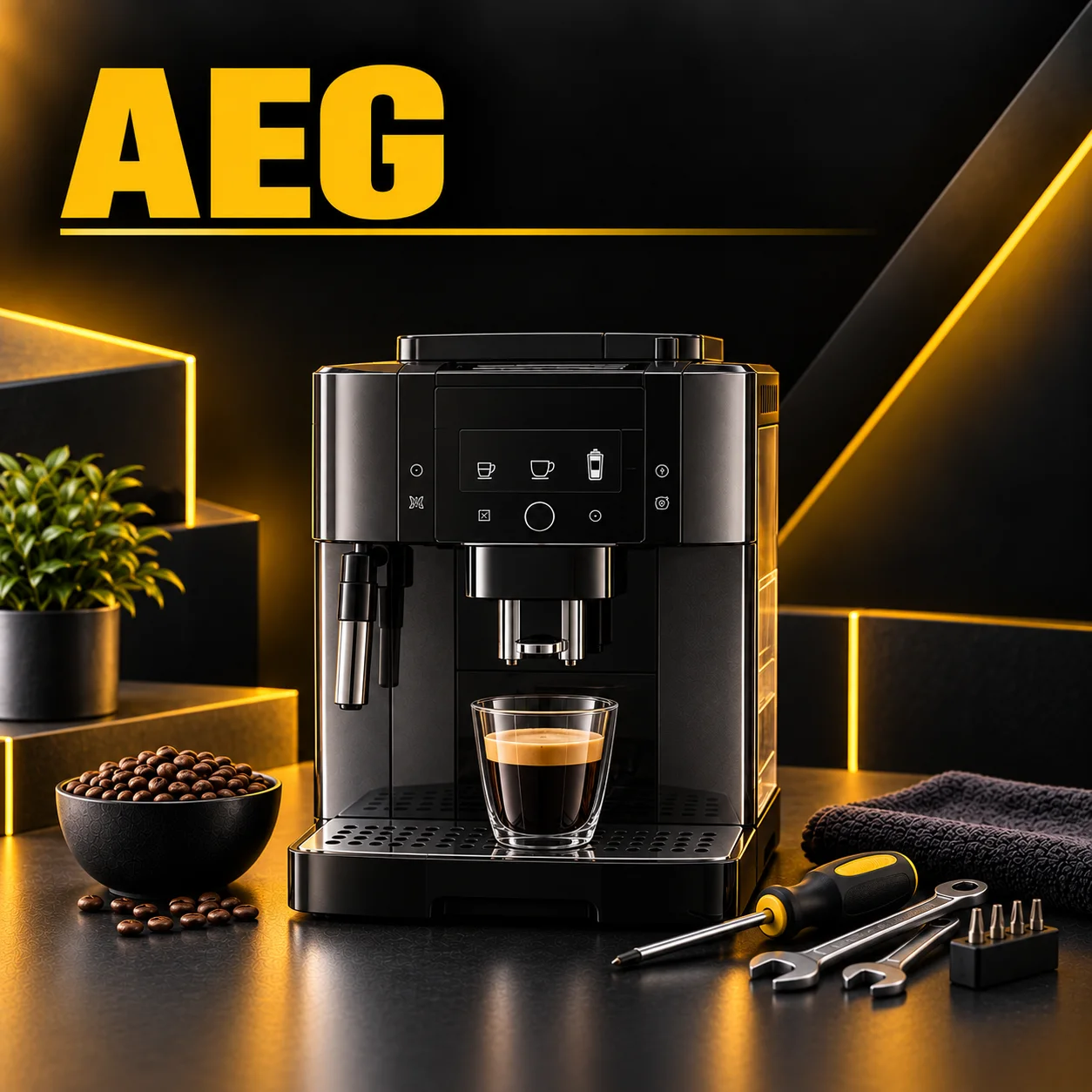
AEG fully automatic coffee machines have been offered for many years in different series and technical versions. Models such as the well-known AEG CaFamosa, the later Caffè Silenzio and Caffè Grande machines differ considerably in some cases in terms of brewing unit, grinder, water system, drive and other components.
If you want to continue using an older AEG fully automatic coffee machine, you do not necessarily have to replace the entire machine as soon as a single component wears out. AEG fully automatic coffee machine spare parts are still available for many repairs.
At NEW-Kaffeevollautomaten you will find selected spare parts and repair components for various AEG fully automatic coffee machines – including parts for brewing units, grinders, seals and O-rings, pumps and fluid systems, valves, hoses and connectors as well as various repair parts.
AEG fully automatic coffee machines – different series, different technology
When searching for AEG spare parts, it is important to understand first of all that the term “AEG fully automatic coffee machine” does not describe a single technical platform.
Different machine series have been offered over the years. Well-known model families include CaFamosa, Caffè Silenzio and Caffè Grande. Within these families, there are in turn different models and production variants.
Well-known designations include CF80, CF81, CF85, CF90, CF95, CF100, CF120, CF150, CF200, CF220, CF250, CF255, CF260, CF300, CF350, CF400 and CF500. In addition, there are models such as CS5000, CS5200, CG6200, CG6400 and CG6600.
These model designations are important when searching for spare parts because a spare part suitable for a CaFamosa CF100 is not automatically suitable for a Caffè Grande CG6600.
Why the exact AEG model number is so important
Fully automatic coffee machines that look similar on the outside can contain different components inside. Even within one machine family, changes may have been made to pumps, thermoblocks, valves, sensors or other components during the production period.
Before ordering an AEG spare part, the complete model designation should therefore be checked wherever possible.
In addition, the PNC or product number can be helpful with AEG. It is used to identify a specific machine version more precisely.
Particularly with technically more complex components such as pump, electronics, thermoblock, sensor or valve, a decision should not be made solely on appearance.
AEG CaFamosa – an important series for repairs
The AEG CaFamosa is one of the best-known older fully automatic coffee machines from the brand. Many machines from this series are still in operation despite their age and are therefore still being repaired and maintained.
Various CaFamosa models contain technical assemblies that are closely related in design to certain Jura and Krups fully automatic coffee machines of the same machine generation.
This is particularly interesting with regard to the brewing unit, drainage valve, various seals and certain components of the fluid system.
However, this must not be taken to mean that every Jura or Krups spare part is generally suitable for every AEG CaFamosa. The specific product compatibility always remains decisive.
AEG CaFamosa CF80, CF100, CF120 and other models
Frequently searched older machines include, for example, the AEG CaFamosa CF80, CF81, CF85, CF90, CF100, CF120 and CF200.
Among other things, these machines contain an internal grinder, a mechanical brewing unit, water pump, heating system as well as various valves and sealing points.
As the machine ages, typical signs of wear can therefore occur on seals, brewing unit, drainage valve, grinder, water system or pump.
You can find suitable components in our AEG spare-parts section.
AEG CaFamosa CF300, CF400 and CF500
Later CaFamosa models such as CF300, CF400 and CF500 also continue to be repaired. Depending on the version, the machines have additional comfort and operating functions.
Nevertheless, coffee preparation still depends on the interaction of central components: the grinder grinds the beans, the brewing unit processes the ground coffee and the fluid system transports the heated water through the machine.
A fault in just one of these assemblies can affect the entire result. Before replacing parts, it should therefore be determined as precisely as possible which area is actually affected.
AEG brewing unit – central mechanism in coffee preparation
The brewing unit or brew group performs one of the most important mechanical processes in a fully automatic coffee machine.
After grinding, the ground coffee enters the brewing unit. There it is compressed and then hot water flows through it. After the brewing process, the used coffee grounds are ejected.
Several mechanical components move inside the brewing unit every time coffee is prepared. At the same time, piston seals must ensure that the water remains on the intended path during brewing.
As a result, brewing pistons, seals, guides and the drainage valve are among the areas in which wear can occur as operating hours increase.
Overhauling the brewing unit instead of replacing it completely
A problem with the brewing unit does not automatically mean that the complete unit has to be replaced.
On suitable AEG CaFamosa versions, individual wear parts of the brewing unit can be replaced. These include in particular seals and components of the drainage valve.
Such an overhaul can make sense if the basic mechanics of the brewing unit are still in good condition.
Clean assembly is important. Sealing surfaces should be checked and worn O-rings replaced. At the points intended for this purpose, a thin film of food-grade silicone grease can then be used.
Drainage valve on AEG CaFamosa
On suitable brewing units, the drainage valve is located in the lower area of the brew group and performs important functions in water routing and pressure release.
During the brewing process, the water path must be switched accordingly. After brewing, residual water or pressure is discharged in a controlled manner.
Wear on seals or mechanical components of the valve can therefore lead to water loss or unusually large amounts of water in the drip tray.
For corresponding Jura, AEG and Krups brew groups, we offer various drainage valve and repair parts.
Aluminium cap for the valve pin – a small repair solution
One example of a targeted repair solution is the cap or sleeve on the valve pin of certain drainage valves.
Instead of unnecessarily replacing further components because of a small worn part, the corresponding component can be replaced specifically on suitable versions.
For repair businesses and higher requirements, for example, we offer 100 aluminium caps for drainage-valve pins in Jura, AEG and Krups brewing units.
Such individual and repair solutions are an important part of our range because it is not necessary to replace the complete assembly for every defect.
Seals and O-rings for AEG fully automatic coffee machines
Seals and O-rings are among the most important wear parts in an older fully automatic coffee machine.
Depending on the design, they are located on the brewing unit, pistons, drainage valve, hose connections, valves, pumps, heater and other water-carrying connections.
As they age, elastomers can become harder, lose their elasticity or become mechanically damaged.
Typical consequences are leaks, water loss, stiff movement or faulty sealing between different components.
Not every AEG seal is the same
When ordering an O-ring, attention should not be paid only to its colour or approximate diameter.
Important factors include in particular inside diameter, cord thickness, material and intended installation position.
A seal on a moving brewing unit can be exposed to different stresses from a small O-ring on a pressure hose or a seal in a hot-water path.
An old seal should therefore not be replaced with just any O-ring based solely on visual similarity.
Silicone grease for suitable AEG seals
For moving O-rings intended for lubrication, a thin lubricating film can make installation easier and reduce friction.
For this purpose, we offer our food-grade silicone grease in a 6 g aluminium tube.
The silicone grease is suitable for O-rings and sealing points intended for lubrication in various fully automatic coffee machines and is applied only in a thin layer.
However, a damaged or hardened seal cannot be repaired with silicone grease. In this case, the appropriate AEG O-ring or seal should be replaced.
AEG grinder – from coffee bean container to uniform ground coffee
The grinder of an AEG fully automatic coffee machine has to process a large quantity of coffee beans over many years.
Inside, the grinding ring and grinding cone or grinding burrs ensure that the beans are ground to the selected particle size.
The geometry and sharpness of these grinding surfaces influence how quickly and evenly the ground coffee is produced.
After very high operating mileage, the grinding surfaces can wear. Possible indications include a clearly changed grinding quantity, unusually long grinding times or ground coffee that no longer produces the desired result despite the correct setting.
Grinding ring and grinding cone instead of a complete grinder?
On suitable grinder versions, it is not automatically necessary to replace the complete motor including the grinder.
If the motor, bearings and adjustment mechanism are technically in order and only the actual grinding surfaces are worn, replacing the grinding ring and grinding cone can be a repair option.
NEW-Kaffeevollautomaten offers high-quality grinder components for various suitable fully automatic coffee machines, among other products.
For professional repair businesses, for example, our 25-piece premium grinding burr set with grinding ring and grinding cone is also available for corresponding compatible grinders.
Poor coffee results do not automatically mean worn grinding burrs
Before replacing the grinding ring or grinding cone, other possible causes should be checked.
Grind setting, the coffee beans used, contamination, blocked coffee paths, incorrect coffee quantity or problems with the brewing unit can also change the result.
A grinder repair part should therefore not be ordered solely because the coffee subjectively tastes weaker.
A diagnosis that is as precise as possible avoids unnecessary replacement of parts and helps identify the assembly that is actually worn.
AEG water pump – the basis for water transport
The pump of the AEG fully automatic coffee machine transports water from the tank through the fluid system.
Depending on the respective function, water is required, for example, for brewing, rinsing, hot water or steam generation.
An ageing pump can change its delivery performance. However, low water flow does not automatically mean that the pump needs to be replaced.
Limescale, a blocked valve, a contaminated water path, air in the system or a problem with the flow meter can also cause similar symptoms.
Consider the pump and fluid system together
The water pump does not work in isolation. It is part of an entire fluid system.
This includes, among other things, the water-tank connection, hoses, pressure lines, connectors, heater, valves and brewing unit.
If there is a fault in the water supply, it therefore makes sense to consider the entire water path.
A leaking connector, for example, can lose water even though the pump itself is fully functional. A blocked heater can in turn reduce flow even though the pump can be heard operating.
Hoses and connectors in AEG fully automatic coffee machines
Different hoses, pressure lines and connectors are located between the individual assemblies.
Depending on their position, these must transport water at different temperatures and in some cases under pressure.
Leaks can be caused either by the hose itself or by a damaged seal at the connection.
During repair, it should therefore be checked whether the line itself is actually damaged or whether only the O-ring at the plug-in connection needs to be replaced.
Outlet valve – important for pressure and water routing
Various older AEG fully automatic coffee machines use valves that are also used in related machine platforms from other manufacturers.
One example is a 4-bar outlet valve that can be used for various suitable machines from AEG and other manufacturers.
The valve influences the intended water path or pressure state within the machine.
For workshops with regular requirements, we also offer the outlet valve 66289 as a workshop pack of 25.
Thermoblock and heater – hot water for the brewing process
In addition to the grinder and brewing unit, the heating system is one of the central components of a fully automatic coffee machine.
Different designs are used depending on the AEG series. A single thermoblock therefore cannot be used universally for all AEG fully automatic coffee machines.
If there is a problem with the water temperature, the complete thermoblock or heater should also not be replaced immediately.
Depending on the fault, the temperature sensor, thermal fuse, electronics, water flow or limescale may also be involved.
AEG Caffè Silenzio CS5000 and CS5200 – a different machine platform
When searching for spare parts, it is particularly important to distinguish between older CaFamosa machines and later models such as the AEG Caffè Silenzio CS5000 and CS5200.
These machines have a different technical basis from many classic CaFamosa models. Certain assemblies are closely related to corresponding DeLonghi ESAM machines.
This applies, for example, to areas such as the brewing unit, heating system, water pump and other internal components.
For this reason in particular, a spare part should not automatically be selected for a CS5000 or CS5200 simply because it is offered as an “AEG CaFamosa spare part”.
AEG Caffè Grande CG6400 and CG6600
Machines from the Caffè Grande series, such as the CG6400 and CG6600, also differ in design from the classic older CaFamosa fully automatic machines.
The CG6600, for example, has an accessible brewing unit and a more extensive operating and care system. Among other things, the machine supports water-hardness settings as well as its own cleaning and descaling programmes.
For these machines, parts must therefore be searched specifically for the respective CG version.
The exact product number can also be decisive for the clear identification of an AEG spare part.
Why similar construction does not automatically mean identical
Terms such as “identical in construction”, “similar in construction” or “compatible” are frequently used for spare parts for older fully automatic coffee machines.
An important distinction is necessary here: two machines can use the same basic design and still have different versions of individual components.
A component should therefore always be selected on the basis of the specific model compatibility, design, connection type and, where applicable, part number.
For precisely this reason, we specify as concretely as possible in our product descriptions which machines or assemblies the respective spare part is intended for.
Typical fault: water in the drip tray
If there is an unusually large amount of water in the drip tray, there may be various causes.
On CaFamosa machines designed accordingly, a problem with the drainage valve or its seals, for example, can play a role.
Leaking hose connections, valves or other parts of the fluid system can also direct water into the inside of the machine or the drip tray.
It should therefore first be observed when and where the water escapes before a complete brewing unit or pump is replaced on suspicion.
Typical fault: coffee ends up in the grounds container
If part of the brewed coffee does not reach the coffee outlet and an unusually large amount of water or coffee instead ends up in the grounds area, the cause may be inside the brewing unit.
Possible causes include worn brewing-piston seals, drainage-valve seals or other leaks within the brewing-water path.
A careful visual inspection of the brewing unit and its sealing points can help narrow down the cause.
Typical fault: AEG grinds, but hardly any coffee comes out
This fault can have several causes.
If ground coffee is present, the grinder should not automatically be suspected. A blocked brewing unit, restricted water path, contaminated screens or a problem in the fluid system can also impair coffee dispensing.
If, on the other hand, the machine grinds for an unusually long time, produces a significantly altered amount of ground coffee or very uneven grounds, the AEG grinder should also be checked.
Typical fault: pump is loud, but no water comes out
A pump that can be heard operating does not prove that sufficient water is actually being delivered.
Possible causes can include air in the system, lack of water supply, a blocked hose, limescale deposits, a closed or jammed valve or a worn pump.
Before replacement, it should therefore be checked whether water reaches the pump and at which point the water flow is interrupted.
Typical fault: AEG fully automatic coffee machine is leaking
A leak should be located as early as possible because escaping water can damage further components.
It should first be determined whether the water comes from the water-tank connection, hose, plug-in connector, thermoblock, valve or brewing unit.
Often only a seal is affected. Complete replacement of the adjacent assembly may then not be necessary.
Opening an AEG fully automatic coffee machine – observe safety precautions
Anyone repairing a fully automatic coffee machine is working on an electrical appliance with mains voltage, hot components and, in some cases, pressurised water paths.
Before opening the machine, it must therefore be disconnected from the mains supply. Hot components should be allowed to cool completely.
Work on electrical components, mains voltage, heating elements or electronics should only be carried out by people who have the necessary specialist knowledge.
If there is any uncertainty, repair by an appropriately qualified specialist business is the better solution.
Repairing old AEG fully automatic coffee machines – when is it worthwhile?
Many CaFamosa machines are now considerably more than ten years old. Nevertheless, a repair can still make economic sense.
The decisive factors are the type of defect and the overall condition of the machine.
If, for example, only a seal, drainage valve or set of grinding burrs is worn, the repair effort can be considerably lower than when several major assemblies are defective at the same time.
Another advantage of older machine generations is that various mechanical assemblies can in some cases still be dismantled into individual components and overhauled.
Repair instead of discarding functional assemblies
At NEW-Kaffeevollautomaten, one focus is on spare-part and repair solutions that avoid unnecessarily replacing a complete assembly.
These include, for example, individual O-rings, moulded seals, repair components for drainage valves as well as grinding-ring and grinding-cone sets.
The prerequisite is always that the rest of the assembly is still technically in order.
A worn motor, for example, cannot be repaired with new grinding burrs. If the motor and mechanics are functional, however, worn grinding surfaces may be replaceable separately.
AEG spare parts also for professional repair businesses
Older AEG machines are not only found in private households. Specialised fully automatic coffee machine workshops also continue to repair CaFamosa and other AEG models.
For repair components that are required regularly, we therefore offer quantity price tiers or larger packaging units for various products.
Examples include our 100 aluminium caps for drainage-valve pins or the set of 25 4-bar outlet valves.
You can find further workshop and bulk quantities in our bulk discount category.
Caring for AEG fully automatic coffee machines correctly
Spare parts are only one part of achieving the longest possible machine service life. Regular care also plays an important role.
Coffee grease, limescale and other deposits can affect different components.
A distinction should be made between cleaning and descaling. Cleaning tablets are intended particularly for coffee-related residues, while a descaler treats mineral deposits from the water.
You can find suitable products in our care products category for fully automatic coffee machines.
Water hardness and limescale in AEG machines
Even on older AEG CaFamosa machines, setting the water hardness was part of the operating procedure.
This makes technical sense because the amount of limescale-forming minerals in the water has a significant influence on how quickly deposits form in the heater and fluid system.
Water hardness is also relevant to maintenance on later AEG models.
If the machine requests descaling, the programme intended for this purpose should be carried out in accordance with the operating instructions.
Combining cleaning and repair sensibly
If an older fully automatic coffee machine is already being opened for a repair, it may make sense to also check the condition of accessible wear and maintenance parts.
When overhauling a suitable brewing unit, for example, seals can be checked, moving parts cleaned and designated O-rings lightly lubricated.
Our food-grade silicone grease in the 6 g tube is particularly economical for corresponding sealing and assembly work.
How to find the correct AEG spare part
1. Determine the exact AEG model
First check the complete model designation, for example CF100, CF120, CF300, CS5000 or CG6600.
2. Check the product number or PNC
For different machine versions, the AEG product number or PNC may additionally be required for clear identification.
3. Narrow down the fault area
Determine as precisely as possible whether the cause lies in the brewing unit, grinder, pump, fluid system, valve, heater, drive or electronics.
4. Compare the existing spare part
For removed components, compare design, connections, dimensions and existing markings with the product information.
5. Observe compatibility information
The information provided with the respective product is decisive. A spare part that looks similar is not automatically technically identical.
Frequently asked questions about AEG fully automatic coffee machine spare parts
Which spare parts are available for AEG CaFamosa fully automatic coffee machines?
Depending on the model, spare parts are available from areas including brewing unit, seals, drainage valve, grinder, pumps, fluid system, valves, hoses and other repair components.
Do Jura spare parts fit AEG CaFamosa machines?
Certain older AEG CaFamosa models share design features with certain Jura machines. As a result, individual components may be compatible. However, this does not apply generally to every part. The specific compatibility information for the spare part is always decisive.
Do Krups spare parts fit AEG CaFamosa?
Certain CaFamosa models also share technical features with various older Krups platforms. Nevertheless, each spare part must be checked individually for its machine compatibility.
Are AEG CS5000 and CaFamosa technically the same?
No. The CS5000 and CS5200 belong to a different machine platform from many classic CaFamosa models. Spare parts must therefore not be selected solely on the basis of the AEG brand.
Is the AEG CS5000 related to DeLonghi machines?
The CS5000 and CS5200 have close design similarities with corresponding DeLonghi ESAM machines in various components. Nevertheless, the specific product and model compatibility should also be checked here.
Why is my AEG CaFamosa losing water?
Possible causes include worn seals, the drainage valve, hose connections, valves or other components of the fluid system. The point at which the water escapes should be located before spare parts are ordered.
Can the AEG brewing unit be overhauled?
On suitable CaFamosa brewing units, individual wear parts such as O-rings and components of the drainage valve can be replaced. Whether an overhaul makes sense depends on the condition of the complete assembly.
Can I replace the grinding ring and grinding cone individually?
Yes, on suitable grinders. If the motor and mechanics are still functional, worn grinder components can be replaced separately. However, the version must match the existing grinder.
Which grease is suitable for AEG brewing units and O-rings?
Suitable food-grade silicone grease can be used on designated sealing and sliding points. It should only be applied in a thin layer.
Should a leaking seal simply be greased more heavily?
No. Silicone grease does not replace a damaged seal. If an O-ring is worn, torn or permanently deformed, it should be replaced.
Is it still worth repairing an old AEG fully automatic coffee machine?
This depends on the overall condition and the defect. With individual wear parts such as seals, drainage-valve components or suitable grinder components, repair can make considerably more sense than replacing the complete machine.
Where can I find spare parts for my AEG CaFamosa?
You can find our available spare parts and repair components in the AEG spare-parts section at NEW-Kaffeevollautomaten.
AEG fully automatic coffee machine spare parts at NEW-Kaffeevollautomaten
Older fully automatic coffee machines do not automatically have to be replaced when a single component wears out. Particularly on machines from the AEG CaFamosa generation, various assemblies can still be maintained or repaired.
At NEW-Kaffeevollautomaten you will find spare parts for AEG fully automatic coffee machines from different repair areas.
These include parts for brewing units, seals and O-rings, grinders, pumps and fluid systems, valves, hoses, connectors and various repair solutions.
In addition, we offer food-grade silicone grease for suitable O-rings and seals, care products for fully automatic coffee machines and, for professional repair businesses, various workshop and bulk quantities.
Correct machine identification is particularly important with AEG. A CaFamosa CF100, Caffè Silenzio CS5000 and Caffè Grande CG6600 all carry the AEG brand name, but are not necessarily based on the same technical platform.
When searching for spare parts, the following therefore applies: determine the model precisely, compare the existing component, observe compatibility information and use only the spare part that actually fits.
All currently available products can be found directly in our AEG fully automatic coffee machine spare-parts category.